 info@gorillatrekkinginafrica.com

Facts About Mount Kilimanjaro
Facts About Mount Kilimanjaro, Mount Kilimanjaro is located in the Republic of Tanzania within Kilimanjaro National Park. Mount Kilimanjaro ascends to 19,341 feet above sea level, making it the tallest free-standing peak globally and the highest in Africa. The inactive volcano has three volcanic cones: Shira, Mawenzi, and Kibo. While there is no definitive consensus regarding the origin or significance of the name, historical documentation from 1860 indicates that the term Kilimanjaro was utilized by local Swahili tribes and then adopted by early European explorers, including Johann Ludwig Krapf. The true origin and significance of the name Kilimanjaro remains enigmatic.
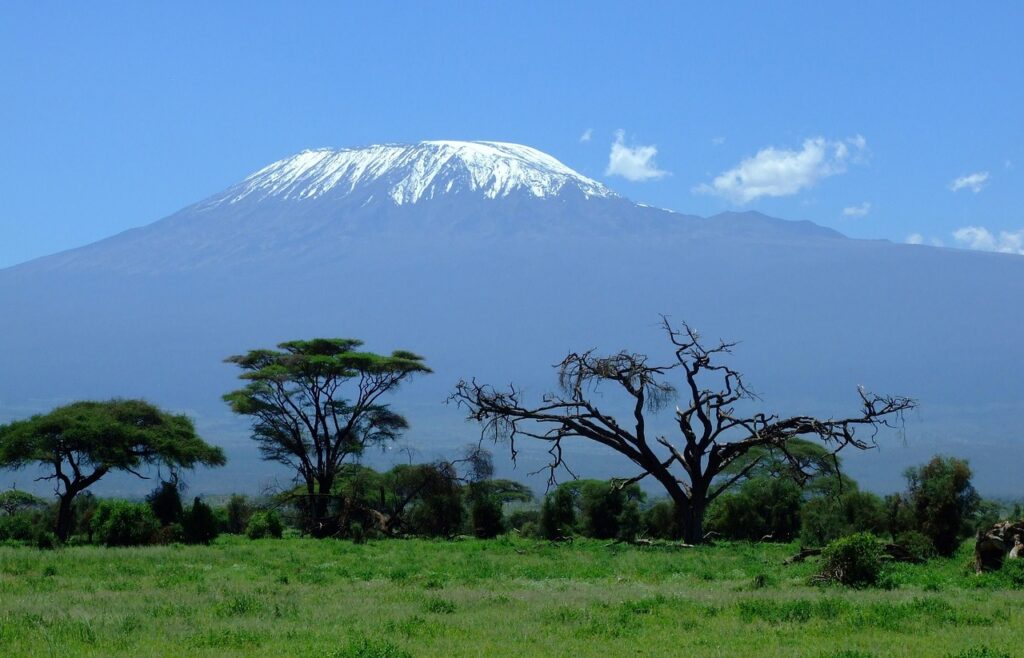
Kilimanjaro, the tallest mountain in Africa, ranks among the premier climbing locations globally. The mountain attracts more than 30,000 climbers annually and ranks among the premier attractions in Tanzania. Nonetheless, not all individuals who commence the hike attain the summit. The primary causes of failure are altitude sickness and the selection of an inappropriate route. The majority of those who fail go for the Marangu route, which requires merely 5 days. The five days do not permit acclimatization to the elevated altitude and heat. To enhance the likelihood of attaining the summit, it is preferable to pursue the longer routes to allow adequate time for acclimatization to high altitude and varying climatic conditions. A further factor for the inability to attain the peak is that several participants are novice hikers. They inadequately prepare by failing to get proper training and acquire appropriate hiking equipment.
Kilimanjaro comprises three significant volcanic cones. Kibo is the highest and largest at 16,893 feet (5,149 meters), whereas Shira is the lowest at 13,140 feet (4,005 meters). Kibo is currently inactive, and scientists anticipate that it will erupt again in the future. Shira and Mawenzi are no longer extant. The Shira core experienced its initial eruptive activity approximately 2.5 million years ago, with the most recent significant event being around 1.9 million years ago. Kibo and Mawenzi both commenced eruption approximately one million years ago. The most recent activity in Kibo occurred approximately 150,000 years ago, resulting in the formation of the crater at the cone.
Mount Kilimanjaro comprises five climate zones that affect the plant and fauna there. Bushland occupies the lower slopes ranging from 2,600 to 5,900 feet. The bushlands are succeeded by rainforest at elevations ranging from 5,900 to 9,200 feet. Moorland or Heather occurs next at elevations ranging from 9,200 to 13,100 feet. The Alpine Desert Zone exists at elevations ranging from 13,100 to 16,400 feet. The Arctic Zone is from 16,400 to 19,300 feet. Mount Kilimanjaro is traversed by numerous streams and rivers. The majority of rivers and streams are located in the more degraded southern section of the park. The primary water bodies are Pangani to the south and Lumi to the west. The Shira Plateau and the lower regions of the mountain encompass woodlands and savanna grasslands that host zebras, warthogs, sunbirds, mongooses, leopards, hyenas, elephants, duikers, dik-diks, chameleons, Cape buffaloes, and bushbucks. Buffaloes and elephants pose a significant menace to mountain climbers.
History of Mount Kilimanjaro and First Hikers
Mount Kilimanjaro may have been recognized by non-Africans prior to the Middle Ages. Ancient mariners, including Ptolemy, documented a spring lake of the Nile and a specific “moon mountain. This information is viewed with skepticism because to its failure to distinctly identify it from other prominent mountains such as those in Ethiopia, the Rwenzori Mountains, Mount Kenya, and the Virunga range. In 1519, Spanish adventurer Martín Fernández de Enciso acquired intriguing information from locals during his journey to Mombasa, who traversed the interior in caravans. They informed him that to the west of Mombasa lay the Ethiopian Mount Olympus, and beyond it, the Mountains of the Moon.
Facts about Mount KilimanjaroThe initial Europeans to endeavor to access there were two German missionaries, Krapf and Johannes Rebmann, from Mombasa. Rebmann was the inaugural individual to document the presence of Mount Kilimanjaro in 1848. Based on documented accounts and a diary, they were only able to observe it from a distance. In August 1861, Prussian Officer Baron Karl Klaus von der Decken and English geologist R. Thornton endeavored to ascend the mountain but were limited to an altitude of 8,200 feet due to adverse weather conditions. In 1862, Von der Decken made another attempt with Otto Kersten, achieving an elevation of 14,000 feet.
In late August 1871, Charles New, an Englishman, became the inaugural European to attain the equatorial snows of Mount Kilimanjaro. This occurred at an altitude of 13,000 feet. In June 1887, Austrian Lieutenant Ludwig von Höhnel and Hungarian Count Sámuel Teleki endeavored to ascend the peak. Höhnel halted at 16,240 feet, whereas Teleki ascended to the snow at 17,400 feet. In 1887, German geology professor Hans Meyer successfully reached the periphery of the ice sheets on Kibo. Regrettably, he lacked the necessary equipment and was had to retreat. Meyer attempted once more the following year with a cartographer named Oscar Baumann; however, the endeavor was thwarted when both were taken hostage and ransomed during a revolution against German authority by Arab and Swahili groups.
Undeterred, German explorer Otto Ehrenfried Ehlers and American naturalist Dr. Abbott ascended the mountain summit from the northwest in 1888. Abbot retraced his steps while Ehlers proceeded forth. He first asserted that he had attained the peak rim but retracted his assertion following criticism. Meyer, the one who was abducted, returned in 1889 for a third expedition with Austrian mountaineer Ludwig Purtscheller. Measures were implemented to guarantee that they would not need to fall excessively in the event of a withdrawal and subsequent return. The pair set several campsites with awaiting porters and provisions. On October 3, 1889, the two approached the crater rim but retreated to regroup due to fatigue. Three days later, they ascended the highest peak on the southern rim. With this notable accomplishment, they became the first to verify the existence of a crater in Kibo. Following this achievement, the duo endeavored to ascend the more technically demanding Mawenzi peak but were only able to attain its secondary summit, Klute Peak. On October 18, 1889, the two ascended Kibo once more to conduct a more comprehensive study of the crater. Their mission spanned a total of 16 days and was aided by a local individual named Mwini Amani. Yohani Kinyala Lauwo, a local from Marangu, is frequently acknowledged as a co-first ascendant of the peak alongside Meyer and Purtscheller, based on images associated with the initial successful ascent. Another native Mwini was tasked with cooking and ensuring that the various campsites were supplied with firewood and water.
The first success achieved by Hans Meyer and Ludwig Purtscheller facilitated matters for all involved. Their accomplishment facilitated Fritz Klute and Eduard Hans Oehler in becoming the first Europeans to ascend the highest peak of Mawenzi on July 29, 1912. The two designated it in honor of Hans Meyer.
Dangers, Deaths and Records while hiking Mount Kilimanjaro
Mount Kilimanjaro ranks among the seven tallest peaks globally. The additional peaks comprise Everest, Aconcagua, Denali, Elbrus, and Carstensz Pyramid. Mount Kilimanjaro is notable for being a prominent free-standing mountain. Most of the other mountains constitute a mountain range generated by plate tectonics, wherein the Earth’s crust collides and elevates rocks. Kilimanjaro, conversely, was formed as a consequence of volcanic activity. This is the location where molten rock erupts and accumulates on the Earth’s surface, resulting in the formation of mountains. Kilimanjaro is the most accessible of the seven summits, making it highly popular among both novice and seasoned climbers. Technical expertise or equipment such as ice axes, harnesses, ropes, or crampons are unnecessary. The focus is on mental readiness and ascending to the summit through trekking or walking.
While ascending Mount Kilimanjaro is less challenging than traversing the Andes or Himalayas, formidable winds, frigid weather, and elevated altitudes can pose obstacles for even the most physically fit trekkers. Seventy-seven Essential information on Mount Kilimanjaro: a percentage of successful trekkers encounter severe altitude sickness. This illness is marked by anorexia, emesis, nausea, and diarrhea. A number of fatalities have occurred due to rockslides particularly on steep sections of the mountain. The Arrow Glacier route was blocked for several years and was only reopened in December 2007 due to safety concerns for hikers. Between 1996 and 2003, a total of 25 individuals perished while endeavoring to ascend Mount Kilimanjaro. The majority succumbed to altitude-related illnesses, trauma, appendicitis, and pneumonia. The mortality rate is 0.1 per 100 climbers.
Which is the best route for climbing Mount Kilimanjaro?
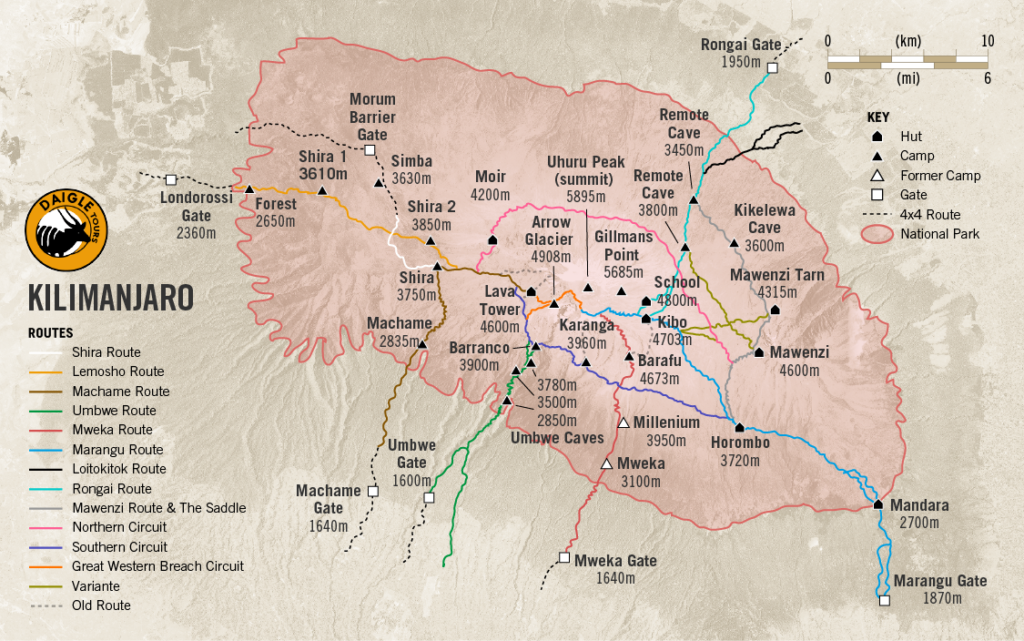
There are six principal routes for ascending Mount Kilimanjaro. The routes comprise the Machame Route, Shira Route, Northern Circuit, Lemosho Route, Rongai Route, and Marangu Route. Machame is the most frequented route; however, it may become exceedingly congested during peak travel seasons for Mount Kilimanjaro. The Shira Route spans 8 days and traverses the unspoiled environment of the Shira Plateau. This path is ideal for individuals seeking to evade crowds while appreciating stunning landscapes. The Northern Circuit is an 8 to 9-day trek. Nearly all individuals use this path reach the summit. The Lemosho route typically requires approximately 8 days to get to the peak and is generally regarded as a more leisurely path. The Lemosho path offers hikers stunning landscapes and woodlands. The Rongai Route is among the most favored paths, requiring merely 6 days to reach the peak. The Marangu route was formerly the most popular before being surpassed by Machame. The trail offers spectacular vistas; nevertheless, recent overpopulation has diminished the overall experience of the hike.
Additional information and interesting facts about Mount Kilimanjaro
Mount Kilimanjaro, sometimes referred to as the roof of Africa, dominates the continent’s landscape. The mountain is so immense that standing at its base, it would be difficult to perceive its entirety. The peak is not distinctly observable from any location in Tanzania unless one ascends it. To have a comprehensive perspective of the mountain, one must visit Amboseli National Park in Kenya. Individuals fortunate enough may observe its complete dimensions while airborne in an aircraft.
What is the cost of climbing Mount Kilimanjaro?
The expense of ascending Mount Kilimanjaro varies based on whether one participates in a scheduled group or opts for a private arrangement. The cost is $2,500 per individual when in a group. Private ascents are costlier and will also vary based on the chosen route.
Crucial Details Regarding Mount Kilimanjaro What is the optimal time to ascend Mount Kilimanjaro? Mount Kilimanjaro is accessible to hikers year-round. The optimal period for climbing is from July to October. This period is optimal for observing wildlife in Tanzania’s additional national parks. The period from March to May is regarded as the rainy season, which is not ideal for obtaining unobstructed views of the peak. The remaining months are equally excellent for hiking. To attain the peak on a clear day, consider climbing between July and October. During this period, crowds are more prevalent; therefore, if you like a more secluded trip, consider scheduling your hike in the alternative months.
How long will it take to hike Mount Kilimanjaro?
The outcome is contingent upon the selected route and your fitness level. The simpler routes may need about 4 nights, although the majority of individuals often take from 6 to 9 days to reach the top. As previously mentioned, Mount Kilimanjaro may be ascended by anyone who possesses adequate fitness and the appropriate mindset. Some routes might be exceedingly arduous and will assess your endurance and stamina. Prior to ascending Mount Kilimanjaro, confirm that you own the appropriate climbing gear and are psychologically equipped to manage altitude sickness. It is advisable to visit your physician for a comprehensive fitness assessment.