 info@gorillatrekkinginafrica.com
Northern Circuit Route
The Northern Circuit Route represents the most extensive path on Kilimanjaro. The itinerary comprises a 9-day expedition that commences along the Lemosho route on the western flank of Kilimanjaro, ascends to the Shira Plateau, and subsequently proceeds northward, encircling the principal peak in a clockwise manner.
It thereafter merges with the Rongai path to ascend the summit from the eastern flank and descends directly by the southern Mweka route.
The Northern Circuit is the most recent way to ascend Mount Kilimanjaro and is arguably the superior option. This is due to the amalgamation of the finest aspects of the other trails, consolidated into a singular exceptional hike. If you seek stunning landscapes, ample solitude, a rigorous challenge, and the opportunity to observe wildlife, this route is unequivocally suitable for you.
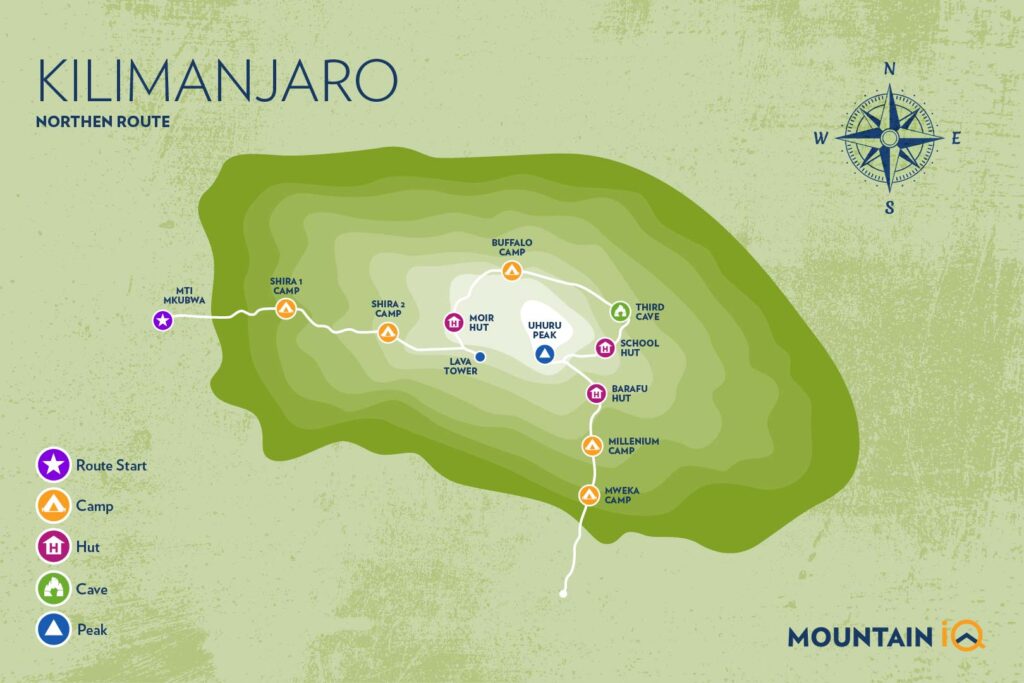
The Northern Circuit route initially parallels the Lemosho route for several days, but diverges to utilize the less frequented northern routes instead of remaining on the southern flank of Kibo. This trail is nearly empty of fellow hikers, resulting in tranquil, serene, and largely unoccupied campsites.
The Northern Circuit route, being longer than the other trails, affords hikers the opportunity to experience more of the mountain. They get the opportunity to traverse the magnificent Shira Plateau while also observing Kibo Peak and Uhuru Summit en route.
It offers spectacular vistas of the expansive plains situated to the north of the summit, a sight encountered by just a select few hikers ascending Kilimanjaro.
Which route on Kilimanjaro boasts the highest success rate?
The Northern Circuit Route boasts the best success rate for Kilimanjaro ascents at 98% and approaches from the southern side of the mountain. The path is the most recent and longest on Kilimanjaro, providing the most breathtaking 360-degree views of the mountain. The ascent of Mount Kilimanjaro via this method requires 8 to 9 days to reach the summit.
The Northern Circuit route, characterized by its considerable length and consistent altitude for enhanced acclimatization, has the highest success percentage of any Mount Kilimanjaro route, exceeding 95% to 98%.
The expedition commences from the Londorossi Gate, ascending the western slopes of the mountain, traversing the rainforest, and ascending to the Shira Ridge.
From that point, the route proceeds to the Shira Plateau, then continues north in a clockwise manner, beginning at the Moir Hut, followed by Buffalo Camp, and concluding at School Hut. Trekkers undertake an approximately 360-degree circuit of Kilimanjaro before ascending from the east.
Considering the numerous advantages of the Northern Circuit route, what are its drawbacks? The sole drawback of hiking this path is its demand for additional time, a resource scarce among many people. The Northern Circuit route often needs nine or more days, whereas most other routes may be completed in six or seven days. This frequently restricts the number of individuals who can incorporate this trail into their schedules; however, those who do will discover it is entirely worthwhile.
The Northern Circuit trek on Kilimanjaro spans 9 days.
Overview of the 9-Day Northern Circuit Itinerary
Commencing from Londorossi Gate, proceeding to the top, and concluding at Mweka Gate. For a daily schedule for the Northern Circuit Route, please click on this link: Nine-Day Northern Circuit Route
Comprehensive Itinerary for the Northern Circuit
7 nights and 8 days
Day One — Lemosho Glades
We will depart from your lodge and proceed to the Londorosi gate on the western flank of Mt. Kilimanjaro, which is a few hours’ drive from Arusha. Our hike will commence at the Lemosho trailhead. In inclement weather or muddy circumstances, cars may be unable to reach the actual trailhead, necessitating additional hiking. However, Serengeti Pride vehicles typically advance further than those of other companies, owing to our exceptional drivers and vehicles.
Following a picnic lunch, we will go on a four-hour hike to the woodland camp. In the forest, vibrant moss and flowers captivate the visual senses, while avian sounds provide auditory pleasure. Black and White Colobus monkeys may be observed, along with evidence of the elephants that traverse this region. We will spend the night in Forest Camp.
Hiking duration: 4 to 5 hours
Overnight Elevation approximately 9,498 feet
Day 2 – Shira Plateau
Upon departing the Montane Forest and entering the Hagenia zone, our vistas expand, revealing our initial glimpses of the Kibo summit. This trip serves as an effective acclimatization exercise, featuring multiple ascents and descents across ridges, culminating at a peak elevation of 11,500 feet before returning to camp. Stay overnight at Shira 1 Camp.
Duration of hiking: 6 to 9 hours
Overnight Elevation 11,500 feet
Day 3 – Moir Camp
We will navigate the Heath zone of the Shira Plateau and commence our ascent of the western slope of the Kibo Massif. We will have a picnic lunch in the memorial camp of Scott Fisher, the renowned Mt. Everest guide. We shall proceed to the higher heath zone and Moir camp. Acclimatization walks may be scheduled in the late afternoon, contingent upon weather conditions.
Hiking duration: 5-6 hours
Overnight Elevation: around 13,580 feet
Day 4 – Pofu/Buffalo Camp
Hike for approximately 4 to 7 hours, contingent upon the duration of stops en route. As you leave Moir camp, you face a significant ascent, therefore it is advisable to begin at a deliberate pace until you reach the ridge’s summit. This is an excellent acclimatization day.
Hiking duration: 5 to 7 hours
Overnight Elevation: around 13,200 feet
Day 5 – Tertiary Cave Encampment
Proceed along the northern perimeter of Mount Kilimanjaro, enjoying extensive vistas, as you navigate towards Third Cave Camp.
Duration of hiking: 5 to 7 hours
Overnight Elevation: around 12,700 feet
Day 6 – Educational Shelters Camp
Today, we arrive at our highest elevation camp. Attempt to retire early for relaxation before to commencing your nocturnal journey to Gilman’s Point, typically beginning about midnight, via Stella Point, culminating in the last hike to the top.
Hiking duration: 4 to 5 hours
Overnight Elevation: around 15,600 feet
Day 7 – Summit and Mweka Camp (or Millennium Camp upon request)
Day of the summit. We will commence our trek to the top (19,340 ft – 5,896 m) at approximately 11:00 PM or midnight the preceding night. Your objective, along with many other climbers, is to attain the summit precisely at sunrise. In actuality, owing to variations in hiking pace, stamina, and altitude acclimation, there exists a several-hour interval during which the majority of climbers attain the peak. Utilizing headlamps (bring additional lithium batteries, which perform far better in cold, dark circumstances), you will ascend for 6-7 hours to Gilman’s Point, traverse the Crater Rim to Stella Point, and then continue for another 1-2 hours to Uhuru Peak, the summit.
Following a summit celebration and photograph, descend to Barafu Camp for lunch, then proceed to Mweka Camp for overnight accommodation. Upon prior request, we can stay at Millenium camp instead; this is situated at around 12,000 feet, resulting in less descend today but necessitating greater descent tomorrow.
Hiking: Highly variable in both ascent and descent; often 13-17 hours
Summit elevation: 19,341 feet
Overnight Elevation: 10,065 feet
Day 8 – Mweka Park Entrance
We will complete the last descent to the trailhead today, requiring around 3 to 5 hours of hiking. We will eat lunch and bid farewell to our mountain crew before departing Mount Kilimanjaro and returning to town. Check in at your lodge often between 3:00 and 5:00 PM.
Hiking duration: 3 to 5 hours
Northern Circuit Route Common inquiries
The following questions and answers pertain specifically to the Northern Circuit Route.
What is the level of difficulty of the Northern Circuit Route?
The Northern Circuit presents the least challenging difficulty level among all Kilimanjaro routes. Despite being the longest path, the extended schedule offers superior acclimatization, hence rendering the trek less arduous.
The nine-day physical journey is superb for altitude acclimation and generally manageable underfoot. A commendable level of fitness is strongly advised.
What is the length of the Northern Circuit Route and the duration of the journey?
The precise trekking distance for the Northern Circuit Route is 88 kilometers or 53 miles. The minimum duration for the Northern Circuit Route is 8 days; however, shorter durations are feasible, albeit necessitating more arduous trekking days.
When include arrival and departure days, the total is 10 or 12. Nonetheless, given its status as one of the longest paths on the mountain, it is advisable to undertake the trek over a duration of 9 days to enhance the likelihood of success.
What is the success rate for summiting using the Northern Circuit Route?
The Northern Circuit is the most extensive path on Kilimanjaro, offering the optimal opportunity for acclimatization. Although official statistics are lacking, the average summit success rate among all operators is 90%.
Our summit success percentage for the Northern Circuit Route exceeds 98%!
What is the landscape like on the Northern Circuit Route?
The primary approach will take you through the magnificent Lemosho forest and across the Shira Plateau. As the climber navigates to the secluded and little visited northern aspect of Kilimanjaro, the landscape transforms into a more parched and austere environment. This location is so isolated that the elusive eland are frequently observed, along with the rare buffalo that visit to ingest minerals from the natural caves on the elevated slopes of Kilimanjaro.
What is the optimal period for trekking the Northern Circuit Route?
The optimal period for trekking the Northern Circuit Route is from July to September, since the weather is most stable and the likelihood of rain is diminished. Consequently, because to its proximity to the equator, the peak may be ascended at any time during the year. April and May constitute the rainy season; so, this period is best circumvented.