 info@gorillatrekkinginafrica.com

Lemosho Route
The Lemosho Route is frequently regarded as the most picturesque of all the trekking paths on Mount Kilimanjaro. The hike traverses the Shira Plateau from west to east, characterized by a pleasant and reasonably level terrain. Attendance is minimal until the path converges with the Machame trail around Lava Tower.
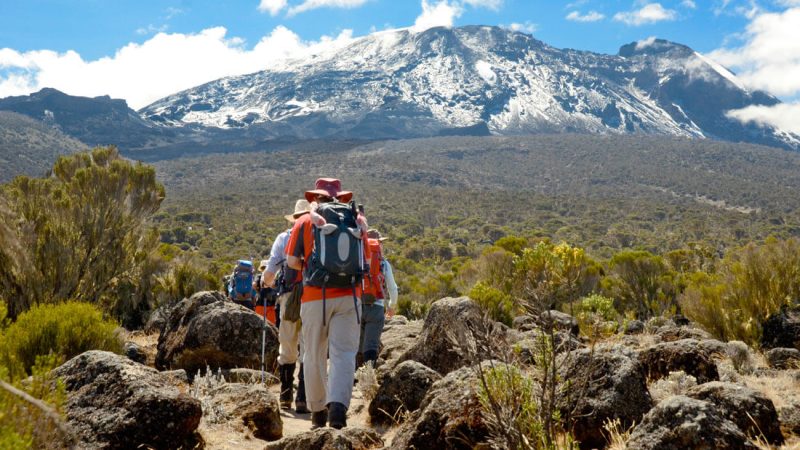
This is a relatively new route on the mountain that shares part of its way with the Machame route, however it offers certain advantages that merit consideration, especially for those with additional time. The Lemosho Route commences at the Londorossi Gate on the western flanks of Mount Kilimanjaro, traversing a rather secluded area of the mountain.
The walk traverses a picturesque rainforest, offering hikers the opportunity to observe wildlife en route. Black and white colobus monkeys, blue monkeys, small lizards, and a diverse array of birds are frequently observed in the woodlands. The route traverses the Shira Plateau, moving from west to east across reasonably level and easily navigable terrain.
The initial stages of the Lemosho Route offer ample seclusion, as this path experiences far less foot traffic compared to the Machame and Marangu routes. This enhances an already exceptional trekking experience, as there are moments when it seems as though you possess the entire mountain exclusively.
Ultimately, the Lemosho road converges with the Machame route, resulting in a surge in traffic. However, if you seek tranquility throughout the initial phase of the ascent, this is an excellent choice.
The Lemosho path shares most of its scenery with the Machame route, including the Lava Tower and Barranco Wall. However, during the initial days, this trail provides distinctive vistas of the surrounding landscapes that are not seen from any other location on the mountain.
Travelers will have the opportunity to explore unspoiled rainforests and ascend to the Shira Plateau, where breathtaking views lie above the tree line.
Due to its isolated location and extended path, the Lemosho route requires many additional days for trekking. The majority of individuals traverse this trail over a span of seven to eight days, resulting in a significant enhancement of the success rate.
If you aim to optimize your likelihood of summiting the mountain, this alternative is undoubtedly superior, especially compared to the Machame and Marangu routes. Notwithstanding its superior success rate, the Lemosho path is a more arduous trek compared to the “Whiskey” and “Coca-Cola” ways.
Certain segments of the trail are steeper and more arduous, necessitating trekkers to spend an additional night or two in tents. Nonetheless, the benefits of this route distinctly differentiate it from others, rendering it an increasingly favored option for intrepid tourists.
Climbing Kilimanjaro presents the Lemosho route as a 7-day or 8-day ascent. The seven-day option merges days five and six, traveling directly from Barranco Camp to Barafu Camp, bypassing Karanga.
Detailed Itinerary for the Lemosho Route
7 nights and 8 days of climbing
Day 1 — Lemosho Glades
We will depart from your lodge and proceed to the Londorosi gate on the western flank of Mt. Kilimanjaro, which is a few hours’ drive from Arusha. Our hike will commence at the Lemosho trailhead.
Be advised that in inclement weather or muddy circumstances, vehicles may be unable to reach the actual trailhead, necessitating additional hiking. Following a picnic lunch, we will embark on a hike lasting approximately four hours to the forest camp.
In the forest, vibrant moss and flowers captivate the visual senses, while avian sounds provide auditory pleasure. Black and White Colobus monkeys may be observed, along with evidence of the elephants that traverse this region. We will spend the night in Forest Camp.
Hiking duration: 3 to 4 hours
Overnight Elevation approximately 9,498 feet
Day 2 – Shira Plateau
Upon departing the Montane Forest and entering the Hagenia zone, our vistas expand, revealing our initial glimpses of the Kibo summit. This trip serves as an effective acclimatization exercise, featuring multiple ascents and descents across ridges, culminating at a peak elevation of 11,500 feet before returning to camp. Overnight stay at Shira 1 Camp.
Duration of hiking: 6 to 9 hours
Overnight Elevation 11,500 feet
Day 3 – Moir Camp
We will navigate the Heath zone of the Shira Plateau and commence our ascent of the western slope of the Kibo Massif. We will partake in a picnic lunch at the Scott Fisher memorial camp, renowned for its association with the esteemed Mt. Everest guide. We shall proceed to the higher heath zone and Moir camp. Acclimatization walks may be scheduled in the late afternoon, contingent upon weather conditions.
Duration of hiking: 5 to 6 hours
Overnight Elevation: around 13,650 feet
Day 4 – Barranco Camp
We exit the heath zone and transition into the alpine zone as we trek for 4-6 hours beyond Lava Camp (about 14,300 feet), characterized by its volcanic terrain, before descending slightly into the picturesque Barranco Valley to establish camp.
Hiking duration: 4 to 6 hours
Overnight Elevation: around 13,044 feet
Day 5 – Karanga Camp
Climb the Great Barranco Wall, admiring the vistas of Kilimanjaro’s glacial fields, then traverse several minor valleys en route to Karanga Camp.
Hiking duration: 3 to 5 hours
Overnight Elevation: around 13,106 feet
Day 6 – Barafu Camp
Trek for around 3-5 hours to Barafu Camp, navigating various elevations across minor valleys. Upon establishing camp, we will do a demonstration on the utilization of safety equipment, including the Gamow bag and oxygen apparatus. Commence with an early supper and repose in camp prior to your wake-up call for the summit ascent, scheduled for approximately 11:00 PM or midnight.
Hiking duration: 3 to 5 hours
Overnight Elevation: around 15,100 feet
Day 7 – Summit and Mweka Camp:
The day of the summit. We will commence our trek to the top (19,340 ft – 5,896 m) at approximately 11:00 PM or midnight the preceding night. Your objective, along with many other climbers, is to attain the summit precisely at sunrise. In actuality, variations in hiking pace, stamina, and altitude acclimation result in a several-hour interval during which the majority of climbers attain the summit.
Utilizing headlamps (bring additional lithium batteries, which perform far better in cold, dark circumstances), you will ascend for 6-7 hours to Stella Point and subsequently a another 1-2 hours to Uhuru Peak, the summit. Following a summit celebration and photograph, proceed to Barafu camp for lunch, then continue to Mweka camp for overnight accommodation.
Hiking: Highly variable in both ascent and descent; often 12-17 hours
Peak 19,341 feet
Overnight Elevation: 10,448 feet
Day 8 – Mweka Park Entrance
We will complete the last descent to the trailhead today, requiring around 3 to 5 hours of hiking. We will eat lunch and bid farewell to our mountain crew before departing Mount Kilimanjaro and returning to town. Check in to your lodging often between 3:00 and 5:00 PM.
Hiking duration: 3 to 5 hours
Frequently Asked Questions
The following questions and answers are only to the Lemosho route.
What is the difficulty level of the Lemosho Route?
The Lemosho route is regarded as one of the most accessible paths on Kilimanjaro because to its extended itinerary, which facilitates superior acclimatization. Nevertheless, trekkers must still scale the Barranco Wall and rise sharply on summit night. Technical climbing is not necessary; nonetheless, a high degree of physical fitness is strongly advised. For further information on training for Kilimanjaro, please see our Kilimanjaro training program page to assist with your preparation.
What is the length of the Lemosho Route and the duration of the trek?
The precise trekking distance for the Lemosho Route is 71 kilometers or 43 miles. The minimum duration for the Lemosho Route is 7 days; however, including arrival and departure days, the total extends to 10 days. Nonetheless, due to the extended approach path, it is advisable to undertake the journey over 8 or 9 days to enhance the likelihood of success.
What is the summit success rate for the Lemosho Route?
The extended length profile of the Lemosho route contributes to its elevated summit success rates on the peak. Although official figures are unavailable, the average success rate among all operators is 90% for the 8-day trek and 85% for the 7-day expedition. Our success rate exceeds 95% for the 8-day Lemosho method and 92% for the 7-day option. Explore the duration required to ascend Kilimanjaro to understand our endorsement of extended expeditions.
What is the landscape like on the Lemosho Route?
The Lemosho Route is regarded as the most aesthetically pleasing of all the routes. The path guides trekkers from the western flank of the mountain through verdant jungle before converging with the Lemosho Route to traverse the magnificent Shira Plateau. The path traverses the western and southern flanks of the mountain, offering breathtaking vistas, especially along the southern circuit.