 info@gorillatrekkinginafrica.com

Health and Safety in Tarangire National Park
Health and Safety in Tarangire National Park , Tarangire National Park, located in the Manyara Region of northern Tanzania, is one of East Africa’s most spectacular wilderness destinations. Covering approximately 2,850 square kilometres, the park is renowned for its massive elephant herds, ancient baobab trees, and the Tarangire River — a vital lifeline that attracts extraordinary concentrations of wildlife during the dry season.
While Tarangire offers an unparalleled safari experience, the African bush presents genuine health and safety challenges that every visitor must understand before entering the park. This guide has been compiled to help travelers, safari operators, and park rangers navigate the most important wellness and security considerations, ensuring that every visit is as safe as it is unforgettable.
| 📋 NOTE | This guide is for general information only. Always consult a travel health physician before visiting Tanzania and follow the specific advice of your tour operator and TANAPA (Tanzania National Parks) rangers. |
General Park Overview & Safety Context
Understanding the park’s geography and ecology is the first step in staying safe. Tarangire is a semi-arid savannah ecosystem with diverse habitats including open grasslands, seasonal swamps, riverine woodland, and acacia-commiphora bushland. Each habitat presents its own safety profile.
| Parameter | Details |
| Location | Manyara Region, Northern Tanzania |
| Area | 2,850 km² |
| Altitude | 1,000 – 1,250 metres above sea level |
| Climate | Semi-arid; hot dry season (June–October), short & long rains (Nov–May) |
| Entry Points | Kuro Gate (main), Boundary Hill Gate |
| Park Authority | Tanzania National Parks (TANAPA) |
| Emergency Contact | +255 27 254 4082 (TANAPA HQ) |
| Nearest Hospital | Mount Meru Hospital, Arusha (~120 km away) |
Wildlife Safety
The most immediate safety risk in Tarangire comes from its wildlife. The park is home to one of Africa’s largest elephant populations (over 3,000 individuals), along with lions, leopards, cheetahs, buffaloes, hippos, crocodiles, and highly venomous snakes. Respecting wildlife at all times is non-negotiable.
General Wildlife Safety Rules
- Never exit your vehicle outside of designated picnic and campsite areas.
- Maintain a minimum viewing distance of 20–30 metres from large mammals.
- Do not make sudden movements, shout, or honk your horn near wildlife.
- Never feed wildlife — it habituates animals and makes them dangerous.
- Follow all ranger instructions without question or delay.
- Keep vehicle engines at low revs near sensitive wildlife to minimise disturbance.
- Never position yourself between a mother and her young.
- Do not drive off designated tracks — this endangers you and destroys habitat.
Elephant Safety
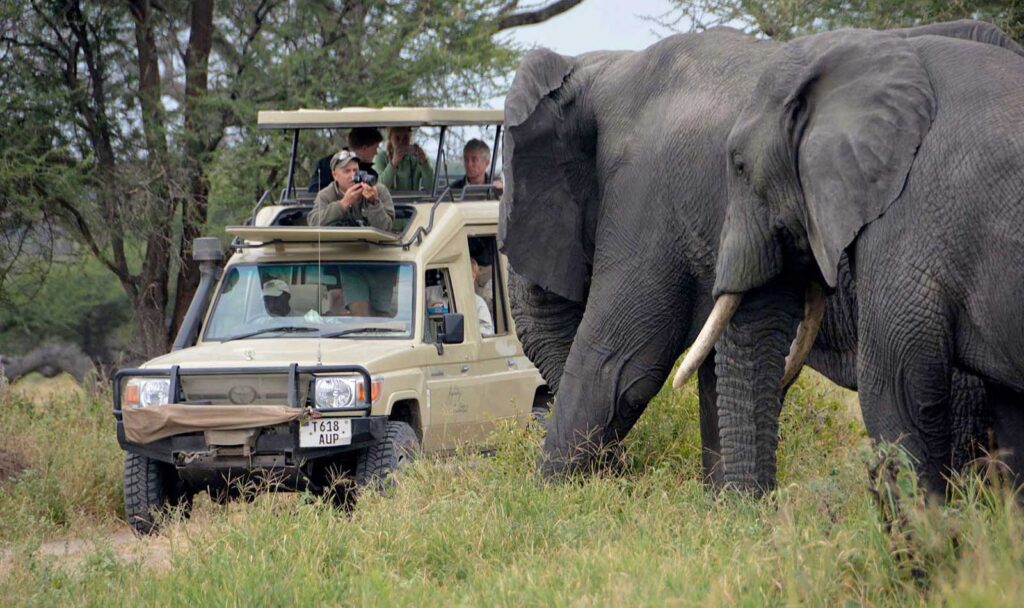
Elephants are the park’s most iconic species and its most common cause of visitor incidents. Bulls in musth (a hormonal state) are highly unpredictable and especially dangerous. Mock charges are common; real charges are fast and fatal.
| ⚠️ DANGER | If an elephant faces you directly, raises its head, spreads its ears wide and begins to walk or run toward you — this may be a real charge. Instruct your driver to reverse slowly and calmly. Never attempt to drive around a charging elephant. |
- Look for signs of aggression: lowered head, pinned-back ears, raised trunk, and raised tail.
- Give elephants extra space near waterholes, during feeding, and when young calves are present.
- If a lone bull approaches your vehicle, do not rev the engine — remain quiet and give way slowly.
- At campsites, store food securely — elephants are attracted to human food smells.
Big Cat Safety (Lion, Leopard, Cheetah)
- Never leave your vehicle during a predator sighting.
- Do not crowd lions resting in shade — they may charge if suddenly disturbed.
- At campsites, keep tent zips fully closed at all times, especially overnight.
- Never walk at night without an armed escort in areas where big cats are present.
- Do not urinate or eat outside tents after dark — smells attract predators.
- Cheetahs occasionally enter open-top vehicles; remain seated and do not panic.
Buffalo, Hippo & Crocodile Safety
- Cape buffalo are responsible for more human deaths in Africa than lions — they are highly aggressive, especially injured individuals.
- Never approach hippos on land — they are fast (up to 30 km/h) and extremely territorial.
- Keep at least 50 metres from hippos in water; do not approach rivers on foot.
- Crocodiles inhabit the Tarangire River and all permanent waterbodies — never wade or swim.
- Stay in your vehicle near riverbanks and low-lying water areas.
Snake & Reptile Safety
Tarangire is home to numerous snake species, including the Black Mamba, Puff Adder, Green Mamba, and African Rock Python. Bites, while rare, can be life-threatening without prompt antivenom treatment.
- Wear closed-toe shoes and long trousers when walking in bush areas.
- Never lift rocks, logs, or leaf litter without checking underneath first.
- Shake out boots and clothing before putting them on — especially at campsites.
- If bitten, immobilise the limb, keep it below heart level, and seek medical help immediately. Do NOT cut, suck, or tourniquet the wound.
- Scorpions and centipedes also inhabit the park — check bedding and equipment daily.
Malaria & Disease Prevention
Tarangire National Park lies within a high-risk malaria zone. Malaria, transmitted by the Anopheles mosquito (primarily active between dusk and dawn), is the single greatest health risk for visitors to the park. Prevention is essential and highly effective.
Malaria Prevention Protocol
| 🦟 HIGH RISK | Malaria transmission in Tarangire is perennial but peaks during and after the rainy seasons (November–December and March–May). Prophylactic medication and physical protection are both mandatory precautions. |
- Consult a travel health clinic at least 4–6 weeks before departure for antimalarial prescription.
- Common prophylactics: Atovaquone/Proguanil (Malarone), Doxycycline, Mefloquine — your doctor will advise.
- Apply DEET-based insect repellent (30–50% concentration) to all exposed skin from dusk onwards.
- Wear long-sleeved shirts and long trousers in the evenings.
- Sleep under a permethrin-treated mosquito net — even in tented camps with screening.
- Use permethrin spray on clothing, gear, and tent openings.
- Ensure all accommodation has window screens in good condition.
- If you develop fever, chills, headaches, or muscle aches within 3 months of return — seek medical attention immediately and report your safari travel history.
Other Insect-Borne & Waterborne Diseases
| Disease | Transmission | Prevention |
| Dengue Fever | Mosquito-borne | No vaccine; use DEET, cover skin, avoid standing water near campsites |
| Rift Valley Fever | Mosquito/livestock contact | Avoid contact with animal blood; use insect repellent |
| African Tick Bite Fever | Tick bite | Check for ticks daily; use permethrin-treated clothing |
| Bilharzia (Schistosomiasis) | Freshwater contact | Never swim or wade in rivers, lakes, or streams in the park |
| Typhoid Fever | Contaminated food/water | Vaccination recommended; drink bottled or purified water only |
| Hepatitis A & B | Food/water & bodily fluids | Vaccination strongly recommended before travel |
Safe Food & Water Practices
- Drink only sealed bottled water or water that has been boiled, filtered, and chemically treated.
- Avoid ice in drinks unless you are certain it was made from purified water.
- Do not eat raw or undercooked meat, shellfish, or unwashed fruits and vegetables.
- Use alcohol-based hand sanitiser (60%+ alcohol) before all meals.
- Treat all camp water sources as potentially contaminated regardless of appearance.
Vehicle & Driving Safety
The vast majority of visitor time in Tarangire is spent inside a safari vehicle. Vehicle condition, driver competence, and passenger behaviour all play critical roles in park safety.
Vehicle Safety Standards
- Use only TANAPA-registered, roadworthy safari vehicles with experienced, licensed drivers.
- Ensure the vehicle carries a spare tyre (ideally two), jack, tow rope, and basic toolkit.
- Verify the vehicle has a first aid kit, fire extinguisher, and working communication device.
- Inspect tyres, brakes, engine oil, and fuel before each game drive.
- 4WD (four-wheel drive) vehicles are strongly recommended, especially in the wet season.
Road & Track Safety
- Tarangire’s tracks range from smooth gravel to deep mud and rocky terrain — drive to conditions.
- Maximum speed limit inside the park is 25 km/h on game tracks.
- Never drive through water of unknown depth — check on foot first from a safe position.
- If stuck in mud, do not spin wheels excessively — use recovery tracks, traction boards, or a tow rope.
- Do not drive after dark unless escorted by armed TANAPA rangers.
- Park closing time is strictly enforced — gates close at 6:30 PM. Late returns incur heavy fines.
| 🚗 RULE | All visitors must be back at their accommodation or park gates before official closing time. Driving at night in Tarangire without TANAPA authorisation is both illegal and extremely dangerous. |
Passenger Safety in Vehicles
- All passengers must be seated and holding a fixed support when the vehicle is moving.
- Stand-up game viewing through roof hatches is permitted only when the vehicle is stationary.
- Keep hands, arms, and camera equipment inside the vehicle at all times when near animals.
- Do not dangle food or brightly coloured items from the vehicle windows.
Walking Safari & Foot Safety
Tarangire offers walking safaris within certain designated zones and around permanent camps. Walking in the African bush is an intimate and deeply rewarding experience — but demands strict adherence to safety protocols.
Armed Escort Requirement
| ⚠️ MANDATORY | All walking safaris in Tarangire National Park MUST be led by an armed TANAPA ranger. It is illegal and life-threatening to walk unescorted in any area of the park. No exceptions. |
- Book walking safaris in advance through your lodge, camp, or tour operator.
- Maximum group size for walking safaris is typically 8 people — groups larger than this increase risk.
- Walking safari permits must be obtained from TANAPA before the activity begins.
Walking Safety Protocols
- Walk in single file and maintain strict silence unless instructed otherwise by the ranger.
- Wear neutral-coloured, muted clothing (khaki, olive, beige) — avoid bright colours and white.
- Wear sturdy closed-toe boots that cover the ankle — no sandals or open shoes.
- Do not use strong perfume, cologne, or scented sunscreen on a walking safari.
- Follow the ranger’s hand signals immediately and without question.
- If the ranger indicates ‘stop,’ stop immediately and do not speak.
- If wildlife is encountered at close range, remain perfectly still and allow the ranger to take control.
- Never run — running triggers a predator’s chase instinct.
Campsite & Lodge Perimeter Safety
- At unfenced camps, assume dangerous wildlife may enter the camp at any time.
- Never walk alone between tents, dining areas, or ablution blocks after dark.
- Use the escort service provided by camp staff for all after-dark movement.
- Never leave torches, food, or scented items outside your tent.
- Report any wildlife sightings within camp perimeter immediately to camp management.
Climate, Sun & Heat Safety
Tarangire’s semi-arid climate means intense sun, high daytime temperatures (often 30–38°C), low humidity, and dry, dusty air. Heat-related illness and severe sunburn are common among unprepared visitors.
Sun Protection
- Apply broad-spectrum sunscreen (SPF 50+) to all exposed skin before leaving accommodation.
- Reapply sunscreen every 2 hours, especially after sweating.
- Wear a wide-brimmed hat at all times when outside — the equatorial sun is extremely intense.
- Wear UV-blocking sunglasses — prolonged sun exposure without eye protection causes photokeratitis.
- Schedule game drives in the early morning (6:00–10:00 AM) and late afternoon (3:30–6:30 PM) to avoid peak sun hours.
Hydration & Heat Management
- Drink a minimum of 3–4 litres of water per day during the dry season.
- Increase water intake significantly during strenuous activities such as walking safaris.
- Avoid alcohol consumption during midday game drives — alcohol accelerates dehydration.
- Eat light, easily digestible meals during hot weather to reduce metabolic heat load.
- Carry electrolyte sachets — mineral depletion through sweating contributes to heat illness.
| Condition | Symptoms | Immediate Action |
| Heat Cramps | Painful muscle spasms during or after activity | Rest, cool the person, oral electrolytes, water |
| Heat Exhaustion | Heavy sweating, weakness, cold pale skin, rapid pulse, nausea | Move to shade, loosen clothing, cool water sponge, rest, fluids |
| Heat Stroke | High body temp (40°C+), hot dry skin, rapid strong pulse, confusion | MEDICAL EMERGENCY — call for evacuation immediately; cool patient aggressively |
| Severe Sunburn | Red, blistered, painful skin; possibly fever | Cool water, aloe vera gel, ibuprofen for pain; seek medical care if blistered |
Wet Season Hazards
- Wet season (November–May) brings risk of flash floods in low-lying areas and riverbeds — never camp in a dry riverbed.
- Roads become extremely slippery during heavy rains — reduce speed and avoid steep tracks.
- Increased mosquito populations significantly elevate malaria risk after rainfall.
- Lightning is common during afternoon thunderstorms — avoid open ground and tall isolated trees.
Medical Preparedness & First Aid
Tarangire’s nearest major hospital (Mount Meru Hospital, Arusha) is approximately 2–3 hours away. The park has no resident doctor or hospital within its boundaries. Medical preparedness is therefore the visitor’s own responsibility.
Recommended First Aid Kit
| Item | Purpose/Notes |
| Antimalarial medication | As prescribed by your travel health physician |
| Broad-spectrum antibiotics | For traveller’s diarrhoea and wound infections — as prescribed |
| Oral rehydration salts (ORS) | For dehydration and diarrhoea |
| Ibuprofen / Paracetamol | Pain relief and fever management |
| Antiseptic wipes & cream | For wound cleaning |
| Sterile wound dressings | Various sizes; include butterfly closures |
| Elasticated bandages | For sprains and snake bite immobilisation |
| Tweezers & scissors | For splinters, ticks, and wound care |
| Digital thermometer | To monitor for fever |
| Eye wash solution | For dust, insect, or chemical eye contamination |
| Anti-histamine tablets | For allergic reactions and insect bites |
| EpiPen (if prescribed) | For those with known severe allergies (anaphylaxis) |
| Personal prescription medications | Minimum 2-week supply beyond trip duration |
| Insect repellent (DEET 30–50%) | For continuous mosquito and tick protection |
| High-SPF sunscreen | SPF 50+ broad spectrum |
Pre-Travel Vaccinations
The following vaccinations are recommended or required for visitors to Tanzania. Consult your travel health clinic well in advance of departure:
- Yellow Fever — Required if arriving from a yellow fever endemic country; strongly recommended for all.
- Hepatitis A & B — Strongly recommended.
- Typhoid — Recommended.
- Meningococcal Meningitis — Recommended.
- Rabies (pre-exposure) — Recommended for extended stays and wilderness activities.
- Tetanus, Diphtheria & Pertussis (Tdap) — Ensure up to date.
- Measles, Mumps & Rubella (MMR) — Ensure up to date.
- COVID-19 — Follow current national and WHO guidance.
Medical Evacuation
| 🏥 EVACUATION | For serious medical emergencies, AMREF Flying Doctors (AMREF Health Africa) provides air evacuation services from Tanzania. Visitors are strongly advised to purchase comprehensive travel insurance that includes emergency medical evacuation coverage before departure. |
- AMREF Flying Doctors: +254 20 699 2299 (Nairobi) — available 24/7
- Flying Doctors Society of Africa (FDSA) membership provides coverage across East Africa.
- Ensure your travel insurance explicitly covers helicopter or fixed-wing medical evacuation.
- Share your medical insurance documents and emergency contacts with your tour operator before arrival.
Personal & Property Security
Tarangire National Park is generally considered safe from crime. The primary security concerns relate to wildlife, but visitors should also take sensible precautions to protect personal property and safety.
Personal Security Practices
- Keep your accommodation locked at all times, even when occupied.
- Store all valuables (passport, cash, electronics) in your vehicle or accommodation safe.
- Do not display expensive cameras, jewellery, or cash in public areas.
- Use authorised, registered guides and drivers only — avoid unofficial offers of service.
- Carry a photocopy of your passport and travel insurance documents separately from the originals.
- Register with your country’s embassy or consulate before travel.
Fire Safety
- Open fires must be contained within designated fire pits at all times.
- Extinguish all campfires completely before leaving the site or retiring for the night.
- Never leave cooking stoves unattended.
- Store flammable materials (fuel, gas canisters) away from tents and sleeping areas.
- Dry season vegetation is extremely flammable — exercise extreme caution with any ignition source.
Environmental Responsibility & Park Regulations
Observing park regulations protects both you and Tarangire’s extraordinary ecosystem. Violations may result in heavy fines, confiscation of equipment, or deportation from Tanzania.
Key Park Regulations
- No littering anywhere within the park — all waste must be removed and disposed of outside the park.
- No collection of plants, rocks, feathers, bones, or any natural material is permitted.
- No off-road driving except where explicitly permitted by TANAPA.
- Noise must be kept to a minimum — no music, shouting, or loud conversation near wildlife.
- Photography of rangers, military or police personnel, or government infrastructure is prohibited without written permission.
- Drones are strictly prohibited in all Tanzanian National Parks without TANAPA approval.
- Smoking is prohibited in the bush and within 50 metres of any vegetation during the dry season.
- Alcohol consumption while actively game driving is strongly discouraged and illegal for drivers.
Leave No Trace Principles
- Pack out all waste including biodegradable waste such as food scraps.
- Use biodegradable, eco-certified soaps and toiletries to protect water sources.
- Do not use chemical insecticides near water — use DEET-based repellent on skin only.
- Respect all designated camping zones and do not create new clearing areas.
Quick Visitor Safety Checklist
Use this checklist before entering Tarangire National Park:
| Before You Arrive | In the Park |
| ✅ Pre-travel health consultation completed | ✅ Antimalarial medication started as prescribed |
| ✅ All recommended vaccinations received | ✅ Comprehensive travel insurance purchased (incl. evacuation) |
| ✅ First aid kit packed and accessible | ✅ DEET insect repellent and sunscreen (SPF50+) packed |
| ✅ Minimum 4 litres water per person per day | ✅ Emergency contacts saved in phone and on paper |
| ✅ Safari vehicle roadworthy and equipped | ✅ Park entry permit and ranger contacts confirmed |
| ✅ Neutral-coloured clothing for game drives | ✅ Campsite safety briefing received from camp staff |
| ✅ Walking safari armed escort arranged | ✅ No food stored outside tent or in open areas at camp |
| ✅ Night driving plan confirmed with ranger | ✅ TANAPA regulations reviewed and understood |