 info@gorillatrekkinginafrica.com

Wildebeest Migration in Africa
Wildebeest Migration in Africa , the Great Migration in Africa denotes an annual and cyclical movement of around 1.5 million wildebeest between Serengeti National Park and Maasai Mara National Reserve in Kenya. The wildebeest are escorted by 200,000 zebras, 400,000 Thomson’s gazelles, 12,000 elands, and predators poised to prey on any struggling animal. Certain researchers assert that wildebeest can detect rain in the atmosphere from thousands of miles distant.
The wildebeest migration is regarded as one of the world’s great natural wonders. Some even designate it as “The Greatest Show on Earth. The voyage spans approximately 800 kilometers and is perilous, particularly for newborns, the frail, or the weak during the Great Wildebeest Migration in Africa. The migratory species must contend with both resident and migratory predators, including crocodiles, lions, hyenas, cheetahs, and leopards. Approximately 3,000 lions trail the migrating herds.
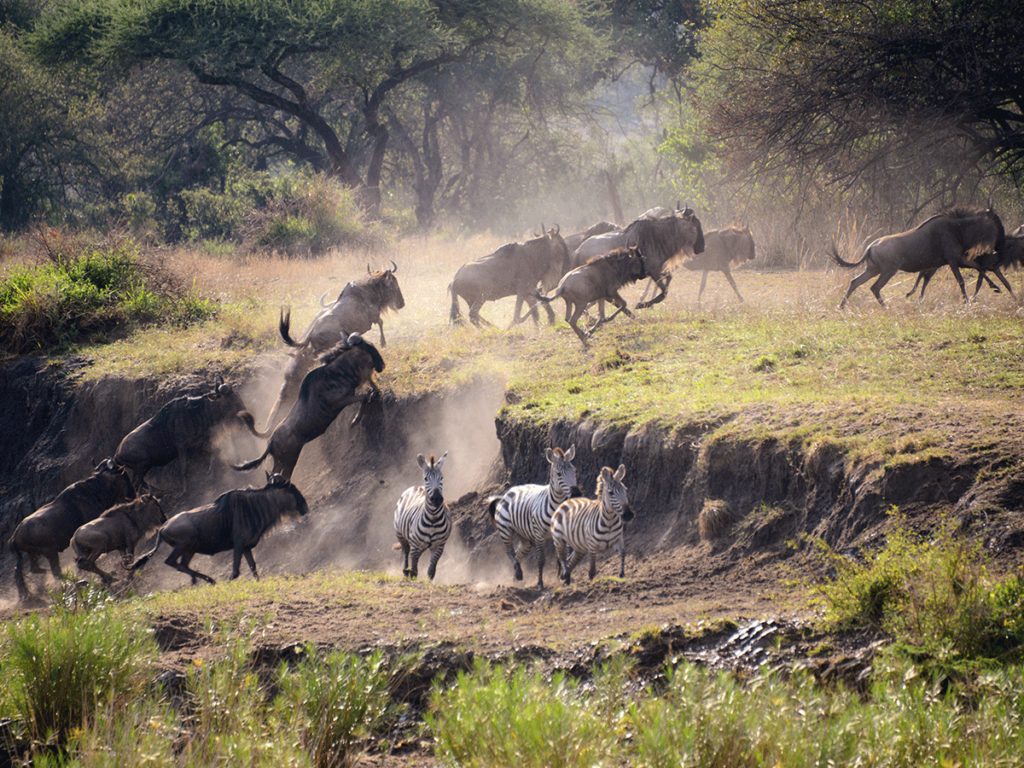
A crucial aspect of the wildebeest migration is the river crossings. The river crossings take place in the Grumeti and Mara rivers, located in Tanzania and Kenya. While attempting to traverse these rivers, formidable crocodiles lie in wait to seize and pull them beneath the water’s surface with their powerful teeth. The wildebeest migration presents a remarkable show for wildlife enthusiasts, rendering the Maasai Mara and Serengeti among the most frequented national parks in Africa. Describing the migration of several wild species across the wide savanna grasslands is challenging. The river crossings and calving season are equally remarkable. The absence of walls between the two parks facilitates wildlife migration, hence creating one of the most significant conservation areas globally. We provide a 3-day flying safari to Masai Mara for observing the great migration in Kenya.
What factors inspire the Great Migration in East Africa?
Researchers continue to grapple with elucidating the precise factors that instigate the massive migration in Africa. Nevertheless, it is now understood that it really pertains to the instinct for survival. Fossils discovered in the region indicate that wildebeest had inhabited the area for over 1 million years, coinciding with the Great Wildebeest Migration in Africa. Evolution has encoded inside their DNA the instinct to migrate collectively. Wildebeest and other herbivores are unable to endure without precipitation. In the absence of rain, the quality of the grass diminishes, perhaps resulting in famine for the herd. The wildebeest track the rains to ensure a consistent supply of water and forage. To prevent famine, numerous predators are compelled to pursue the moving herds. The migratory wildebeest, zebras, and antelopes travel in herds to dodge predators, so enhancing their survival prospects.
It is important to note that not all wildebeest, zebras, and other herbivores partake in migration. Many opt to reside exclusively within Serengeti National Park or Masai Mara National Reserve. These indigenous creatures permit tourists to access these areas year-round. If you overlook the moving animals, you can anticipate observing those that remain sedentary in the two wildlife reserves. Consider exploring our 3-Day Serengeti Safari trip to witness the migrating wildlife.
Migration Routes and Seasonal Trends
The vast herds do not remain in a single location for extended periods and are perpetually in motion. Understanding rainfall patterns might indicate the location of herds during a specific week. Nevertheless, due to global warming, accurately predicting the locations of migrating species is becoming challenging. We will soon address the overarching trend of migration.
November to December — Brief Precipitation
From late November to mid-December, the animals migrate from Kenya in fragmented groups to graze on the Eastern and Central plains of the Serengeti. By late December, they are typically observed grazing in the Ngorongoro Crater and the Ndutu plains. This is the optimal period to witness the Great Migration in Africa, characterized by the perpetual conflict between predator and prey. The Serengeti harbors the most extensive population of lions in Africa. Observing their reception of the migratory wildebeest, zebras, and other antelopes is both cruel and intriguing.
In addition to tracking the migratory wildebeest, guests can also explore the remarkable Ngorongoro Crater. This crater was created over 1 million years ago when a colossal volcano, larger than Kilimanjaro, collapsed, resulting in a floor that is 610 meters deep and spans 260 square kilometers. The crater ensnared numerous renowned African animal species, including the Big Five, within a bountiful paradise. The Ngorongoro Crater possesses the highest density of lions in Africa. The majority of animals residing in the crater do not migrate due to the abundant food supply year-round.
January to March – Calving Time
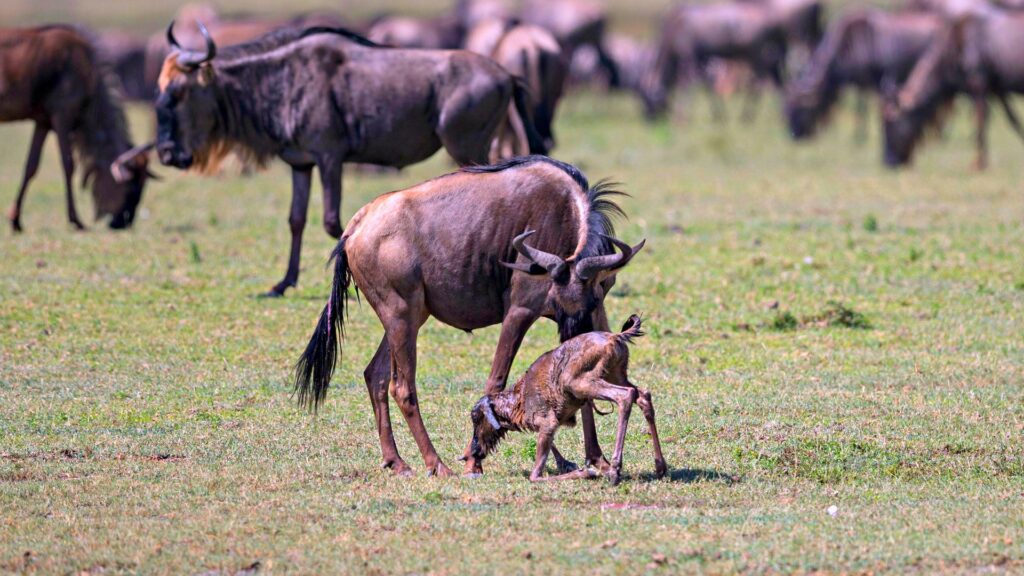
From January to March, the herds remain in the Southern Serengeti grasslands. Food is abundant, and the earth is nutrient-rich. This is when the females begin to exhibit indications (excessively heavy abdomens) of the impending Wildebeest migration in Africa, preparing to give birth. Calving commences in late January and continues until mid-March. February experiences the peak calving rate, with approximately 8,000 wildebeest born daily. At the conclusion of the calving season, more than 500,000 adorable wildebeest calves are born. This serves as a suitable substitute for the 250,000 individuals who perish during migration as a result of weariness and dehydration. Tourists seeking to observe the calving season should visit the Southern Serengeti grasslands around February. The calving season attracts predators such as hyenas, leopards, cheetahs, and lions, which readily seize the opportunity to prey on the infants. The substantial quantity of newborns guarantees that the majority evade predation.
April – Prolonged Rain
April brings abundant rainfall, resulting in the Serengeti plains becoming verdant and teeming with Africa’s renowned creatures. As April concludes, the wildebeest perceive the diminishing rains and the scarcity and degradation of grass. They commence their expedition to the western region of the Serengeti.
April to May — Western Serengeti
The annual wildebeest migration occurs from late April to late May, as the animals traverse in elongated formations towards the western Serengeti. Hyenas, leopards, cheetahs, and lions trail behind them as they graze on the grass around the Grumeti and Seronera River. The Serengeti National Park’s headquarters are located at Seronera. This region features a stunning savanna scenery, vast plains, rocky formations, and thorny trees. This is the primary location for organizing game drives and hot air balloon safaris in the Serengeti. This spot is frequented by numerous tourists who can be observed watching the extensive lines of animals while holding their picnic lunches. Explore our 4-Day Lake Nakuru and Masai Mara Tour package in greater detail.
June to July — Traversing the Grumeti and Mara rivers into Maasai Mara National Reserve
By June, the majority of the fragmented herds of wildebeest, zebras, and antelopes will have congregated in Grumeti and its adjacent regions. They graze in the region, but an eventual stimulus prompts the initial animal to initiate the wildebeest migration in East Africa. Their initial crossing occurs at the Grumeti River in Tanzania, followed by the Mara River, which serves as a natural demarcation between Tanzania and Kenya. The convergence of the Grumeti and Mara rivers is highly anticipated by tourists. Observing the animals stampede across rivers while attempting to dodge massive crocodiles constitutes the pinnacle of any African safari. In addition to the crocodiles, the wildebeest must select the appropriate crossing place and timing to prevent drowning or being carried away by powerful river currents. Those fortunate enough to endure the crocodiles and river current will be greeted by delectable grass in the Maasai Mara National Reserve.
August through October
Significant migration in AfricaFrom August to October, the wildebeest migration is concentrated in the Masai Mara National Reserve. The animals graze in the expansive savanna plains. Grazing is solely disrupted by persistent assaults from indigenous lions, hyenas, and leopards. In October, the quality of the grass in the Mara commences to decline. The wildebeest detect the impending rains in the Serengeti, prompting their migration back to Tanzania in search of more fertile grazing grounds.
Be advised: The aforementioned routes and schedules may not consistently reflect accuracy and are contingent upon precipitation conditions. Global warming has affected the annual migration patterns. It is not unusual for the animals to arrive at a specific juncture sooner or later than anticipated.
Best country for witnessing the Great Wildebeest Migration
Every nation possesses its own advantages. Experiencing the Great Migration in Tanzania’s Serengeti National Park reveals expansive plains and the chance to observe the calving season. Additionally, visiting the Serengeti entails touring the remarkable Ngorongoro Crater, other exceptional national parks, and ascending Mount Kilimanjaro. The Serengeti presents diversity, whilst the Masai Mara boasts a greater density of species due to its reduced area. We strongly advise that you arrange to observe the migration in both nations. Always bear in mind that the two game parks constitute a broader animal conservation region, delineated solely by artificial boundaries.
Supplementary Information Regarding the Great Migration in Africa
Some academics assert that wildebeest effectively surmount all challenges because to what they refer to as ‘swarm intelligence.’ Collective behavior and decision-making not only safeguard them from predators but also enhance their ability to anticipate rainfall patterns.
Zebras and other herbivores successfully move alongside wildebeest as they consume different sections of the same grass species. Consequently, there is no rivalry for grass, as all have sufficient sustenance.
Significant wildebeest migratory pathwaysPredicting the timing of animal crossings at the two rivers or their entry into any of the parks is challenging. Tourists are encouraged to reserve an extended safari to adequately observe the wildlife. The two wildlife reserves are remarkable destinations to visit year-round. There is a plenty of local wildlife to observe even after the migratory herds vacate a specific region. August and September are regarded as the optimal months to observe the migration in Kenya.
The vast migration can be observed in two ways. One method involves remaining in stationary camps and awaiting the arrival of the herds, or pursuing them in semi-nomadic tents.
It is essential to plan your migration expedition beforehand. This is mostly due to the overbooking of camps and lodges during the migration of animals in specific reserves. Plan your migratory safari judiciously, tailored to your desired experiences and observations.