 info@gorillatrekkinginafrica.com

Usambara Mountains
The Usambara Mountains are characterized by significant geological activity, surpassing the age of other nearby mountains such as Kilimanjaro and Meru, which are believed to have formed approximately 25 years ago. The uplift of the West Usambara rocks contributed to the emergence of a biodiverse island, which has since influenced climate stability and moderated temperatures from the intense heat of the surrounding safari plains. While the indigenous African violet flourishes in its serene, natural environment, the ensuing human population in these mountains endures significant hardship, approaching extinction. In these regions, substantial evidence indicates that Neolithic settlements engaged in iron smelting activities between 3000 and 35000 years ago, followed by the arrival of the Bantu people approximately 2000 years ago. The Bantu people are believed to have migrated from the Congo.
Some individuals engaged in intermarriage and mingled with the indigenous populations and tribes, resulting in the emergence of the Shambaa, recognized as the inhabitants of the Usambaras. The Shambaa clan historically embraced the refugees in their highlands, coexisting well with them. They established favorable relations with their neighbors, however the historical context remains ambiguous until the 18th century with the advent of the inaugural monarch of the Usambara, Mbega, progenitor of the Kilindi Dynasty.
Members of this ruling elite are recalled with admiration and reverence, with numerous accounts detailing their supernatural abilities to summon rain, alongside their light-colored eyes and notably fair complexion. Lord Mbega was reputed to be a proficient bush pig tracker from the Nguru Mountains, who gallantly took a woman from each tribe and bestowed upon them a kid to govern. When the notorious Maasai tribe convened in the western plains and menaced the Shambaa’s agricultural and militaristic endeavors over grazing lands and cattle, the mountain clan established more formidable political and military frameworks under the leadership of Mbegha’s grandson, Kinyashi. During the mid-1800s, the Usambaras experienced intense conflicts due to incursions from surrounding clans that pillaged livestock and provisions, alongside slave traders; yet, the region was largely protected owing to its elevated terrain and adherence to social order.
Following Kinyashi’s demise, his son Kimweri, associated with the Kilindi government, was proclaimed “Simba Mwene,” the Lion King. He became as a formidable military leader, ultimately exerting power over a significant expanse of the Southern Pare Mountains from his stronghold at Vuga, near Soni. Nevertheless, as the adjacent faction leaders, Kimweri’s offspring shown greater proficiency in attacking the slave trains for weaponry to resist incursions, they commenced infighting for increased dominance, so decentralizing and undermining the organization. The formation of a military coalition facilitated the Shambaa clans’ involvement in the 1888/89 Abushiri Uprising; yet, the weakened power structure permitted the German Administration to intervene as a final recourse.
Amidst a period of upheaval and chaos, the Europeans successfully convinced local leaders to relinquish control of their territories for a nominal compensation. The appealing and remarkable landscape of the Usambaras attracted numerous pilgrims to its expansive green valleys, prompting the German organization to establish it as their provincial seat, christening the town Wilhelmstal in honor of Kaiser Wilhelm. The terrain is rugged and steep, yet the novices successfully finalized architectural ideas that embody their managerial perspectives.
A robust cobblestone road was constructed to traverse the 33 km between Mombo and Lushoto, which has mostly remained unchanged to this day, and one can still observe their distinctive brickwork in the several mountain stream crossings along the route. This ascends a gentle incline to facilitate the passage of oxcarts laden with heavy cargo, concealed by a substantial avenue of broad-trunked plane trees. Pilgrim agriculture thrived, facilitating the construction of large stone residences designed in the pioneer style, which remain prominent today, and the area was developed, albeit with some tumultuous beginnings. The Germans initiated well-conceived plans to cultivate espresso plantations in this region; however, after deforesting the area and planting crops, they ultimately abandoned their endeavors. This information will be revealed to you upon your decision to explore the Usambara Mountains.
Fruit trees, especially pears and plums, flourished, and the region persists in exporting fresh produce nationwide. Success was also evident in sisal plantations, which became select planters affluent, enabling them to construct rural retreats in locations like as Lushoto, where crops included rubber, cotton, tobacco, sugar, wheat, and maize. Tanganyika was designated a Mandate Territory by the League of Nations after the Versailles Treaty of 1919 and subsequently given to the United Kingdom for administration. Despite British discouragement, several civil servants need and constructed their own residences. Numerous appealing edifices remain in the Lushoto region, contributing to the eclectic blend of antiquated colonial German and British architecture.
Methods for accessing the Usambara Mountains
There exists a singular landing region in the Usambara Mountains, extending from Mombo to the quaint town of Soni, characterized by its little cascades, and subsequently along a vibrant and picturesque canal valley to Lushoto, the central hub of the territorial organization. This distinctive region is situated high on the mountains and possesses an intriguing local and border history. The territory radiates impressive, consistent beauty, featuring deep valleys and tumultuous mountain streams at the base of steep terraced slopes that ascend to greet the overcast morning. The rich diversity of plant species in its dense shrubbery has bestowed to this frequently neglected region of Tanzania the title “the Galapagos of the plant world.” The 4 km wide Lwengera Valley separates the Usambara Range into eastern and western sections.
Tourism activities in Usambara
The Usambara tourism office is located on your left after leaving the bank, and it plays a crucial role in coordinating safari guides for hiking and walking safaris in the Usambara region. The office provides guests the option to arrange their bags for an overnight stay with local families or friends, with guides typically charging a fee of $10 per person per day, payable to the tourism office or the designated tourism project.
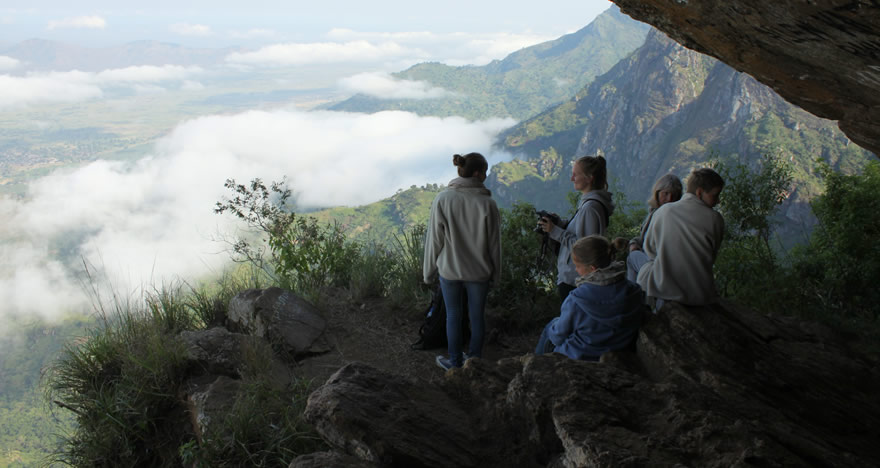
Irente Viewpoint is one of the least challenging and most notable natural attractions accessible from the town center. This is a rugged outcrop, approached via a small, flower-adorned path, ascending to a vibrant, wind-swept prominence above the Maasai steppe. The vistas are exceptional, and the surrounding terrain is very evocative.
The complete circuit requires three to four hours to traverse on foot from the town, however individuals with own vehicles can travel a significant distance at their convenience. Louis, the captivating proprietor with innovative designs for his camping area and culinary offerings (mostly guacamole thus far), has renovated and enhanced an antiquated campground, aptly dubbed both Viewpoint and Bellavista Campsite. Costs ultimately seem to represent future aspirations and are undoubtedly contentious (5000 TSH lease, 2000 TSH park).
Any tourism office guide can direct you to Irente viewpoint, but the route is evident from Irente Farm. Having established itself as a dependable producer of wholemeal bread, jams, and fresh dairy products, the farm has transformed into a valuable stop for procuring picnic provisions. The farm has garnered attention from Comrade “Kipepe,” meaning “butterfly,” a renowned local artisan who has constructed his family residence entirely from mud, encompassing the table, seats, shelves, and water system. Kipepe has constructed a mud shop, referred to as a “duka” in Swahili, at Irente, which is aesthetically adorned with a prominent head of horned cattle.
Guides can lead you on an enriching trek through the Magamba Rainforest, inhabited by troops of strikingly collared colobus monkeys and a multitude of avian species, such as the Usambara akalat and Usambara weaver, rendering it an especially gratifying locale for avid birdwatchers. Camping is available at a serene location equipped with a restroom and running water near an abandoned sawmill in the forest, or one can opt for the cozy and hospitable resorts at Mkuzi and Migambo.
Recent additions to the Cultural Tourism Program include new trips, one of which explores the remote and unique settlement of Mlalo, situated high in the hills 30 kilometers from Lushoto, farther into the Usambara range. Mlalo, an expansive collection of remarkable two-story residences featuring intricately carved wooden balconies, is situated in a meticulously manicured and terraced valley watered by the Umba River, framed by a striking panorama of rugged mountain ranges.
The village offers an assortment of handcrafted pots inspired by the Shambaa tradition, which holds that the creator deity Sheuta molded humanity from the dirt, like to a potter crafting her earthenware. Traditional beliefs assert that pottery is crafted by women, utilizing techniques transmitted through the matrilineal lineage from mother to daughter. Their crockery and pots are produced in the adjacent town of Kileti and thereafter transported to the Lushoto market for sale. Daily transportation operates between Lushoto and Mlalo, traversing Magamba, and requires around two hours. The Afilex Hotel is esteemed as the premier inn, despite its accessibility being limited to gaslamp illumination due to the absence of electricity at this hour.
Extended excursions may be undertaken over multiple days, either by establishing a campsite or residing in guesthouses en route. A remarkable extended excursion traverses the Lushoto hinterlands, encompassing mountains, valleys, and villages, including the renowned town of Mtae, a prominent boundary marker between the Maasai plains and the Shambaa territory, situated at a high elevation on the westernmost edge of the West Usambara range. The principal German European educators were authorized to establish their congregation in Mtae (formerly spelled Mtii) after surmounting the challenge posed by the local chief, who directed them to a hereditary burial site, and astonishing him by not being harmed or deterred by the potentially lethal mizumu, the spirits of the deceased.
The journey from town to Mgamba via Kwembago, the historic residence of the Daffa family, a subclan of the Kilindi Dynasty, the traditionally esteemed ruling elite. This hike lasts approximately five to six hours and concludes in the settlement of Magamba, where one can also board a bus to Lushoto or continue to Mlalo.
Where should I begin my hiking journey in the Usambara Mountains?
In the 19th century, German immigrants settled in the region, introducing crops like as coffee and tea, along with numerous churches. The concept of partitioning the forest from the villages was proposed and subsequently embraced by the residents. The geography ranges from irrigated agricultural fields to a tropical rainforest in the valley. Lushoto town is the predominant settlement in this region. It is a vibrant commercial center featuring multiple street marketplaces where residents trade things.
Mountain hikes may also commence from Lushoto. To discover the best-kept secrets and traverse the most scenic paths, our expert guides will lead you through the most beautiful regions of the Usambara Mountains.
Birding in Usambara Mountains
The Usambara Mountains, characterized by their tropical forest coverage, are exceptionally unique in East Africa and are hence considered a biodiversity hotspot with numerous protected areas. The Usambara eagle-owl, Usambara akalat, Usambara weaver, and African violet are among the species inhabiting the Usambara woodlands. Additional avian species you may encounter are Hartlaub’s Turaco, Mountain Buzzard, Crowned Eagle, Eastern Bronze-Napped Pigeon, Lemon Dove, Dusky Turtle Dove, and Crowned Eagle.
Flora and fauna present in the Usambara Mountains
The Usambara Mountains include around 600 tree species and more over 3000 plant species. Consequently, it is considered one of the world’s biodiversity hotspots. This attracts ecologists and nature enthusiasts globally who visit to see birds and study trees, flowers, or butterflies. The Usambara woodlands harbor numerous indigenous species.