 info@gorillatrekkinginafrica.com
 +256 787505601
Shoebill Stork Size and Facts
Shoebill Stork Size and Facts : The shoebill, also known as the whale head, whale-headed stork, or shoe-billed stork, is a large, stork-like avian species. The title derives from its large, shoe-shaped bill. It possesses a somewhat stork-like general morphology and was first classified within the order Ciconiiformes with storks due to this anatomical resemblance.
The foot-long bill resembling a Dutch clog is what characterizes the aptly named shoebill. It measures five inches in width, exhibits a tan coloration with brown splotches, features sharp edges, and possesses a pointed hook at the end. The shoebill’s distinctive bill enables it to capture substantial prey, including lungfish, tilapia, eels, and snakes. It will also consume newborn crocodiles and Nile monitor lizards.
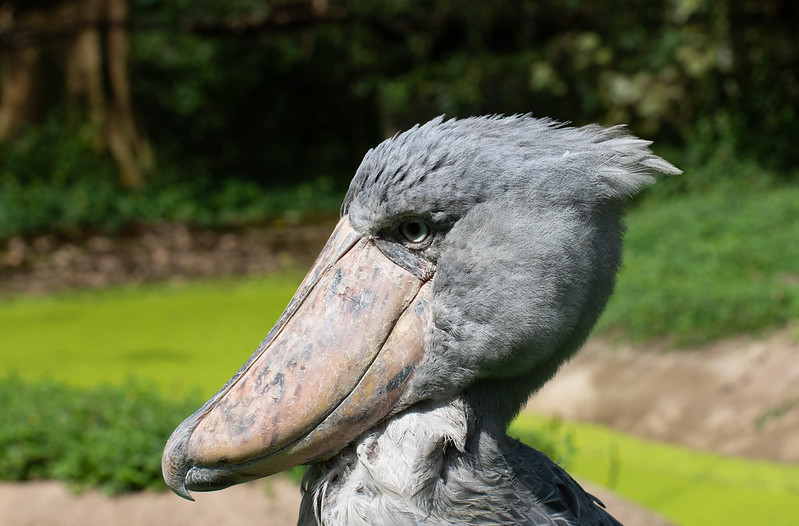
Shoebill Stork Size and Facts.
This page details the physical structure, dietary habits, behaviors, longevity, movements, and habitats of the rare shoebill stork.
The Shoebill Stork is an exceptionally large avian species relative to others.
Shoebill Storks possess golden eyes, grey plumage, white abdomens, and a little feathered crest on the posterior of their heads, potentially reaching a height of five feet with an eight-foot wingspan. They possess elongated, slender legs with large feet, ideally suited for traversing the vegetation in the freshwater marshes and swamps of East Africa, spanning from Ethiopia to South Sudan, Uganda, Rwanda, Kenya, Tanzania, and extending to Zambia.
Physical Attributes of the Shoebill Stork.
The shoebill stork possesses a mouth resembling a shoe, which is reflected in its name, and features a robust, curved beak that enables it to sever prey into manageable portions for efficient digestion.
The shoebill stork possesses an elongated foot that can reach up to 18 cm, akin to the dimensions of a human foot.
The height: An adult shoebill stork may attain a height of 4-5 feet when bipedal, rendering it one of the tallest avian species globally.
A mature female shoebill weighs roughly 5.6 kilograms (11 pounds), whereas a male shoebill weighs about 5.4 kilograms (12 pounds).
Conservation Status of the Shoebill Stork.
The population is estimated to range from 5,000 to 8,000 individuals, predominantly residing in wetlands in South Sudan, Uganda, the eastern Democratic Republic of the Congo, and Zambia. A viable population exists in the Malagarasi wetlands in Tanzania. Birdlife International classifies it as Vulnerable, with the main threats being habitat destruction, disturbance, and hunting. The Shoebill Stork is classified as an endangered species by the Convention on International Trade in Endangered Species of Wild Fauna and Flora (CITES).
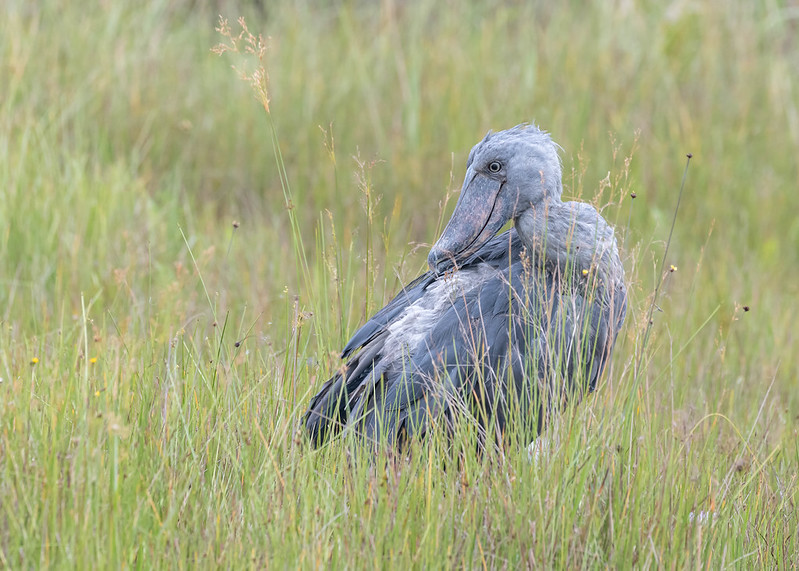
Identified Habitats of the Shoebill Stork.
Shoebill storks are nocturnal aquatic birds that like to inhabit areas near water and utilize concealment for shelter. The Shoebill stork inhabits regions characterized by aquatic environments and extensive marshlands, which offer optimal concealment during foraging activities. Shoebill storks thrive abundantly in Africa due to their favorable climate. Shoebills can be located in several regions around Africa, particularly in Uganda, where over 1,000 individuals can be easily observed during birdwatching, boat excursions, and game drives.
Notable destinations to explore on a holiday include Mabamba Swamp adjacent to Lake Victoria, Lake Mburo National Park, Queen Elizabeth National Park inside the Ishasha sector, Semliki Wildlife Reserve, Ziwa Rhino Sanctuary, and Nabajuzi Swamp in the Masaka district. Uganda is a paradise for birdwatchers, with various unique and uncommon avian species endemic to the region.
Additional regions in Africa to observe shoebills encompass Rwanda, Zambia, Sudan, Tanzania, eastern Congo, Cameroon, Botswana, and Kenya, among others, which possess wetland habitats that provide ample sustenance for the shoebill stork, adequate concealment from predators, and breeding sites for the endangered shoebill stork, which favors constructing nests in open marshes.
Reproductive Cycle of the Shoebill Stork.
Shoebills reach maturity between three and four years of age, and breeding pairs exhibit monogamous behavior. Nonetheless, these birds have a solitary disposition, with even mated pairs foraging in distinct areas of their territory. Breeding pairs create nests that may reach a width of eight feet, either on water or on floating vegetation. At the conclusion of the rainy season, females lay an average of two eggs.
Both avian species engage in the nurturing of eggs and offspring as co-parents. Incubating and turning eggs, together with cooling them using water transported in their large bills, constitute the responsibilities of the task. Incubation requires around one month. Chicks possess bluish-gray down and exhibit a lighter-hued beak. Generally, just a single chick lives to fledge.
What constitutes the Shoebill’s diet?
Shoebill storks are distinguished by their reliance on aquatic mammals, preying on various fish species, including lungfish, catfish, eels, juvenile crocodiles, as well as reptiles and amphibians such as water snakes and frogs, provided they fit within their beak. Consequently, they favor waterlogged habitats where they employ their distinctive hunting techniques.
The association between humans and the Shoebill Stork.
This species is considered one of the five most sought-after birds in Africa by birdwatchers. They are benign towards humans and do not display any menacing behavior. Researchers observed a bird on its nest from a distance of 2 meters, or 6 feet 7 inches.
Shoebills can remain stationary for extended periods, rendering them undetectable to unsuspecting lungfish surfacing for air until it is too late. The avians employ a predatory strategy termed “collapsing,” wherein they lunge or descend upon their prey.