 info@gorillatrekkinginafrica.com
 +256 787505601
Guide to Mount Kenya National Park
Mount Kenya National Park is located in Kenya and is the second-highest mountain in Africa, following Mount Kilimanjaro. It is often referred to as “Come Touch the Sky” due to its greatest elevation of 5,199 meters and was designated as a protected area in 1949. The protected area encompasses 715 square meters, including the Kenyan mountain and the adjacent fauna within the forest reserve. The various vegetation zones provide as excellent habitats for wildlife, particularly for mammals and birds.
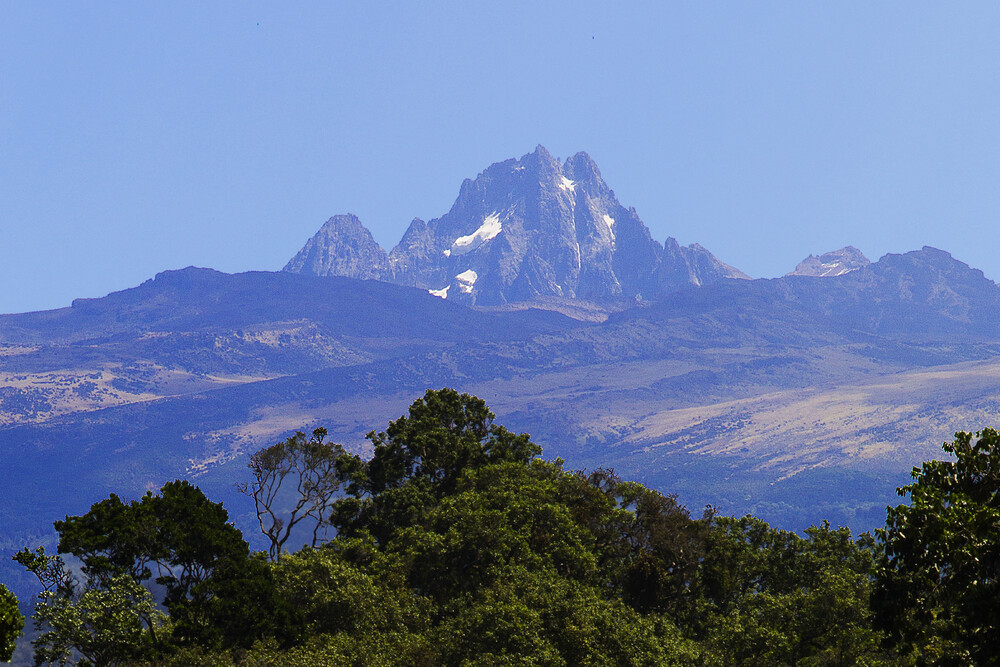
The mountain serves as the water catchment source for the park, deriving from melting glaciers and mineral springs. The park is a habitat for rare and endangered wildlife species. The elevated height is inhabited by terrestrial fauna and flora, such as alpine plants. The guests partake in trekking, camping, and caving amidst the rugged glacier throughout their Kenya Wildlife tours.
The park was once a forest reserve before being designated as a national park encompassing Mt. Kenya and the forest reserve. In 1978, the entire area was classified as a UNESCO Biosphere Reserve, after its declaration as a UNESCO World Heritage Site in 1977. The Government of Kenya designated the park primarily to preserve the area’s natural picturesque vistas, conserve its biodiversity, and protect the vital water source essential to the local population.
Getting to Mount Kenya National Park
Accessing Mount Kenya National Park is straightforward via road transport, requiring a distance of only 175 kilometers from Nairobi. Numerous public taxis and shuttles operate daily to the Mt. Kenya region via the Nanyuki-Isiolo Road. One may traverse the Sirimon Track or the Nyeri-Nanyuki road, which passes through Naro Moru.
The park can also be accessed via Chogoria on the Embu-Meru route, located 150 kilometers north of the capital city, Nairobi. A private tour operator driver-guide can arrange to pick you up from your hotel in Nairobi. If organized by local operators, it will be convenient for you, however expensive, yet it offers numerous advantages for guests, including safety and punctuality. It is important to acknowledge that there are primarily three routes that are strongly advised for effectively accessing the park or being left near the park gates when utilizing public transportation.
Utilizing public transportation incurs a cost ranging from 500 to 800 Kenyan shillings, depositing passengers on the major thoroughfare. One must engage a specific hire service to transport you to the park gates, incurring a cost ranging from 2000 to 8000 Kenyan shillings, contingent upon the distance from which the initial cab has left you. Mount Kenya National Park features four entrances: Kamweti Gate, Marania Gate, Burguret Gate, and Themwe Gate.
The park is accessible via domestic planes that land at the nearest airfield, Nanyuki airstrip. Your driver-guide will meet you at the airfield and transport you to the park gate for clearance, after which the day’s hike will commence. Hiking for 3 to 4 days is advisable, contingent upon your physical fitness level.
Vegetation of Mount Kenya National Park
The flora of Mount Kenya National Park is varied due to the height variations, resulting in distinct vegetation zones within the park. The park’s flora is categorized into distinct vegetation zones that vary with height. Each Zone is characterized by distinct plant species according to their adaptive capacity to altitude. At the Mountain, it is distinctive that the majority of plant species possess both local Kikuyu and Embu names with their English counterparts.
The park’s climate is humid, influenced by moisture from the Indian Ocean to the east and southeast. The slopes that see substantial rainfall are adorned with dense bamboo vegetation, but the park’s surrounding flat areas are characterized by wide savannahs that receive minimal precipitation. The wide savannah has been converted into agricultural land by the local Kikuyu. The vegetation classification ranges from open savannah grassland to montane forest, followed by bamboo and the Afro-alpine zone.
Structure of the vegetation zones on Mount Kenya
Cultivated Zone: This area, originally open savannah grassland, has been transformed into agricultural land by the Kikuyu.
Montane Forest: Ascending to 2000 meters, one encounters the montane forest, predominantly characterized by Ocotea usambarensis.
Bamboo Zone: Located in the mountain’s center, this area is characterized by bamboo forests, is confined, and experiences significant rainfall.
Timberline Forest: Located at approximately 3,000 to 3,500 meters above sea level, it is predominantly characterized by African rosewood.
Heathland and Chaparral: This ecosystem is located at altitudes ranging from 3,200 to 3,800 meters above sea level. It predominantly inhabits the most humid regions of the mountain, whereas the Chaparral is located in the arid sections. The predominant flora of Heathland is Erica, whereas in Chaparral it is African sage.
Afro-alpine Zone: This is the penultimate vegetation zone on the mountain, commencing at 3,500 meters and extending to 4,500 meters. It is dominated by two prominent species: Dendrosenecio keniensis and Dendrosenecio keniodendron.
Nival zone: This is the final zone containing glaciers, situated above 4500 meters.
Attractions of Mount Kenya National Park:
Wildlife: Mount Kenya National Park hosts a diverse array of fauna, including the African Forest Elephant, Cape buffalo, monkeys, leopards, dik-dik, forest hogs, and numerous more species. The park is home to more than 130 avian species, predominantly forest-dwelling birds.
Mount Kenya, the second tallest mountain in Africa, is the principal feature of the park. The mountain occupies over half of the park. The mountain may be ascended in 3 to 5 days, predominantly by individuals with technical expertise, to reach the summit.
Things to do in Mount Kenya National Park
The park offers a variety of engaging activities that enhance the visitor’s experience in Africa. The authentic environment of Africa is encountered during a safari to Mount Kenya National Park.
The park’s name obscures its diverse activities, leading many to erroneously believe that it solely offers hiking. This article highlights several activities available in the park.
Hiking is the primary activity conducted in Mount Kenya National Park, which features seven distinct trails. Among the seven ways, Naro Moru is the most accessible and much favored. Alternative routes comprise Sirimon, Chogoria, Batian, Nelion, Timau, and Burguret roads.
The park is renowned for its mountains and serves as a habitat for diverse animals, particularly mammals such as forest elephants and buffalo. The guests partake in game viewing from the Kenya safari vans. On an auspicious day, they may observe leopards and forest hogs.
Birding:
The park hosts around 130 avian species, predominantly forest-dwelling birds, with a few including open savannah species. Birding safaris can occur year-round, however they are most advantageous during the rainy season when birds are nesting and reproducing.
Scenic vistas:
Appreciate the panoramic views of the mountain, particularly for trekkers, as opposed to walkers who are unable to attain the peak. Visiting the caverns is also part of the park experience, which is exceptional during the Kenya Safari Tour.
Mount Kenya National Park is characterized by Africa’s second highest mountain, offering picturesque views just a few meters from the Equator. Visiting Ngai, the ancient deity of the Kikuyu. To this day, the residents maintain open doors and orient themselves towards the mountain, since they feel it bestows a gift. The Kikuyu ascend the mountain slopes for prayers and many cultural rites.