 info@gorillatrekkinginafrica.com
 +256 787505601
Lake Nakuru National Park
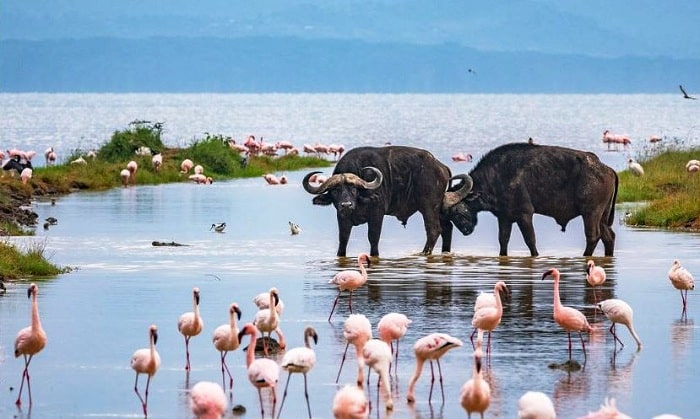
Lake Nakuru National Park is among the premier national parks in Kenya, as it include one of the Rift Valley soda lakes, namely Lake Nakuru. The park features three primary entrances, and upon entry, visitors can appreciate a diverse array of wildlife, particularly the flamingos that render the lake a vibrant pink.
History of Lake Nakuru National Park
Nakuru National Park is renowned for the colonies of flamingos residing along the shores of Lake Nakuru within the park. Lake Nakuru Park in Kenya is a premier game reserve, one of only three in the nation and among the most frequented game parks in the country.
Lake Nakuru Park is renowned as a sanctuary for avian enthusiasts due to the multitude of species that inhabit the area. Lake Nakuru National Park in Kenya hosts approximately 400 avian species, including flamingos that inhabit both the lake and the park’s savannah grasslands. The avian species comprise, but are not limited to, the African Fish Eagle, Slender-billed Greenbul, Long-tailed Widowbird, Rufous-throated Wryneck, Montane White-eye, Red-capped Lark, Northern Puffback, Rüppell’s Robin-chat, Shining Sunbird, among others.
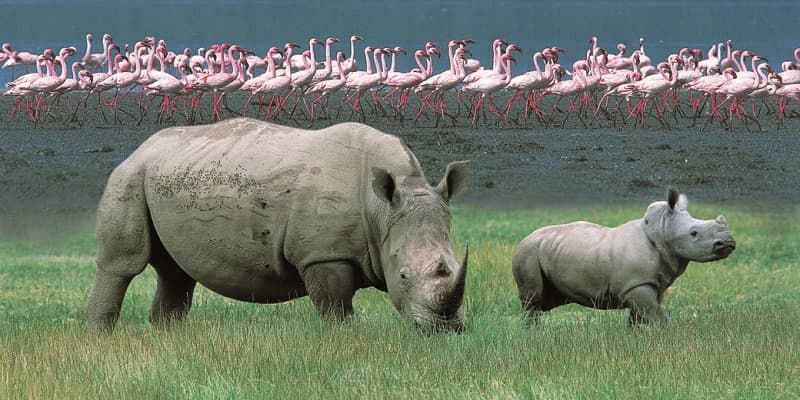
Nakuru National Park, while renowned for its abundant avifauna, also serves as a prime location for wildlife enthusiasts and animal aficionados. Lake Nakuru Park serves as a refuge for approximately 100 endangered rhinos, comprising both black and white types. Additionally, the park is home to the endangered Rothschild’s giraffe and more than 50 other animal species, including buffalo, waterbucks, lions, and impalas, among others.
Over the years, Lake Nakuru National Park has evolved into one of the most frequented parks in Kenya, attracting numerous travellers annually due to its avian diversity and other remarkable attributes. Visitors to Lake Nakuru Park can engage in activities such as birdwatching, game viewing, camping, and picnics at the scenic rocky viewpoints, among other pursuits.
Nakuru The Kenya National Park was initially designated as a protection area for avian species, particularly flamingos, at Lake Nakuru in 1957, encompassing only the lake and limited adjacent regions. This was undertaken to safeguard the lake, mitigate pollution, and conserve the flourishing avian population at Lake Nakuru.
In 1961, the previously designated area, now the southern section of Nakuru National Park, was established as a bird sanctuary, and various protocols were implemented to assure avian preservation in that region.
Lake Nakuru National Park was designated as one of Kenya’s national parks in 1968. This occurred with the expansion of the park to incorporate the northern savannah regions, resulting in a total area of 188 km². Additionally, several mammals were introduced to the park to transform it from solely a bird sanctuary into a comprehensive animal park.
In 1977, Lake Nakuru National Park was designated as the habitat for the exceedingly rare and endangered Rothschild giraffes, who were relocated from western Kenya for conservation and preservation purposes. This programme by the Kenyan government bolstered its efforts to conserve wildlife in the East African nation.
In the 1980s, following the introduction of Rothschild’s giraffes, rhinos were also transported to Lake Nakuru National Park in Kenya as part of a government project aimed at conserving the endangered rhino population, which was experiencing a significant decline. In 1984, Lake Nakuru Park was established as Kenya’s inaugural government-protected rhino sanctuary.
In 1986, the Kenyan government constructed an 188 km² electric fence surrounding Nakuru National Park to provide protection for rhinos against poachers. This barrier was and continues to fulfil the function of deterring poachers from Lake Nakuru Park while also confining the rhinos within the park’s boundaries. Following the successful erection of the 188 km² electric fence, the Kenyan government officially designated Lake Nakuru Park as a rhino sanctuary in 1987.
Lake Nakuru National Park is a UNESCO World Heritage Site and has been internationally identified as an Important Bird Area (IBA) since 2009 due to the presence of over 400 bird species; in 1990, it was designated a RAMSAR site.
Lake Nakuru Park has significantly evolved and developed over the years, making it an ideal safari destination to experience its growth, as well as its avian and terrestrial wildlife, alongside the extraordinary beauty of this unique park in Nakuru Town, Central Kenya.
Where is Lake Nakuru National Park
Lake Nakuru National Park is situated in the central region of Kenya, on the floor of the Great Rift Valley, to the north-west of Nairobi. This national park features forests and grasslands that serve as habitats for several wildlife species observable during game viewing in Lake Nakuru National Park. Kenya Wildlife Services administers Lake Nakuru Park together with other national parks and reserves in Kenya, and is responsible for wildlife conservation.
Lake Nakuru National Park features stunning landscapes, including the renowned Lake Nakuru and the Rift Valley escarpment. The terrain of this national park features high rocky escarpments, dense woods, and hills that provide as vantage places for wildlife observation. This national park is conveniently situated a short distance from Nairobi, the capital of Kenya. Lake Nakuru Park is situated near Hell’s Gate National Park and Naivasha National Park, enhancing its appeal as a destination. Soysambu Conservancy is located on the southeastern perimeter of the national park.
The national park features entry gates, including the less used Nderit gate and the primary Lanet gate, situated in proximity to Nakuru town. Entry costs for tourists at Lake Nakuru Park are categorised based on citizens, residents, and non-residents.
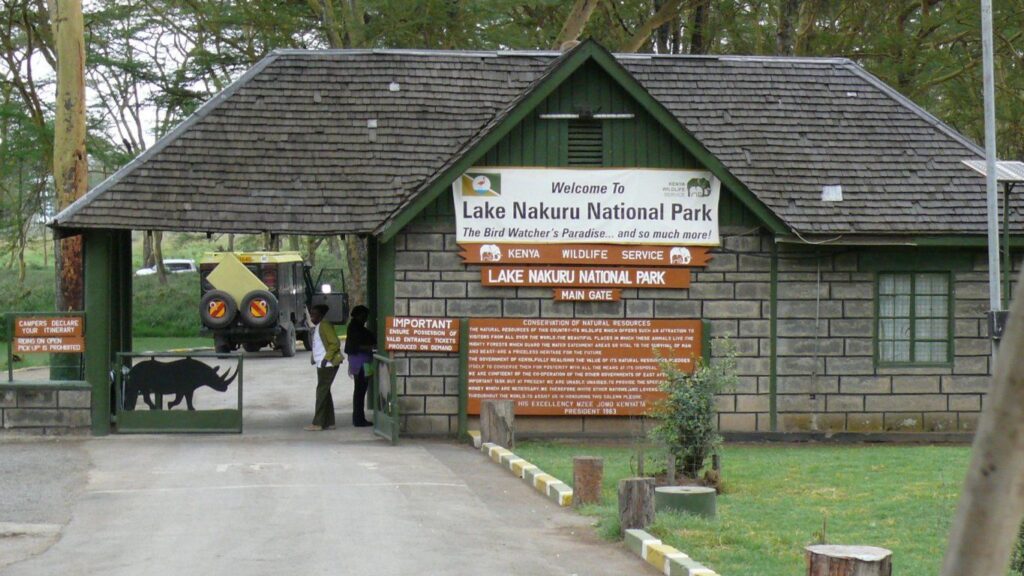
Accepted payment methods for entry fees at Lake Nakuru National Park include Mpesa, Visa card, and direct contributions to the Kenya Wildlife Service bank account at any of the park’s access gates.
Recreational pursuits in Lake Nakuru National Park
Tourists can partake in the following activities during their safaris at this destination:
Game drives are one of the methods to experience Lake Nakuru National Park. These drives offer proximity to several wildlife species, including white rhinos, leopards, lions, giraffes, hippos, impalas, and waterbucks. The wildlife drives occur at various times of day, offering distinct experiences on safaris at this location.
Birdwatching is an engaging hobby conducted in Lake Nakuru National Park. This is due to the diverse avian species observable at the several birding locations across the national park.
Hiking is an activity conducted at Lake Nakuru National Park, occurring while tourists explore the vistas across the park.
Points of Interest in Lake Nakuru National Park
Lake Nakuru National Park features several attractions, including the following:
Lake Nakuru is a renowned attraction of this national park. This is due to the enormous population of flamingos seen along the lake’s shoreline. The lake is a shallow soda lake that draws flamingos to its alkaline edges for feeding on algae.
This lake is an excellent birding location, offering opportunities to observe various bird species, including both native and migratory birds.
The lake is inhabited by lesser and greater flamingos, distinguished by their pink plumage. Flamingos are observable from various vantage points within the national park, including Baboon Cliff and Lion Hill.
Despite its lesser size relative to other national parks and reserves in Kenya, Lake Nakuru National Park is home to a diverse array of wildlife species. The observable wildlife species encompass waterbucks, white rhinos, black rhinos found in the woodlands, Rothschild giraffes, leopards, lions, and cheetahs, among others.
Adjacent to Lake Nakuru lies the enclosed sanctuary where several wildlife species, including giraffes and rhinos, can be observed. The fence surrounding the sanctuary deters poachers while also limiting the migration of wildlife species.
Lake Nakuru National Park is home to various avian species, including both migratory and indigenous birds such as the greater and lesser flamingos, African fish eagle, goliath heron, hammerkops, pied kingfishers, eagles, white pelicans, Hottentot teals, starlings, black-winged lapwings, crab plovers, grey crowned cranes, among others.
The Makalia Waterfalls in Lake Nakuru National Park, situated in the southern region, serve as an excellent location for hiking and picnicking, allowing travellers to appreciate the picturesque scenery and surrounds of this area.
Observation stations throughout the national park offer excellent perspectives for seeing various wildlife species and other attractions in Lake Nakuru National Park. Notable perspectives include Baboon Cliff and Makalia Cliff, among others.
The rivers supplying water to Lake Nakuru are the Njoro River, Makalia River, and Enderit River.
How to arrive there
Lake Nakuru National Park can be entered through various methods, including the following:
Lake Nakuru National Park can be entered by car from Nairobi via the park’s entry points, including the main gate near Nakuru town or the Lanet gate off the Nairobi-Nakuru highway.
Tourists can access the national park via air travel to Naishi airstrip, located in the southern region of the park.
Where to stay in Lake Nakuru national park
Accommodations near Lake Nakuru National Park are classified into luxury, midrange, budget options, and camping facilities. The lodging options near this national park are Sarova Lion Hill Lodge, Lake Nakuru Lodge, Lake Nakuru Flamingo Lodge, Merica Hotel, Mbweha Camp, Miali Saba Camp, Mirius Guesthouse, and Hotel Waterbuck Nakuru, among others.
Tourists may choose camping as a kind of accommodation during their safaris, with notable campsites in Lake Nakuru National Park include Naishi Campsite, Rhino Campsite, Soysambu Campsite, Kambi Nyuki Campsite, and Makalia Campsite, among others. Experience the gorgeous flamingos as well as a variety of wildlife during a safari to Lake Nakuru national park as you discover its numerous attractions.