 info@gorillatrekkinginafrica.com
 +256 787505601
Lake Baringo National Reserve
Lake Baringo National Reserve is situated near the northern frontier of Kenya, with its freshwater serving as an oasis amidst the parched plains. This is the ancestral territory of the Njemps tribe, a distinctive group that is the sole pastoral, cattle-herding tribe that also engages in fishing. In addition to other pastoral tribes like the Masai, the consumption of fish is considered prohibited.
The 129 square kilometer lake is abundantly populated with fish and draws numerous pelicans, cormorants, and fish eagles. The lake is also densely filled with crocodiles. The lake is exceptionally picturesque, encircled by volcanic peaks that extend indefinitely.
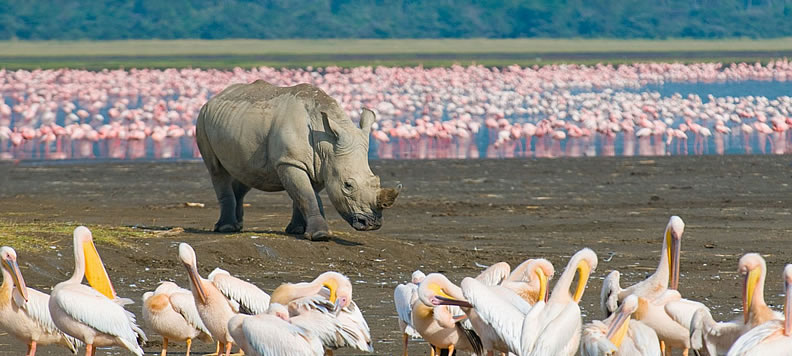
At the core of Lake Baringo lies OlKokwe Island, a rugged rocky isle that hosts Njemps settlements and a well-equipped campsite. This serves as an exceptional foundation for lake exploration, featuring boat excursions that are optimal for observing birds and hippos.
Baringo serves as an optimal waypoint for a safari to Northern Kenya. The lake is nourished by two rivers, El Molo and OlArabel, and lacks a discernible exit. Nevertheless, it is one of only two freshwater lakes in the Great Rift Valley of Kenya, although it is slightly saline, which does not deter crocodiles, hippos, or swimmers.
The region’s climate is predominantly hot and arid, and the terrain away from the lakeshore appears somewhat desolate. The towering cliffs host several avian species and are also inhabited by the Rock Hyrax, a small rodent-like creature. The Hyrax are particularly charming and intriguing to observe; but, from a birdwatcher’s viewpoint, they are noteworthy as the preferred prey of Vereaux’s Eagle, which is occasionally spotted gliding over the basalt cliffs along the western shore of the lake.
The vegetation surrounding the lake is home to intriguing avian species, provided one can locate them. Heuglin’s or Three-banded Courser is relatively frequent, and one may also observe Lichtenstein’s Sand-grouse and the Spotted Thick-knee.
Lake Baringo National Reserve boasts a diverse array of avian species inhabiting its coasts and surrounding areas. Over 470 species have been documented in total, with more than 300 species recorded in a single day. A recent avian census conducted over two three-hour intervals on successive days documented just over 280 species within the six-hour timeframe, occurring outside the primary migration seasons for northern or southern birds.
Although encountering all 470+ species during a brief visit is improbable, numerous birds are observable even by inexperienced birdwatchers. The pale and dark phase Gabar Goshawk, Paradise Flycatcher, African Fish Eagles, Marabou Storks, Shikra, and White-faced Scops Owl are frequently observed, while less common species such as Hemprich’s Hornbill (along the cliffs), African Darter, and occasionally the African Skimmer may also be sighted.
The lake formerly featured a substantial Goliath Heronry; however, while Goliaths continue to breed in the vicinity, the Heronry has vanished. Zimmerman characterizes the Goliath breeding in this region as “sporadic,” suggesting that this disappearance may be merely transient. The Baringo district is situated near the southernmost and easternmost extremities of Jackson’s Hornbill’s range, yet the species remains prevalent in the region.
To the south and east, these birds are supplanted by Von der Decken’s Hornbill, which closely resembles them, except for its white-spotted wings. Certain authorities see the two as conspecific.
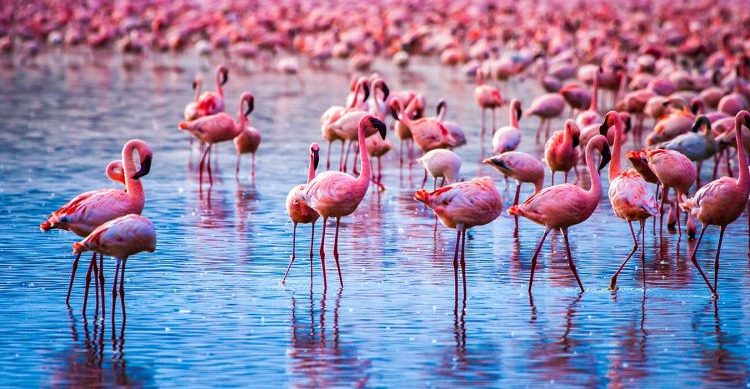
Lake Baringo
Lake Baringo is located in the Rift Valley, Kenya, once known as Baringo District and now designated as Baringo County. The lake is situated within Lake Bogoria National Reserve, making it a highly recommended tourist destination by Kenyan safari trip operators and for birdwatching. The journey from Nairobi, the capital of Kenya, to the lake is roughly 239 kilometers via car. It has two principal inflows, the Sandai and Emsos rivers, with no outlet. Lake Bogoria measures approximately 34 kilometers in length and 3.5 kilometers in width, encompassing a drainage basin of 700 square kilometers. It was once referred to as Lake Hannington. It is a saline, alkaline lake situated in a volcanic environment. It is renowned for its geysers emitting beautiful hot water volcanic springs and its substantial population of pink flamingos that eat on algae and sip fresh water from lakeside springs. The lake is very alkaline and twice as saline as seawater, rendering it incapable of supporting fish.
Being a national reserve Kenya wild life service charges entry fees into the national reserve.
The charges vary:
- Citizen adults 18 years and above -kshs 300
- Residents above 18 years – kshs 1000
- Non residents above 18 years 50 USD
- Citizen children – ksh 150
- Residents children kshs 300
- Non residents children (5-9) years – 10 USD
- Citizens ( 75 years and above) – ksh 150
- Vehicles
- Motor bike ksh – 100
- Saloon car – ksh 300
- 4WD/D cabin / prato/ Nissan ( 14 pass) – Ksh 1000
- Mini bus (32 pass) – ksh 2500
- Overload truck / Bus ( over 32) – ksh 3000
FILMING/ LANDING
- Filming commercial 1 week – ksh 50,000
- Filming full features 1 week – ksh 75,000
- Filming documentary 1 week – 25,000
- Landing fee ( less than 5 seats) – ksh 1,000
- Landing fee caravan – ksh 2,500
- Helicopter – ksh 2,500
- Micro and paramotor glider – ksh 750
- Paraglider – ksh 500.
Accommodation in Lake Baringo National Reserve
A plethora of accommodation options exists, including campers, lodges, resorts, and opulent hotels, catering to midrange, budget, and high-end luxury preferences.
The adjacent city is Nakuru, located in Nakuru County, 82 kilometers away, approximately a two-hour journey by road, offering a diverse selection of hotels, including up to five-star accommodations.Included among the hotels are Lake Bogoria Spa and Hotel, Island Camp Baringo, Sandai Resort, Soi Safari Lodge, Robbert’s Camp, Sarmatian Island, Ronella Cottages, Tumbili Cliff Lodge, and numerous others.
Things to in Lake Bogoria National Reserve
This involves driving in and around the park, providing a remarkable nature experience.One can observe wildlife grazing or relaxing in the shade of acacia trees from the rooftop.
Nature trail excursions
This involves traversing the park with the assistance of a guide trained by the Kenya Wildlife Service. This is ideal for the offer. Question-and-answer sessions are strongly advised for researchers and students.
Bird watching
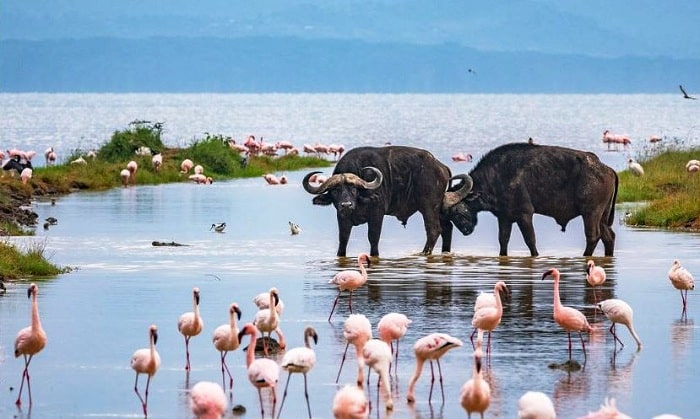
An ideal location for an avian observer. This location features a diverse array of avian species, including the largest bird, the ostrich, and flamingos, among others.
Hiking and cycling.
This location is ideal for individuals who appreciate fitness, long walks, or cycling while engaging with wildlife.
Massage and spa servicesThe Lake Bogoria Hotel and Spa provides massage and spa services following a demanding day of activity.
Camping
One may choose to immerse oneself in nature by spending one’s trip in a tent.
A visit to Lake Bogoria National Reserve guarantees:
Flamingos:
Visitors can appreciate a close-up view of flamingos and other avian species cohabiting with them, such as the grey crowned crane, black-headed herons, ostriches, hadadas, and sacred ibises.
Thermal springs. It boasts over 100 remarkable hot springs, reaching temperatures of up to 94 degrees. Locals frequent these springs for spiritual reasons, while tourists and others attend to appreciate their distinctiveness; some even utilize the springs to boil eggs.
Geysers and fumaroles. Some species include antelopes, impalas, gazelles, zebras, and baboons.
This is among the premier tourist spots in the region. Lake Bogoria, a highly recommended destination by Kenya Wildlife Safaris, Kenya Camping Safaris, Kenya Hiking Safaris, and Kenya Nature Walks, can be visited year-round; however, many prefer to travel during the dry season.
The wet season does not significantly impact your visit to the lake, as the roads and access routes are modernly constructed and remain navigable even during inclement weather.