 info@gorillatrekkinginafrica.com
 +256 787505601
Kopjes in serengeti National Park
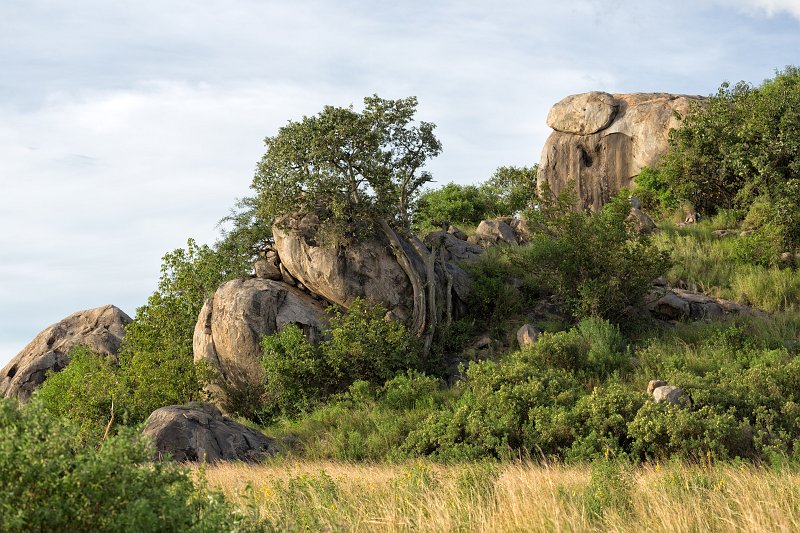
Kopjes in serengeti National Park, the expansive grasslands of the Serengeti are intermittently interrupted by isolated and extensively eroded granite formations known as kopjes. Kopjes, often referred to as inselbergs or “island hills,” were formed millions of years ago when volcanic bubbles emerged and consolidated at the surface, followed by erosion from storms and floods that sculpted their distinctive and aesthetically pleasing shapes observed today. Rainwater runoff from the kopjes and permanent water puddles trapped in rocky crevices enhances wildlife visibility during the dry season, as lions often lie in ambush for other animals approaching to feed or drink; therefore, exercise caution when traversing kopjes.
Lions
Lions, nearly indistinguishable from the grass during the dry season, are more readily observable at some rocky kopjes, granite inselbergs dispersed throughout the terrain. The Moru Kopjes are favored by many felines, including lions, leopards, servals, and caracals, and elephants may also be present in the vicinity. The kopjes have a rare and clearly marked Maasai rock-art site. The lions, after which they are called, frequently utilize Simba Kopjes for sunbathing. The Gol Kopjes are favored by cheetahs, whilst the Maasai Kopjes draw lions and notably huge cobras.
Moru Kopjes
Humans have historically been drawn to kopjes, including hunter-gatherers like the Dorobo, who were displaced in 1955, and seasonal nomads such as Maasai cattle herders. In 1959, the Maasai were displaced, leaving a tangible imprint in a rock shelter located on one of the Moru Kopjes, 32 kilometers south of Seronera. A natural rock shelter is adorned with rock paintings (in red, white, and black) depicting Maasai shields that resemble the ceremonial shields still utilized today. The paintings, among drawings of elephants and indistinct animal and human figures, were created by young Maasai warriors (morani) who utilized the place for an orpul meat-feasting, as evidenced by the soot on the shelter’s ceiling. In accordance with Maasai tradition, junior warriors were forbidden from consuming meat, particularly in public; so, they would pilfer a cow and transport it to this location. Like all rock art, the paintings are ephemeral.
Black Rhino
The Moru Kopje serves as a habitat for the black rhino. Black rhinos are exclusively observed at Moru Kopje within the Serengeti park. They inhabit that area and are primarily observed continuously traversing a location adjacent to the riverbeds. They predominantly prefer sickle bushes. Observing the black rhino is quite spectacular. It is estimated that there are 2,000 rhinos in the Moru Kopje area of Serengeti National Park.
The rock gongs
The lithophonic instruments Another enigmatic kopje, located 1 km away, features rock gongs, comprising an assemblage of three loose stones. A certain huge lemon-shaped wedge features several circular indentations, formed by individuals repeatedly striking the rock with stones to generate peculiar reverberative and metallic noises, which vary based on the striking location. While rock gongs are currently utilized solely by tourists, the wedge-shaped variant was undoubtedly employed as a musical instrument long before the Maasai’s arrival a few centuries ago (as they possess no musical tradition involving percussion instruments), and analogous gong rocks have been discovered as far south as Zimbabwe. Nevertheless, the precise age and purpose of the gongs remain enigmatic due to the little knowledge regarding the now-extinct hunter-gatherers who presumably crafted and utilized them. Notably, time spent exploring the boulders may yield an unexpected finding — in 1992, a previously unidentified species of tree frog was discovered in one of the depressions of the rock formation.
Candelabra trees
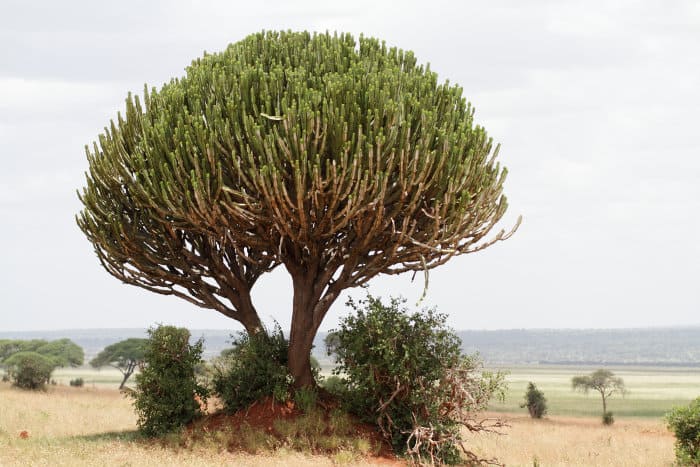
This is a thorny tree indigenous to Africa. The African Candelabra trees are alternatively referred to as desert cacti. This plant favors a dry climate like to that of cacti and other drought-resistant flora, along with ample sunlight. It is exquisite. Moru Kopje possesses well-drained soil that facilitates the growth of Candelabra trees. This plant can be cultivated both in its native environment and indoors. It possesses distinctive characteristics.
The candelabra tree derives its name from its distinctive morphology. This tall specimen produces flat, spherical leaves throughout the length of its bent stems. These winged leaves develop on all four sides of the branches. The branches began to be located at a height above 3 feet (1 meter). The branches extend outward and upward from a central trunk, creating a resemblance to a candelabra or menorah. The juvenile candelabra tree exhibits a rather straight form, producing branches as it matures.
The African Candelabra trees of Moru Kopje attain a height of approximately 30 feet (9 meters), with older examples typically exceeding this size. Captive candelabra trees tend to be diminutive. These low-maintenance plants have somewhat modest growth. Pruning them is ill-advised due to the presence of a toxic milky latex that may irritate the skin or induce disease if ingested. When pruning or relocating candelabra trees, don gloves and minimize contact with the branches.
Applications: Notwithstanding this tree’s toxic sap, fleshy leaves, and thorns, it is frequently utilized as a supply of timber in certain African communities and other regions of its indigenous habitat. Harvesters ignited a fire surrounding the tree to prepare the sap prior to felling it. The wood from the primary trunk is aesthetically pleasing and lightweight, suitable for constructing boats, doors, and timber. Avifauna and primates consume the fruits and seeds, although cane rats and porcupines occasionally ingest the roots. Indigenous societies utilize this tree as a purgative, for wart removal, and in cancer therapy, while investigating the Moru Kopje.
The great migration
This is a migration of wildebeests accompanied by their calves and zebras. The wildebeest migration in Moru Kopje commences in the early months of the year. It is the preeminent natural marvel in Serengeti National Park. As a safari tourist, you will have the opportunity to observe wildlife movement from the proximity of safari vehicles.
The wildebeest experience a calving season at Moru Kopje in late January and early February, during which about 8,000 calves are born daily. Following the conclusion of the calving season, the wildebeest begin their migration towards the western Serengeti. The movement commences during the protracted rainy season from April to May.