 info@gorillatrekkinginafrica.com
 +256 787505601
How Fast Can Ostriches Run?
How Fast Can Ostriches Run, Ostriches are among the most remarkable and distinctive bird species globally, notable for their substantial size, remarkable running speed, and peculiar mannerisms. What is the maximum speed at which ostriches can run?
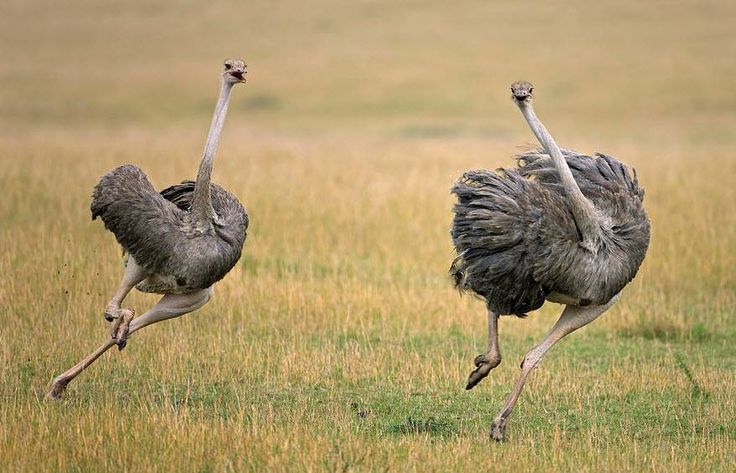
National Geographic states that an ostrich can reach an astonishing running speed of approximately 43 mph or 70 km/h, despite its inability to fly. These birds can run at remarkable rates of approximately 30 to 32 miles per hour, irrespective of the ostrich species. The ostrich is the largest bird globally, both in size and weight. The average ostrich measures approximately 8.5 feet (2.5 meters) in height and weighs between 200 and 220 pounds (90 to 100 kg).
Why Do Ostriches Run So Fast?
1. Exceptionally Strong Legs
To assert that ostriches possess robust legs is an understatement. A research published in the Journal of Zoology regarding the biomechanics of locomotion in common ostriches demonstrates the strength of their legs.
According to the researchers’ findings, ostriches possess an average stress strength of approximately 240 kilonewtons per square meter and tendon stress of up to 40 meganewtons per square meter.
Given their remarkable strength, a single kick from an ostrich can lethally incapacitate predators, making it unsurprising that they can cover vast distances with one stride.
2. Ideal Center of Gravity
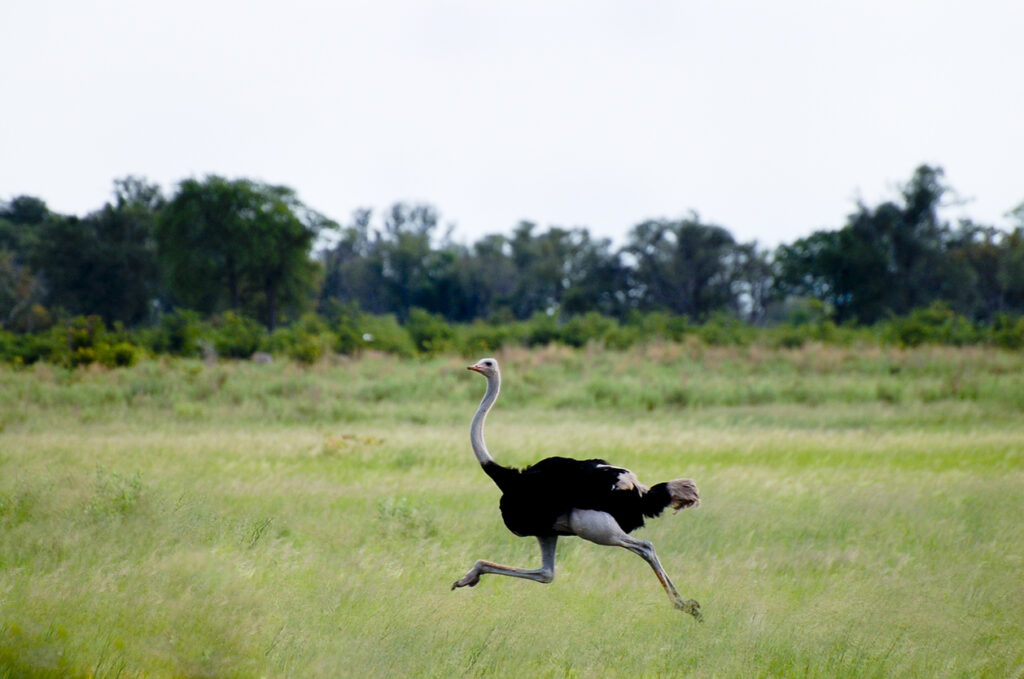
The physique of an ostrich may initially appear disadvantageous for sprinting until one observes it in motion. The optimal center of gravity is derived from the ostrich’s elongated neck, which extends forward during locomotion to sustain the center of gravity between the bird’s legs.
This architecture enables the ostrich to allocate nearly all its energy to forward locomotion instead of maintaining its center of gravity in an optimal position. Their energy expenditure efficiency enables them to operate at the maximum speeds achievable by their leg muscles.
3. Extremely Elastic Tendons
Tendons are fibrous connective fibers that connect muscles to bones. Muscle contraction exerts tension on tendons, resulting in the movement of bones and, consequently, limbs.
Ostriches possess extraordinarily elastic tendons. This enables them to retract at a much accelerated rate compared to their muscle’s capacity for contraction. Consequently, the ostrich can leap significantly farther than average, enhancing its speed, positioning, and force management.
4. Balancing Wings
Have you ever contemplated the reason most high-performance supercars are equipped with rear spoilers? These attachments are engineered to maintain vehicle stability at high velocities, analogous to the function of an ostrich’s wings during running.
Ostriches stretch their wings while sprinting to maintain balance, enhance aerodynamics, and diminish air resistance. This enables them to attain remarkably high velocities when running.
5. Developed in Relation to Some of the Swiftest Predators
Ultimately, the ostrich, a flightless avian species inhabiting the expansive plains of Africa, coexists with some of the swiftest predators on Earth. Consequently, ostriches have been refining their running techniques, as it is their primary means of survival.
Do Various Ostrich Species Exhibit Identical Speeds?
Ostriches exhibit significant differences among species and variants. There are four primary subtypes of ostriches globally, all of which developed from the common African ostrich (Struthio camelus) on the African continent.
The sole non-African species of ostrich, the Arabian Ostrich, is now extinct. The species encompassed are:
- The North African Ostrich
- The South African Ostrich
- The Somali Ostrich
- The Maasai Ostrich
Despite the existence of four distinct species and subtypes of ostriches, the differences among them are not readily discernible to the untrained observer. Moreover, regarding running rate and the ability to maintain high-speed runs over extended durations, all three species achieve a comparable maximum velocity of approximately 43 mph or 70 km/h.
Can Ostriches Fly?
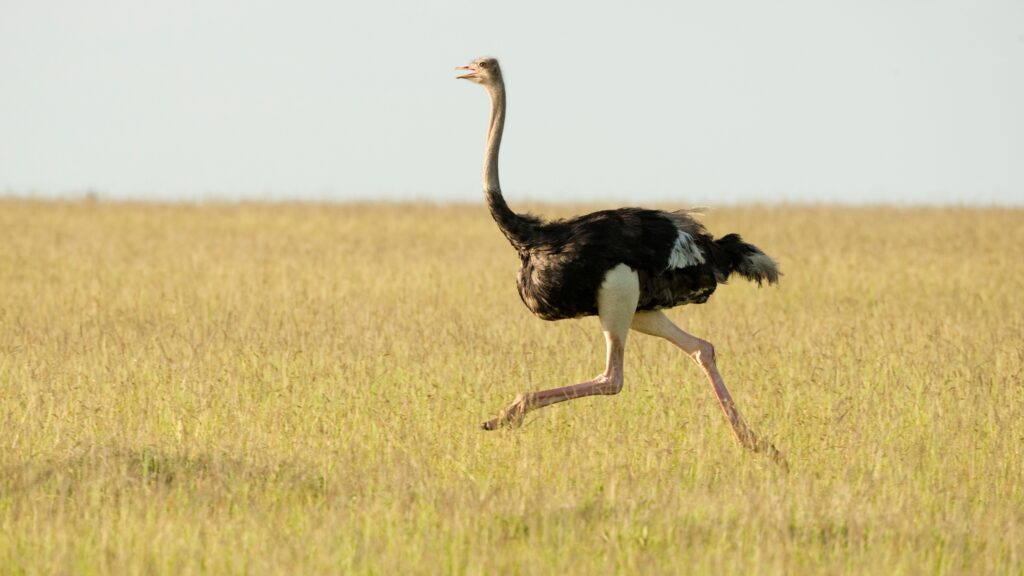
Although exceptionally swift, ostriches are incapable of flight, categorizing them as “flightless birds.” These avians are bipedal, sizable species located in many regions globally. This encompasses cassowaries and rheas (nandus) in Asia, together with the emu in Australia.
The primary reason ostriches are incapable of flight is their weight. In other words, an ostrich’s wings possess the capability for flight; nevertheless, ostriches are excessively hefty to achieve sustained levitation.
Nevertheless, the first ostriches that existed during the dinosaur age were far lighter than contemporary ostriches, enabling them to fly. Following the extinction of the dinosaurs, ostriches evolved to traversing expansive savannahs, resulting in increased weight over hundreds of thousands of years, rendering their wings insufficient for flight.
Are Ostriches the Fastest Living Bird?
The response to this inquiry fluctuates based on the comparative subject regarding the ostrich. For instance, when comparing the ostrich to all other avian species, the succinct response is negative.
This is due to the fact that numerous avian species capable of flight can attain greater velocities than ostriches and maintain such speeds for extended durations.
Species such as the golden eagle, peregrine falcon, white-throated needletail, common rock pigeon, and Anna’s hummingbird are all recognized for their superior speed compared to the common ostrich.
Undoubtedly, juxtaposing a flying bird with a flightless species is somewhat inequitable. When comparing ostriches to other flightless birds and most non-flying animals, the ostrich consistently outpaces them.
The cheetah is recognized as the fastest terrestrial animal, with a maximum velocity of approximately 68 to 75 mph (109.4 to 120.7 km/h). Ostriches are the second fastest terrestrial animals, reaching speeds of 60 to 70 mph. It is also considerably swifter than emus (50 mph or 80 km/h) and rheas (40 mph or 64.3 km/h).
What Should You Do If an Ostrich is Chasing You?
The normal human’s maximum speed ranges from approximately 5 to 7 mph (8 to 11.2 km/h). Usain Bolt, the human with the fastest recorded speed in history, achieved a maximum velocity of 23.4 mph (37.6 km/h), which is significantly less than half the maximum speed of an ostrich.
In summary, attempting to outrun an ostrich is futile, and it is advisable to avoid approaching or getting too close to one unless you are an experienced handler.
In the event that an ostrich is in proximity, the most prudent course of action is to retreat cautiously to avoid startling the bird. When pursued by an ostrich, the optimal course of action is to lie prone on the ground, shielding your head to evade its lethal kicks. Fortunately, although ostriches exhibit considerable aggression and should be seen from a safe distance, they do not display this behavior unless provoked or approached too closely.
Concluding Reflections
This page provides a comprehensive overview of ostrich speed and their ability to maintain prolonged high-velocity runs.
Their muscular leg muscles and tendons, together with well-balanced wings, let them can endure a maximum load of approximately 240 kilonewtons per square meter, resulting in an extensive stride. These remarkable traits render them among the swiftest birds globally, despite their status as the largest and heaviest, therefore precluding flight.