 info@gorillatrekkinginafrica.com
 +256 787505601
Guide to Central & Southern Serengeti
Central & Southern Serengeti, the Seronera River Valley, located at the park’s center, constitutes one of the most abundant wildlife habitats in the region, serving as a crucial water source and delineating the transition between the grassy plains and the northern wooded hills, thereby attracting fauna and avifauna from both ecosystems. Seronera, the location of the park headquarters, its oldest lodge, a visitor center, and multiple public campsites, is the most frequented area of the park regarding tourist traffic, hence it is often eschewed by more exclusive safaris.

Seronera serves as the hub for Serengeti Balloon Safaris, offering a uniquely enchanting experience of gliding over the expansive landscape at dawn, occasionally low enough to brush the treetops, and at other times, ascending to appreciate the immense grandeur of this huge wilderness. Notwithstanding the substantial visitor influx, Seronera provides consistent, exceptional game watching year-round. The woodland is inhabited by olive baboons, vervet monkeys, buffalo, giraffes, elands, bushbucks, and dik-diks, in addition to the usual plains grazers. Waterbucks and reedbucks congregate along the riverbanks, and several species of the park’s over 500 avian inhabitants are present in the vicinity.
Approximately 15 kilometers (9 miles) north of the park headquarters, the Retima Hippo Pool, located at the confluence of the Seronera and Grumeti rivers, typically accommodates several dozen hippos basking in close proximity. Seronera is the premier location in Tanzania for observing leopards, which often repose in the shade of the sausage trees and acacias along the river, disclosing their presence only through sporadic tail movements. The region hosts numerous lethargic lion prides that have increasingly adopted arboreal habits in recent years; in fact, sightings of lions engaging in such activity are now more common at Seronera than at Lake Manyara, which was previously renowned for this distinctive trait.
Seronera Visitor Center
The Seronera Visitor Centre, expertly designed, is an excellent destination following an early-morning wildlife drive. It is a genuine delight to integrate permanent exhibits, displays, and wildlife film screenings during lunchtime, accompanied by a hilarious informational walk around a neighboring kopje. Additionally, there exists a shop offering beverages and snacks, as well as a picnic area where semi-tame rock hyraxes and avian species, such as hoopoes and charming Fischer’s lovebirds, observe your meal. The center’s gift store ought to provide a brochure with information from the trail, along with a leaflet featuring a map and comprehensive explanations of the many game drives in Seronera. The personnel can typically provide information on recent predator sightings and road conditions, and some park wardens are stationed here to address more specific inquiries.
A journey along this circuit is optimally paired with the Songore River Circuit (junctions 30–34), which meanders into the plains south of the Seronera River. Thomson’s and Grant’s gazelles, topis, hartebeests, and ostriches are commonly observed, as are cheetahs during the arid season. Finally, the Wandamu River Circuit (junctions 40–49) encompasses ecosystems akin to those of the Seronera River Circuit and closely follows the banks of the Wandamu River, which is particularly favored by buffaloes.
The Central Plains
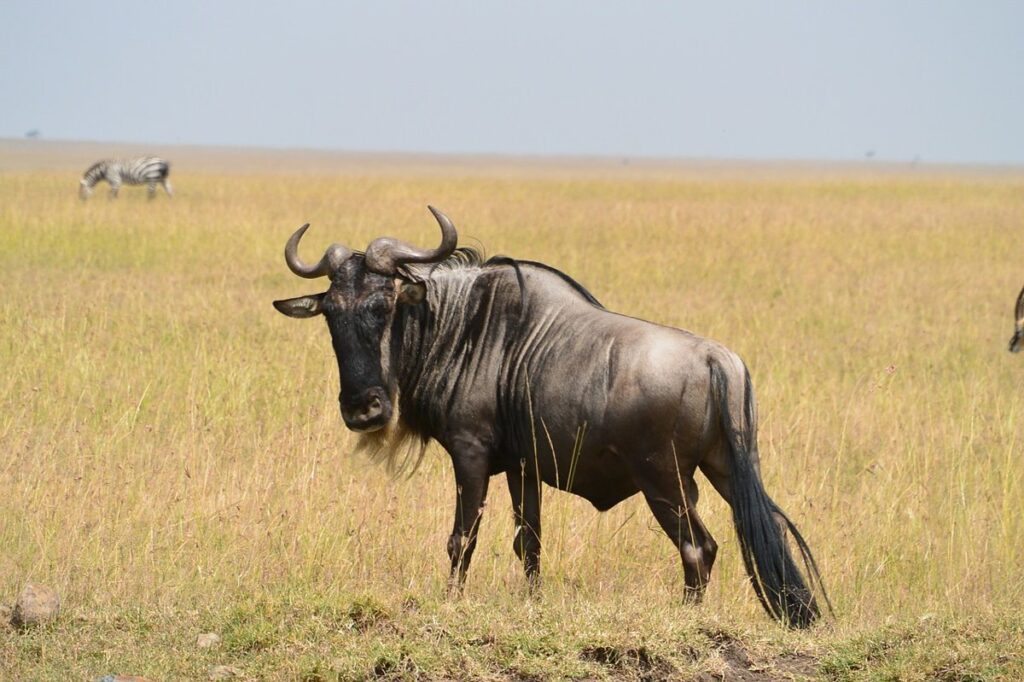
The undulating, semi-arid Serengeti Plains constitute the foundation of the Serengeti ecosystem. To obtain a panoramic perspective, ascend the kopje situated behind Naabi Hill Gate; this vantage point and picnic area is optimal for witnessing the migration from January to April, particularly in February and March when vast numbers of wildebeest, zebra, and gazelle graze across the grasslands beneath. The prevalence of wildlife in the plains seems attributable to the alkaline composition of the soil, enriched by volcanic ash deposited during the eruptions of Ngorongoro’s Crater Highlands, and further enhanced by the annual cycle of precipitation and evaporation that draws minerals to the surface. Calcium, potassium carbonate, and sodium carbonate are the primary components that recent research indicate are vital for the diets of many animals, particularly during lactation, which elucidates why eighty percent of the Serengeti’s wildebeest give birth on these plains.
Despite the migration departing the region and the Central Plains transforming into a parched expanse of straw, a substantial population of resident animals persists, including lion prides, notably huge clans of hyenas (up to eighty individuals), as well as hartebeest, topi, warthog, and ostrich. Avian diversity peaks during the rainy season; nevertheless, secretary birds and kori bustards can be observed year-round. The black-throated honey guide is another avian species notable for its unique symbiotic association with the ratel (honey badger). The honeyguide, as indicated by its name, directs the ratel to wild beehives in trees, which the ratel – apparently impervious to stings – dismantles and opens. The ratel consumes honey, whereas the honey guide indulges in beeswax.
Frequently Asked questions about Serengeti National Park
In which country is the Serengeti located?
Serengeti National Park is located in the northern part of Tanzania, a nation in the Great Lakes region of East Africa, within the Great Rift Valley.
Serengeti National Park is a component of the extensive Serengeti Ecosystem, which extends from the shores of Lake Eyasi in the south, incorporating the Maswa Game Reserve, the Ngorongoro Conservation Area, and various other national parks, reaching northward to encompass the Maasai Mara National Park in Kenya.
Encompassing an expansive 11,583 square miles (30,000 km²) of unfenced and unspoiled nature, Serengeti National Park is undoubtedly the most renowned wildlife reserve on Earth.
How Big is the Serengeti National Park?
Serengeti National Park encompasses an area of 5,700 square miles (14,763 km²), with its northern boundary delineated by the Kenyan border, beyond which lies the Maasai Mara habitat.
Despite being less than one-third the area of the Nyerere Game Reserve, the largest national reserve in Tanzania and Africa, it remains approximately ten times larger than the Maasai Mara National Park in neighboring Kenya and is the second largest park in Tanzania.
In comparison to its renowned neighbors in Tanzania, Serengeti National Park is more than three times larger than Tarangire National Park and twice the size of Ngorongoro Conservation Area, despite the Ngorongoro Crater’s diminutive overall area of about 102 square miles (264 km²).
Why Is The Serengeti So Famous?
Serengeti National Park is renowned for hosting the Great Wildebeest Migration, which was previously considered the longest terrestrial mammal migration on the planet. More than two million wildebeest, zebras, and gazelles migrate over the expansive plains in pursuit of seasonal rainfall and new grass.
Although the great wildebeest migration is no longer the greatest terrestrial mammal migration globally (the migration of over six million antelopes in South Sudan surpasses it by threefold), it remains the most spectacular to observe.
The great migration offers no routine, with the daily birth of 8,000 wildebeest during calving season and the dramatic leaps of wildebeests and zebras into the crocodile-infested Mara River as they swim for survival. A multitude of documentaries have been broadcast, highlighting this natural phenomenon and establishing Serengeti as a prominent name.
Moreover, Serengeti is renowned for its vast diversity of species, documented as early as the late 19th century by pioneering European hunters, explorers, and missionaries. It possesses an exceptionally high density of large felines, including lions, leopards, and cheetahs. It is one of the rare locations on Earth where you have a significant likelihood of observing all three.
History of the Serengeti National Park
The Serengeti National Park possesses a lengthy and intricate history, having endured various arduous phases.
How Was Serengeti Formed?
The current geography of the Serengeti was mostly shaped millions of years ago by intense volcanic activity. Millennia of winds, precipitation, and the erosive forces of nature have further shaped the landscape, resulting in extensive, level meadows and undulating hills, enormous plains and gentle valleys, dense forests and riparian woodlands, as well as towering mountains and steep volcanic craters, each habitat possessing its distinct climate.
Consistent precipitation has facilitated the unimpeded flow of several rivers, which traverse this diverse terrain before emptying into the renowned large lakes of East Africa, simultaneously sustaining the surrounding vegetation and the myriad species inhabiting this region.
This biologically diversified topography has enabled a wide array of wildlife to flourish, with each species adapting over millennia to the requirements of this dynamic ecosystem.