 info@gorillatrekkinginafrica.com
 +256 787505601
Busoga Kingdom
Busoga Kingdom is one of the numerous kingdoms located in the eastern region of Uganda. The Busoga region is delineated to the north by the marshy Lake Kyoga, to the west by the Victoria Nile, to the south by Lake Victoria, and to the east by the Mpologoma River. Additionally, Busoga include several islands in Lake Victoria, including Buvuma Island.Busoga, literally meaning Land of the Soga, is the kingdom of the 11 principalities of the Basoga/Soga (singular Musoga) people. The term Busoga also broadly denotes the region traditionally inhabited by the Basoga. The Busoga Kingdom comprises seven politically organized districts: Kamuli, Iganga, Bugiri, Mayuge, Jinja, and the recently established districts of Kaliro and Busiki. The Busoga Kingdom, as a cultural institution, was established to foster popular engagement and solidarity among the Busoga populace through cultural and developmental initiatives aimed at enhancing their livelihoods. It aimed to foster a unified populace of Busoga, characterized by economic, social, and cultural prosperity. It further improves restoration and establishes an effective institutional and management framework for the Bugosa kingship. Similar to the Buganda kingdom, the Busoga kingdom is governed by a king (Kyanazinga), now His Royal Highness William Wilberforce Kadhumbula Gabula Nadiope IV.


Written history for Busoga commences in the year 1862. On 28 July 1862, John Hanning Speke, an explorer for the Royal Society, reached Ripon Falls, adjacent to the contemporary town of Jinja, where the Victoria Nile emerges from Lake Victoria and commences its journey towards Egypt. As Speke’s path interior from the East African coast circumnavigated the southern extremity of Lake Victoria, he entered Busoga from the west via Buganda. Upon achieving his objective – the source of the Nile, he proceeded northward, tracing the river downstream without further investigating Busoga. He notes, however, that he was informed that “Usoga” (the Swahili variant of “Busoga”) was a “island,” suggesting that the term had a similar meaning to neighboring populations as it does presently. The contemporary Busoga Kingdom is delineated to the north by the marshy Lake Kyoga, to the west by the Victoria Nile, to the south by Lake Victoria, and to the east by the Mpologoma River.
History of the Busoga Kingdom
During the 19th century, a primary route utilized by Europeans traveling from the coast to Buganda traversed the southern region of Busoga. John Speke, James Grant, Sir Gerald Portal, F.D. Lugard, J.R. Macdonald, and Bishop Tucket all observed that Busoga was abundantly provisioned with food and was thickly populated as a consequence. Between 1898–99 and 1900–01, the initial signs of sleeping sickness were documented.
In 1906, directives were promulgated to vacate the area. Notwithstanding the efforts to eradicate the region, the pandemic persisted vigorously until 1910. Consequently, the majority of the densely inhabited regions of Busoga, which housed over 200,000 individuals in the 19th century, experienced complete depopulation within a decade. The Lubas Palace in Bukaleba, along with the esteemed European fruit mission, has collapsed and been transported to other areas of Busoga. Southern Busoga included approximately one-third of the land area of Busoga, and in 1910, it was unoccupied. During the 1920s and 1930s, certain evacuees who survived the plague commenced their return to their own nation. In 1940, a resurgence of sleeping sickness occurred in the region, and it was not until 1956 that government-facilitated resettlement recommenced, but circumstances had irrevocably changed. A limited number of Basoga returned to their ancestral territories.
The Kyabazinga (King)
The Busoga kingdom is governed by the Isebantu Kyabazinga, known as William Kadhumbula Gabula Nadiope IV. Isebantu signifies the father of all people and serves as a symbol of unification. It was bestowed as an expression of acknowledgment by the Basoga people, embodying the notion that Isebantu unites all individuals in love and harmony. The Isebantu Kyabazinga serves as the cultural leader of the Busoga kingdom and, according to tradition, is to be chosen, however the position rotates among chiefs during the periodic election of the Lukiiko.
The kazinga was formerly elected from the five hereditary chiefs thought to descend from the Bunyoro Kitara kingdom. There has been a modification to the Busoga constitution, allowing all 11 hereditary chiefs the opportunity to contest for the Kyabazinga kingship position. The leadership term is now limited, as it is an elected position for life, whereas the initial appointment was for five years.
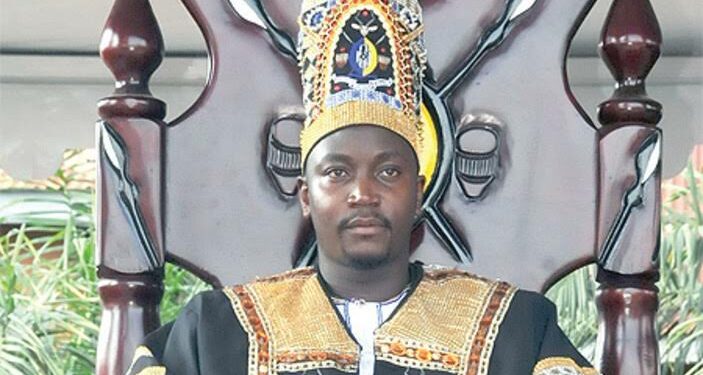
Since 1939, the Busoga Kingdom has undergone the Kyabazinga Regimes, featuring five traditionally elected leaders: Ezekiel Tenywa Wako from 1939 to 1949, William Wilberforce Nadiope II from 1949 to 1955, Henry Wako Muloki from 1955 to 1967, a period of Interregnum from 1967 to 1995 during which the government restored monarchies in Uganda, Henry Wako Muloki again from 1995 to 2008, and currently, Henry Wilberforce Gabula Nadiope IV since 2014.
Agriculture has been the predominant economic activity in the Busoga kingdom, playing a crucial role in the building of the Busoga capital. From 1920 to 1970, cash crops such as cotton were extensively cultivated in the Busoga region, contributing significantly to the establishment of the Busoga capital as an agri-industrial center alongside various companies. The Busoga kingdom gained economic significance when the railway line facilitated the capital’s economic development, concurrently promoting the establishment of additional infrastructure and generating numerous casual employment opportunities for individuals from various regions who sought work in factories and domestic settings.
There was enhancement of amenities including electricity, piped water, hospitals, roads, and schools, among others. The farmers in the Busoga region cultivating both cash and food crops were guaranteed a market for their produce. The cultivated crops include coffee, cotton, potatoes, cassava, bananas, vegetables, and other fruits.
The standards of living of the populace improved, there was a swift growth in the revenue of the Busoga kingdom, and there was significant economic production alongside the ability for individuals to cultivate crops for subsistence consumption. By the time Uganda attained independence in 1962, the Busoga kingdom was firmly established, with Jinja city, the capital of Busoga, housing approximately 70% of Uganda’s industries, including the Nalubale Power Station, renowned for supplying electricity to both Uganda and Kenya. Additionally, Uganda was home to a substantial Asian population, pivotal in the establishment of the largest commercial centers in East Africa.
The political status of the Busoga Kingdom
At the turn of the 16th century, a significant event occurred that shaped the unique cultural identity of the Basoga: the arrival of the Baisengobi clan, who trace their historical lineage to Bunyoro. Prince Mukama Namutukula of the Babiito royal family of Bunyoro reportedly departed Bunyoro in the 16th century as part of its expansionist strategy. He journeyed eastward across Lake Kyoga with his wife Nawudo, a small contingent of servants, weaponry, and a dog, ultimately arriving at Iyingo, situated at the northern extremity of Busoga in present-day Kamuli District.Prince Mukama was passionate about hunting, and his exploits revealed the splendors of the newly discovered territory. He devoted a period to blacksmithing, crafting hoes, iron implements, and spears. Prince Mukama and his wife Nawudo had multiple children, of whom only five sons survived. Upon his return to Bunyoro, Prince Mukama designated those regions under his authority as overseers. The five sons of Prince Mukama considered themselves the rightful kings of their various territories according to their familial lineage (Babiito). They maintained authority over their various territories, utilizing governance techniques and cultural practices reminiscent of Bunyoro-Kitara. The political and cultural situation in Busoga persisted until the late 19th century, when colonial powers convinced the rulers of Busoga to enter into a type of federation. This federation culminated in the establishment of a regional Busoga council known as Busoga Lukiiko.
Prior to 1906, despite frequently being referred to as a ‘Kingdom’, the classification of Busoga as such was contentious. In contrast to its western neighbor, Buganda, Busoga lacked a central ‘all-powerful’ figurehead (King or Queen) until 1906, at the request of the British colonial authorities. Previously, the Busoga were structured into semi-autonomous chiefdoms, initially influenced by Bunyoro and subsequently by Buganda.

Prior to the arrival of the British in Uganda, Busoga lacked cohesive leadership. Upon Uganda’s designation as a British protectorate, efforts were initiated to establish a centralized administration modeled after Buganda, which was a complete kingdom. The Buganda King, known as the Kabaka, possessed a dynasty that extends back for generations. In Busoga, several chiefs were directly selected by the Kabaka, and it is believed that some were descendants of esteemed Baganda leaders granted jurisdiction over land in Busoga. Others were affiliated with influential landowning families in Busoga that had assumed self-designated authority over extensive territories. The British incorporated all these chiefs into an administrative framework known as the Lukiiko. The British designated Semei Kakungulu, a Muganda from Buganda, as the President of the Lukiiko, making him the inaugural leader of Busoga; but, they declined to confer upon him the title of ‘King,’ as they did not consider him a legitimate monarch.
Nevertheless, disputes among many chiefs and clans persisted, and the majority of Basoga remained to maintain allegiance to their chief, clan, or dialect. It was additionally unhelpful that the ‘King’ hailed from Buganda. The edifice, however, provided the Basoga with a glimpse of the influence they could wield in the protectorate if they possessed a King. It would elevate them to the status of Bunyoro and Buganda.
Simultaneously, the white colonial authorities were preparing Chief Yosia Nadiope, the Gabula of Bugabula, to assume the role of the inaugural permanent resident monarch of the established Busoga federation. Nadiope was among the inaugural Basoga pupils to attend Kings College Budo in 1906. In 1913, tragedy befell Busoga with the death of Nadiope from malaria. In 1914, Chief Ezekeriel Tenywa Wako, the Zibondo of Bulamogi, was finalizing his studies at Kings College Budo. Supported by the British and possessing a princely pedigree, Zibondo of Bulamogi, together with his strong educational qualifications, was an appropriate contender for the highest position. In 1919, the hereditary saza chiefs of Busoga convened in the Lukiiko and decided to elect Ezekerial Tenywa Wako as the president of Busoga. Chief Gideon Obodha of Kigulu, a competing contender for the position, was unfamiliar with the British system, and William Wilberforce Nadiope Kadhumbula of Bugabula was but a child. His regent, Mwami Mutekanga, was a ‘mukoopi’ (a commoner) ineligible to contest for the position. In 1918-1919, the title of Isebantu Kyabazinga was established, and Chief Wako ascended to the throne. He received a salary of 550 pounds and was authorized to collect taxes in Butembe County as compensation for the forfeited position in his ancient chiefdom of Bulamogi. In 1925, Ezekiel Tenywa Wako, the Kyabazinga of Busoga, joined the Uganda Kings Council, which comprised the Kyabazinga of Busoga, the Kabaka of Buganda, the Omukama of Bunyoro, the Omukama of Toro/Tooro, and the Omugabe of Ankole.
On 11 February 1939, Owekitibwa Ezekerial Tenywa Wako, the late father of the last Isebantu Kyabazinga wa Busoga, HRH Henry Wako Muloki, was inaugurated as the inaugural Isebantu Kyabazinga wa Busoga, a title he maintained until his retirement in 1949 owing to advanced age. Upon Owekitibwa E.T. Wako’s retirement as the Isebantu Kyabazinga wa Busoga, the Busoga Lukiiko has broadened to encompass individuals beyond the Hereditary Rulers. The members of the Busoga Lukiiko were elected representatives, with two from each of the 55 Sub-counties in Busoga at the time.
Upon the retirement of Owekitibwa E.T. Wako, a replacement became imperative. The Busoga Lukiiko determined that the Isebantu Kyabazinga wa Busoga shall consistently be elected from among the five lineages of Baise Ngobi (Ababiito) hereditary kings, historically regarded as the five sons of the Omukama of Bunyoro who migrated to Busoga from Bunyoro.
This electoral method was employed in the subsequent elections of the Isebantu Kyabazinga wa Busoga, commencing in 1949 when Owekitibwa Chief William Wilberforce Nadiope Kadhumbula of Bugabula was elected Isebantu Kyabazinga wa Busoga for two consecutive terms of three years each, succeeded by Owekitibwa Henry Wako Muloki, who also served two terms.
In 1957, the term Inhebantu was coined to denote the spouse of the Isebantu. This exemplified the incremental unity of Busoga and the development of Obwa Kyabazinga bwa Busoga.
The Kyabazinga was deposed when monarchs were abolished in 1966. In 1972, when Idi Amin removed the Asians from Uganda, Jinja saw significant social and economic repercussions. The administration of Yoweri Museveni has sought to incentivize the repatriation of Ugandan Asians. This has provided assistance but has not restored Jinja to its previous splendor. Nonetheless, the Asian influence persists, especially in the architecture and street nomenclature.
Historical tourist attractions and locations
Kagulu Hill
This was the initial settlement region for the Basoga of Bunyoro descent, commanded by Prince Mukama. Kagulu Hill, while still unfamiliar to many beyond Busoga, offers breathtaking beauty that provides a panoramic view of nearly the entire region. Kagulu Hill is distinctive in the attractions it provides. This is the sole hill in Uganda that has been modified for tourist ascents, featuring manmade steps to facilitate visitor access to the summit.
Budhumbula shrine/palace
This structure consists of a shrine and serves as the abode of the late Kyabazinga of Busoga, Sir William Wilberforce Kadhumbula Nadiope, who passed away in 1976. The shrine, adorned with exquisite marble, contains the graves of several royal family members, including his father, Yosia Nadiope, and mother, Nasikombi.
The origin of the Nile and Lake Victoria
The source of the Nile, the world’s second longest river, was identified by the early European explorer John Speke and is a globally distinctive destination. The serenity and magnificence of Lake Victoria and the River Nile evoke profound memories for every visitor.Southern Busoga is bordered by the waters of Lake Victoria. The shoreline extends from Jinja, Uganda, eastward to the borders of Kenya and Tanzania.