 info@gorillatrekkinginafrica.com
 +256 787505601
The Best Time To See Wildebeest Migration in Tanzania or Kenya
Best Time To See Wildebeest Migration, we have received numerous inquiries regarding the best time for witnessing the Wildebeest Migration in Tanzania and Kenya.
The wildebeest migration is a yearly phenomenon within the Serengeti ecosystem, encompassing Tanzania’s Serengeti National Park and Kenya’s Maasai Mara National Reserve. It is considered one of the most extraordinary wildlife phenomena on Earth.
Exceeding one million wildebeest, accompanied by hundreds of thousands of zebras and gazelles, traverse the expansive plains of the Serengeti in pursuit of fresh grazing territory and water sources. The wildebeest migrate in a circular route, traversing from the southern Serengeti to the Maasai Mara and returning, reaching as much as 1,800 miles (2,900 km) annually.
The migration is affected by seasonal and climatic patterns. In the dry season, wildebeest are compelled to migrate to regions with available water and grass. In the rainy season, they relocate to regions with verdant grass.
The wildebeest migration is a significant tourist attraction that attracts individuals globally to observe the remarkable phenomenon. The wildebeest migration is a significant ecological phenomenon since it facilitates nutrition distribution across the ecosystem and sustains a variety of predators, including lions, cheetahs, and hyenas.
The best time for seeing the migration are from December to March and from May to November. Experiencing this phenomenon is undeniably one of the most extraordinary and transformative encounters, which explains its designation as one of the new seven wonders of the world.
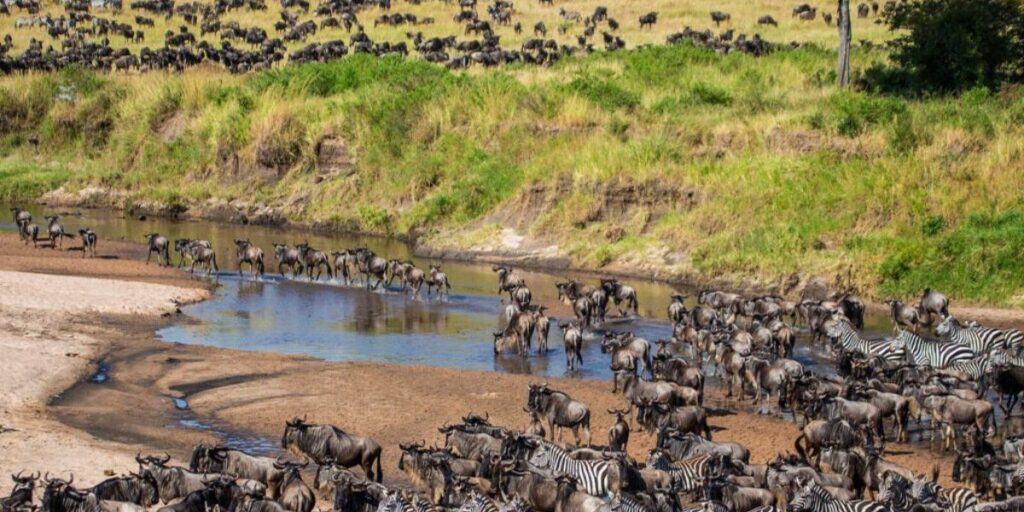
The Wildebeest Migration in Tanzania and Kenya
Annually, during the Great Wildebeest Migration, more than one million wildebeest traverse Northern Tanzania and Kenya in pursuit of fresh grass and water. During this period, they will give birth to calves, navigate crocodile-infested waters, and attempt to outsmart predators such as lions, cheetahs, and leopards lurking nearby.
Certain East African populations of blue wildebeest engage in long-distance migration, apparently synchronized with the annual cycle of precipitation and grass proliferation. The timing of their migrations during both the rainy and dry seasons might fluctuate significantly (by months) from year to year. At the conclusion of the wet season (May or June in East Africa), wildebeest move to arid regions in response to a scarcity of surface water sources. As the rainy season commences anew after several months, animals promptly return to their wet-season habitats. Factors believed to influence migration include
Wildebeest Migration During January, February, and March (The Calving Season)
During this period, numerous herds of wildebeests and zebras inhabit the Ngorongoro Conservation Area and the Southern plains of the Serengeti, where the grass is short and nutrient-rich, making it an ideal location for pregnant wildebeests to remain. The calving season commences at the end of January and extends to mid-March, during which approximately 600,000 calves are born. Their high birth rate facilitates survival against predators compared to those born in smaller numbers and earlier.
From January to March, the wildebeest migration can be observed conveniently from a mobile camp; however, most mobile camps contend with fly infestations. Therefore, clients interested in camping are recommended to choose Lake Masek Tented Camp, while midrange travelers may consider Ndutu Lodge to witness the migration. Individuals seeking luxury accommodations may consider Mwiba Lodge, situated a few kilometers from the Ndutu region, where private transportation is provided by the lodge for migratory observation.
Wildebeest Migration Occurs From April to May
From late March to early May, this period is regarded as the off-season for monitoring wildebeests and other wildlife due to the substantial rainfall in Tanzania during this time. The grass grows exceptionally tall during this period, and the roads become difficult to traverse due to the slippery dirt.
At the beginning of May, the grass is already diminished due to the high population of animals, prompting them to travel in search of more forage. The majority of wildebeests and zebras migrate northward through Seronera and westward along Lake Victoria and the Serengeti’s western corridor, where sufficient water and elongated grass are available at this season.
We typically do not recommend traveling to Kenya in April and May if the Wildebeest migration is on your itinerary.
Wildebeest Migration Occurs From June to July
In early June, the wildebeests commence their westward migration due to insufficient food in their current location. They typically migrate to River Grumeti, encircled by a forest abundant with elephants and buffaloes, while the river harbors numerous hippos and large, famished crocodiles poised to prey on the wildebeests who approach for water.
Various locations are available for accommodation to see the migration. The accommodations include opulent lodges like Sasakwa Hill Lodge, Faru Faru River Lodge, and Sabora Plains Tented Camp; while your stay, you may observe the migration as well as partake in off-road drives, wildlife viewing excursions, and nocturnal drives. Alternative housing options for observing the migration include Kirarwa and Grumeti River Camp; however, night drives and off-road excursions are prohibited in these locations.
In July, the waterholes in the Serengeti plains persist in drying as winter progresses, while over a million wildebeest grazing rapidly deplete the grasses to stubble. The animals must continuously advance northward in seeking sustenance and hydration.
Migration Wildebeest from August to September
The migration proceeds northward from the center Serengeti, diverging into two pathways. The primary group advances into the western corridor, traversing the Grumeti River in magnificent stampedes. Massive crocodiles await opportunistically to capture wildebeest as they traverse the river. The wildebeest persist in their steady migration over the Grumeti region, undertaking another hazardous river crossing to traverse the Mara River and access the verdant pastures in Kenya’s Maasai Mara. The smaller party proceeds directly north from the middle Serengeti into the northern plains and subsequently into the Maasai Mara, circumventing the river crossings.
Wildebeest Migration Occurs From October to November
The influx of wildebeest into the Maasai Mara region is astonishing, as is the diversity of indigenous species, including zebra, giraffe, buffalo, elephant, hyena, lion, eland, and gazelle, among others.
From August until the onset of summer rains in November, the Maasai Mara is verdant and provides the premier wildlife observation opportunities in Africa. Upon the onset of the rains and the wildebeest’s restoration of strength, they commence their migration southward to the verdant and fertile breeding grounds of the Serengeti.
Wildebeest Migration From November to December
The precipitation persists during November, prompting the wildebeests to migrate southward and eastward. By December, they begin their migration back to the Southern Serengeti to access the lush, short grasses. The majority of herds arrive by late December to early January, signifying the conclusion of that cycle.
Certain regions of the Serengeti exhibit rapid growth of thick grass, hence hindering wildlife observation. Travel is not recommended at this time of year, particularly for those interested in game safaris.
Traveling at this season allows you to witness the migration while residing at Namiri Camp, which is advantageous due to the presence of diverse wildlife, including cheetahs and lions. It is important to note that the presence of these predators has resulted in a scarcity of wildebeest herds in this area. Klein’s camp may offer superior vantage points for observing the migration; nevertheless, it is infested with tsetse flies. Following this cycle, the migratory cycle recommences as female wildebeests give birth to numerous calves.
Where is the best place to see the wildebeest migration? Kenya or Tanzania?
Each site excels during distinct periods of the year. The migration typically occurs in Tanzania’s Serengeti National Park for a duration of nine months. It is most active in Kenya’s Maasai Mara National Park for three months, specifically in August, September, and October.
What are the behaviors of wildebeest?
Blue wildebeest exhibit both migratory and stationary populations. In the Ngorongoro, the majority of animals are stationary, with males sustaining a network of territories year-round, although breeding occurs seasonally. Females and juveniles congregate in groups of approximately 10 individuals or amalgamate into larger assemblages, whereas nonterritorial males establish bachelor groups.
In the Serengeti and Tarangire ecosystems, populations are predominantly migratory, with herds comprising both sexes frequently relocating, although resident subpopulations are also present. During the rutting season, males may establish transient territories for several hours or a day, attempting to congregate with a few females for mating; however, they must soon relocate, frequently advancing to establish another temporary territory.
Annually, certain East African populations of blue wildebeest engage in a long-distance migration, apparently synchronized with the seasonal patterns of precipitation and grass proliferation. The timing of their migrations during both the rainy and dry seasons might fluctuate significantly (by months) from year to year. At the conclusion of the wet season (May or June in East Africa), wildebeest move to arid regions in response to a scarcity of surface water sources. As the rainy season commences anew after several months, animals promptly relocate to their wet-season habitats. Factors believed to influence migration encompass food availability, surface water accessibility, predation, and phosphorus levels in grasses.
Where do Wildebeest Live?
The Wildebeest is indigenous to eastern and southern Africa. Its distribution include Kenya, Tanzania, Botswana, Zambia, Zimbabwe, Mozambique, South Africa, Swaziland, and Angola. It is no longer present in Malawi but has been successfully reintroduced in Namibia. Blue wildebeest predominantly inhabit short grass plains adjacent to bush-covered acacia savannah, flourishing in regions that are neither excessively wet nor arid. They inhabit environments ranging from overgrazed regions with dense shrubbery to wide wooded floodplains.
The blue wildebeest is the predominant large game species in East Africa, both in terms of population and biomass. The Serengeti National Park in Tanzania, the Maasai Mara National Reserve in Kenya, and the Liuwa Plain National Park in Zambia are distinguished by a distinctive feature.