 info@gorillatrekkinginafrica.com

How Do Giraffes Sleep
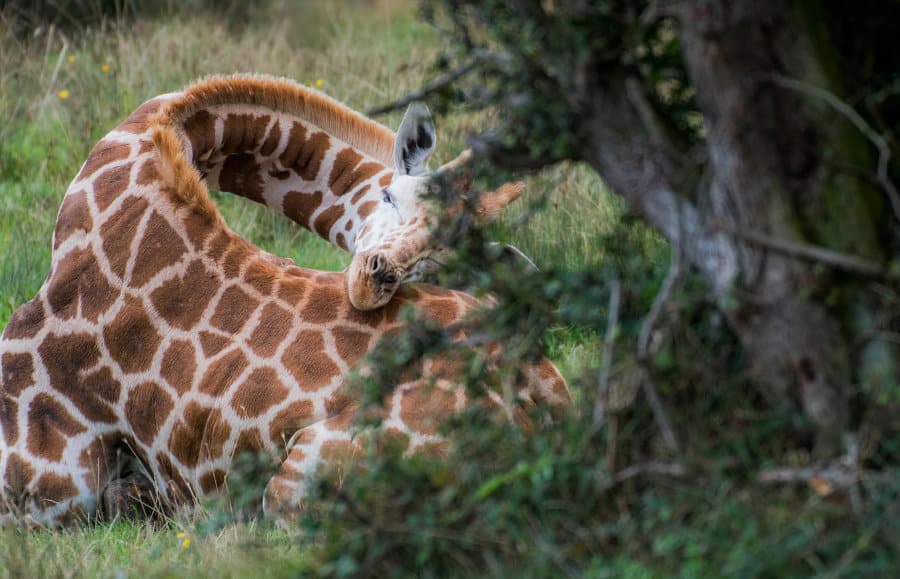
How Do Giraffes Sleep, Envision yourself on a pre-dawn safari. The motor idles softly, dawn remains elusive, and each acacia appears as a silhouette against the sky. There it is: a giraffe, legs folded, neck arched backward, with its head resting on its flank, eyes fluttering beneath elongated lashes.
In a shorter duration than it takes to consume your coffee, the colossal figure rises, surveys the landscape, and departs at a brisk pace. This fleeting drama elucidates how giraffes sleep, and witnessing it firsthand resembles discovering an untold bedtime story.
The 60-Second Snooze – Fundamental Aspects of Giraffe Sleep
An adult giraffe sleeps for merely 30 minutes to two hours within a complete 24-hour period, consisting of little micro-naps shorter than a television commercial. Their circadian rhythm prefers dusk and the deepest part of night, when predators are least active.
In contrast to you, they do not transition from light sleep to deep REM in orderly phases. Their brain enters REM sleep nearly immediately, resets rapidly, and continues this cycle throughout the night. Consider it akin to charging a phone at five-minute intervals between airport terminals—suboptimal, yet it facilitates continued progress.
Standing Tall vs. Curling Small
The majority of naps occur in an upright position. Locking joints function as integrated supports, allowing the body to rest while the legs remain prepared for elevation. Eyelids flicker, tails oscillate, and ears pivot for threats—yet equilibrium remains unshaken.
The sought-after “pretzel pose” occurs when the plains perceive safety. The knees collapse, the torso descends, and the two-meter neck bends like pliable rope until the head rests upon the hindquarters.
Blood pressure decreases, muscles relax, and for three invaluable minutes, the animal is, by mammalian standards, unconscious. The distant cough of a lion breaks the enchantment; the giraffe’s long legs fold, propelling it into the air before you can complete your gasp.
Why So Little Shut-Eye?
Safety dictates the timeline. A supine giraffe, weighing 1,000 kilograms, presents an enticing target for lions, and its struggle to rise is slower than the pounce of any feline. Remaining upright enables the identification of peril promptly and facilitates a swift escape before becoming ensnared.
Nutrition also contributes significantly. Leaves provide limited caloric intake, prompting giraffes to forage for more to 20 hours daily to sustain their towering physique. Increased mastication results in diminished somnolence. Their four-chambered stomach facilitates the upward cycling of food for re-chewing—termed “rumination”—which they can perform even while partially asleep, a multitasking skill that would impress your barista.
Nightlife on Stilts
Even in a state of rest, a giraffe’s senses remain highly attuned: its eyes detect the slightest movement of shadows; its ears monitor distant hyena vocalizations; its skin reacts to the presence of a solitary tsetse fly. One hind leg frequently remains partially raised—prepared to deliver a blow capable of fracturing a lion’s skull.
Researchers employing EEG headsets have discovered micro-bursts of attentiveness occurring every few seconds, as evidenced by investigations on giraffe sleep utilizing night-vision equipment and portable brain scanners. It resembles a home-security system that remains perpetually active while nevertheless allowing the owner to dream—gently.
Baby Giraffes sleep— Dreamers in Training
Calves rest for four to six hours daily, lying on their sides with their legs intertwined and necks elongated like garden hoses. Adults encircle them in a living fence, each assuming the role of sentry in turn.
The additional sleep stimulates rapid growth—you are witnessing the transformation of cartilage into bone in real time. By the time a calf reaches its first birthday, it may attain a height of three meters. Reduced sleep occurs in phases, like to an infant transitioning away from daytime naps, but the implications here pertain to real lions.
ips for Spotting a Sleeping Giraffe
Target civil twilight (pre-sunrise): Their most profound curls congregate shortly prior to daybreak.
Observe the neck: A rapid backward arch indicates the onset of REM sleep. Activate cameras.
Maintain silence and reduce illumination: White flashlights impair night vision; utilize red filters or natural moonlight.
Patience yields rewards. They slumber in intervals of 90 seconds. Did you overlook one? Wait five minutes; another may ensue.
Your guide will maintain distance; nevertheless, use your camera’s burst mode. Five rapid frames can encapsulate the complete collapse-curl-rise sequence, creating a GIF that the office will genuinely view.
Best Giraffe-Spotting Destinations in Africa
Serengeti National Park, Tanzania: Expansive plains provide extensive sight-lines; the shadows of Maasai giraffes at daybreak create picturesque scenes.
Masai Mara National Reserve, Kenya: In addition to the Great Migration, the acacia-laden slopes harbor some of East Africa’s most concentrated giraffe populations.
Kruger National Park, South Africa: Paved circuits allow you to pause near grazing elephants without encountering off-road obstacles.
Etosha National Park, Namibia: Salt-pan vistas transform giraffes into ink-like silhouettes against a glaring white backdrop—breathtaking in the late afternoon illumination.
Chobe National Park, Botswana: Riverfront cruises provide an eye-level view of giraffes as they splay their legs to drink—a rare and amusing spectacle.
Murchison Falls National Park, Uganda: This location is home to the endangered Rothschild’s giraffe, frequently seen against the backdrop of the Nile.
Expert advice: Integrate a minimum of two regions to observe diverse subspecies and behaviors—standing rest among umbrella thorns in the Mara, ground curls along to the Nile in Uganda.
The Implications for Your Safari Photographs
The quick blink curl is more uncommon than a cheetah’s dash; therefore, approach it as one would street photography: anticipate, pre-focus, and capture in bursts.
Increase the ISO to capture action in the dim light of morning, then underexpose by half a stop to preserve the warm glow that transforms giraffe coats into liquid gold. Your memory card fills rapidly, yet you will return home with a sequence that narrates a bedtime tale in six frames.
Conclusion — Prepared to Pursue a Giraffe’s Nocturnal Yawn?
The savanna conceals its secrets, revealing them only through footsteps and moonlight. If you wish to observe a two-story creature contorting itself into a reverie—and spring upright before your heart rate stabilizes—now is the moment. Reserve the seat, secure the duffel, and rendezvous with us beneath the acacias. The giraffes will await you—eyes partially shut, legs poised, instructing you on the art of resting gently and living with stature.