 info@gorillatrekkinginafrica.com

Exclusive Guide to hike Mt Kilimanjaro Through Shira Route
The Shira Route is an alternative track that climbs Mt. Kilimanjaro from the west, located just a few kilometers from the Lemosho Route. The path is utilized by a limited number of hikers ascending Mt. Kilimanjaro, as it is increasingly supplanted by the enhanced Lemosho route. Although it is situated below the Lemosho path, most hikers see them as identical routes since they converge at Shira Camp. The route serves as a rescue pathway, providing convenient and rapid vehicular access, potentially appealing to seasoned climbers who prefer remote locations.
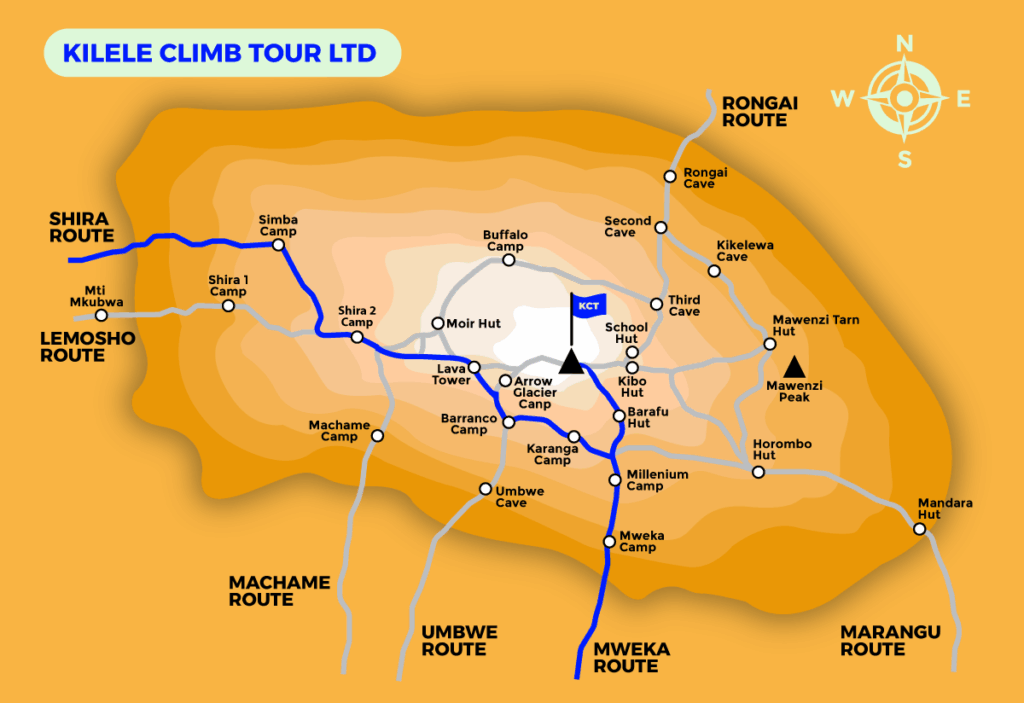
The minor distinction between the two routes is that the Lemosho route commences at Londorossi Gate, traversing the rainforest to Shira One Camp, but the Shira route circumvents the Lemosho route by utilizing a vehicle to take climbers directly to Shira Gate, located few meters from Shira Ridge. The initial ascent of the Shira route commences at an elevation of 11,800 feet, or 3,600 meters above sea level, maintaining this altitude until arrival at Simba Camp, where the first night is spent.
Subsequent to the Simba camp, the path converged with the Lemosho route along the Southern circuit. The climb commences at a significant altitude, necessitating adequate acclimatization the preceding day prior to driving to the gate situated in the secluded heathland, which can occasionally become inaccessible during the wet season due to extensive muddy areas. The hikers encounter their most formidable task on day 7 when they confront a strenuous hike. This is the moment at which most climbers experience altitude sickness.
Shira is characterized by a low success rate, attributed to time constraints and its status as the shortest route, around 56 kilometers to the summit. We allocate additional days to ensure one complete day for acclimatization, hence enhancing the likelihood of reaching the summit. The Shira route traverses many ecological zones, including the Shira plateau, heath, and alpine regions, characterized by unique flora such as towering columns of daisy-flowered gigantic groundsel, flowering bulbs, red-hot pokers, tussocky white everlasting flowers, among others. The distinct vegetation zoning results from altitude changes, as various plants adapt to different elevation levels.
The Shira route converges with other trails at Barranco Camp, where you receive a day for acclimatization while exploring the picturesque vistas of the mountain, lava towers, steep slopes, and notably, the Barranco Wall. You will ascend to the final altitude of 5685 meters above sea level, where you will have a magnificent view of the African sunrise from the pinnacle of the continent.
Shira Route/Itinerary Six Days of Climbing and Two Nights at a Hotel: This path to Kilimanjaro Summit allows you to walk the mountain while appreciating the breathtaking vistas of Tanzania and Kilimanjaro National Park.
Day 1: Moshi (890 m/2,920 ft): On the inaugural day of the
remarkable Shira Route, upon arrival at Kilimanjaro International Airport or Dar es Salaam International Airport, our representatives will greet clients and facilitate their transfer to the hotel or preferred accommodation for the night. You may commence your walk on any day of any month throughout the year.
Day 2: Moshi (890 m/2,920 ft) to Shira Gate (1,830 m/6,000 ft) to Shira Camp 2 (3,840 m/12,600 ft) 18 kilometers, 5 to 7 hours, Montane Forest:
On the day of the Shira route hike, we will awaken at 06:00 am and have breakfast from 06:30 am to 07:30 am. Depart from Moshi and travel for many hours to the Shira Gate on the western flank of Kilimanjaro, where you will register with the Kilimanjaro National Park. Commence your hike and enter the jungle, as you will be at high altitude; it is essential to arrive at the Camp early to acclimatize to the climatic conditions along the Shira Route. Your traverse through the rainforest occurs along a serpentine, muddy path ascending a ridge. At these lower altitudes, conditions may be damp and muddy; therefore, gaiters and trekking poles will be beneficial. Pause for lunch midway and arrive at the Shira Route Camp in the afternoon. Unpack, relax, and have tea or coffee. You will dine and spend the night in Shira Camp 2.
Day 3: Shira Camp 2 (3,840 m/12,600 ft) to Lava Tower (4,630 m/15,190 ft) to Barranco Camp (3,950 m/12,960 ft) 15 kilometers, 7 hours Semi-arid region:
Awaken at approximately 06:30 am, and following breakfast on day 3 of the Shira Route climb, commence the hike at around 07:30 am, proceeding eastward over a more steep trail above the highest foliage towards the imposing mass of Kilimanjaro. After several hours, you traverse a rugged terrain to get at the notable landmark known as Lava Tower, standing at 4,630 m/15,190 ft. This substantial remnant of Kilimanjaro’s previous volcanic activity rises several hundred feet, with the trail traversing directly beneath it. For additional credit, the sure-footed may ascend to the summit of the tower. Following a lunch break near Lava Tower, descend for two hours beneath the lower cliffs of the Western Breach and Breach Wall to Barranco Camp at an elevation of 3,950 m/12,960 ft. This hike offers various photographic opportunities, particularly when the walls are adorned with ice. Barranco Camp is situated in a valley beneath the Breach and Great Barranco Walls, offering a beautiful sunset while you await your meal. In the evening, you will dine and spend the night at Barranco Camp.
Day 4: Barranco Camp (3,900 m/12,800 ft) to Karanga Camp (4,200 m/13,780 ft) 7 kilometers, 4 hours in the Alpine Desert:
Following breakfast, we ascend a steep slope to the formidable Barranco Wall, which, upon climbing, proves to be less challenging than anticipated. Reaching just beneath the Heim Glacier, one can now fully appreciate the exquisite beauty of Kilimanjaro. Descending into the verdant Karanga Valley, you arrive at the Karanga Valley campground, with Kibo’s glaciers towering above. From the campsite, one may gaze eastward to observe the serrated summits of Mawenzi piercing the African sky. Following a warm lunch at the camp, your afternoon is free for relaxation or exploration. Following two busy days, this brief day is crucial for your acclimatization, as your ascent is imminent. Following dinner, you will spend the night at Karanga Camp.
Day 5: Transfer from Karanga Camp (4,200 m/13,780 ft) to Barafu Camp (4,550 m/14,930 ft) 13 kilometers, 8 hours in the Alpine Desert:
In the morning, you traverse eastward across intervening slopes and valleys to connect with the Mweka Route, designated as your descent path. Veer left towards Mount Kilimanjaro and ascend the ridge through a barren terrain for an additional hour to reach the Barafu Hut, where a hot lunch will be provided. The final water source along the journey is located in the Karanga Valley; Barafu Camp lacks water, despite “Barafu” meaning “ice” in Swahili. The renowned snows of Kilimanjaro are situated high above Barafu Camp, close to the mountain’s summit. Your tent will be erected on a narrow, rocky, wind-swept ridge; therefore, ensure you familiarize yourself with the landscape before nightfall to prevent any accidents. Prepare your gear and warm attire for the summit ascent and ensure adequate hydration. After an early dinner, retire to bed for several hours of valuable rest.
Day 6 – summit Day! Barafu Camp (4,550 m/14,930 ft) to Uhuru Peak (5,895 m/19,340 ft) to Mweka Camp (3,100 m/10,170 ft) 7 kilometers ascended, 23 kilometers descended 8 hours awake, 7-8 hours asleep Scree and seasonal snow
The 6-hour ascent northwest through dense scree between the Rebmann and Ratzel glaciers to Stella Point on the crater rim constitutes the most arduous segment of the route for the majority of climbers. You will arrive at Stella Point (5,685 m/18,650 ft) at approximately 05:30 am, where you will pause briefly to witness a remarkably serene sunrise. At Stella Point, you connect with the upper section of the Marangu Route; nevertheless, it is advisable not to linger, as resuming would be exceedingly challenging owing to cold and exhaustion. Depending on the season and recent storms, snow may be present on your final hike along the rim to Uhuru Peak. At the pinnacle, you can relish your achievements and recognize that you are crafting a day that will be etched in your memory for eternity. Following your three-hour descent from the top to Barafu Camp, you will enjoy a brief yet well-deserved rest, gather your equipment, and trek down a rocky and scree-laden road into the moorland, ultimately reaching the forest and Mweka Camp (3,100 m/10,170 ft). This campsite is situated in the upper woodland, hence one can anticipate mist or precipitation throughout the late afternoon or evening. Dinner and washing water will be provided, and the camp office offers drinking water, soft drinks, and chocolates for sale. Following dinner, you will spend the night at Mweka Camp.
Day 7: Mweka Camp (3,100 m/10,170 ft) to Mweka Gate (1,980 m/6,500 ft) to Moshi (890 m/2,920 ft) 15 kilometers, 3 hours Woodland:
Following a well-deserved breakfast, a brief, picturesque three-hour stroll leads back to the park entrance. Refrain from providing tips to your porters until you and your equipment have safely arrived at the gate; however, please ensure to tip your workers at the gate. At Mweka Gate, you may inscribe your name and other details in a register. This is also the location where accomplished climbers obtain their summit certificates. Certain climbers prefer to obtain their certificates at the hotel or their accommodation, celebrating with a dinner and drinks alongside their porters and guides. They receive certificates accompanied by photographs of the presentation, commemorating the achievement of their dream. Climbers who attain Stella Point are awarded green awards, while those who reach Uhuru Peak receive gold certificates adorned with green hues. From the Mweka Gate, you will go to Mweka Village, maybe encountering a muddy 3 km climb lasting around 1 hour if the route is impassable for cars. In Mweka Village, a delectable hot lunch will be provided, followed by transportation back to Moshi for a long-awaited hot shower and a restful night in a hotel or comparable accommodation.
Day 8: Moshi:
Depart for the airport or on to other sites in Tanzania or Kenya. A visit to the beaches of Zanzibar is an excellent means of recuperation. We can organize numerous moderately priced excursions and safaris in Moshi, Dar es Salaam, and Zanzibar.