 info@gorillatrekkinginafrica.com

Kibale Forest National Park entry Fees
Kibale Forest National Park entry Fees: the entrance costs for Kibale National Park are determined by the Uganda Wildlife Authority (UWA), which oversees the establishment of all park entry fees and associated taxes for national parks in Uganda. Kibale National Park is a distinguished location for chimpanzee trekking and habituation. The forest is replete with remarkable ecosystems that support the survival of chimpanzees and other animals.
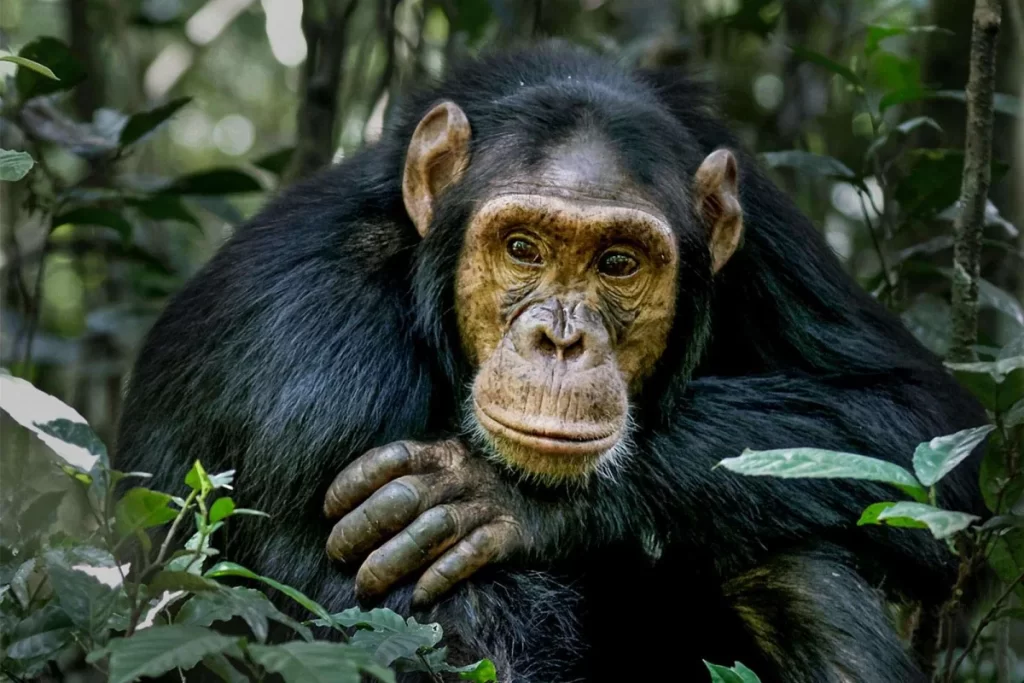
Kibale National Park is home to approximately 1,000 chimpanzees, which perhaps explains why it is designated as the primates’ capital of the world. Kibale National Park is home to over ten species of primates, including black and white colobus monkeys, red-tailed monkeys, and nocturnal primates such as pottos and bush babies, as well as other fauna like night tree pangolins, forest elephants, and various bird species. The primary attraction of the safaris to Kibale National Park is chimpanzee trekking and habituation.
The adaptation of chimpanzees is primarily contingent upon the type of vegetation in Kibale National Park. Kibale National Park is a semi-deciduous rainforest characterized by areas of dense undergrowth. Trekking for chimpanzees can be rather arduous. Chimpanzee trekking in Kibale National Park highlights the primate safaris in Uganda. This is an exceptional opportunity to engage in real-time interaction with habituated chimpanzees and other animals.
Kibale National Park is classified as Category A, encompassing the principal national parks in Uganda. The condition of Kibale National Park somewhat influences the various park costs, including entry charges and activity fees, among others. The entrance fees for Kibale National Park are classified into small groups as follows:
Individual park entrance fees
This is a fee charged each entry per individual, regardless of age. The entrance costs for Kibale Park are classified based on the visitor’s status: foreign non-residents, foreign residents, and East African citizens. A passport serves to indicate that the visitor is a foreign non-resident. Additionally, a work permit, valid for one year, is required for foreign residents of Uganda. Furthermore, a valid national identity card provided at the entrance is necessary for East African natives.
An adult is required to pay 40 USD for park entrance as a foreign non-resident and 30 USD as a foreign resident tourist in Uganda. A member from East Africa is eligible to UGX 20,000 for entry fees to Kibale National Park.
Conversely, minors are subject to a separate fee structure; a child who is a foreign nonresident of East Africa is required to pay a park entrance fee of 20 USD. A foreign resident child in Uganda is obliged to pay a price of 10 USD for access to Kibale National Park, whereas East African citizens must pay UGX 5,000. In this instance, children under the age of 12 are exempt from any park entrance costs.
The student groups are considered to consist solely of East African citizens; they are eligible to a UGX3000 park entry fee for Kibale National Park. Tertiary and university students are charged UGX 5000 for admission to Kibale National Park. Pupils and students affiliated with various wildlife clubs are required to pay a nominal entry fee of UGX 2000 to access Kibale National Park.
Annual park entrance fees to kibale national park
You may opt to pay the annual admission costs for Kibale National Park, so alleviating the recurring burden of seasonal entry payments. An individual entering Kibale National Park is required to pay an annual fee of 350 USD, while East African citizens are charged UGX 150,000. A couple is required to pay an annual entrance charge of 500 USD if they are foreign residents, and UGX 200,000 if they are East African citizens, for Kibale National Park. It is important to note that annual park access is permitted solely for foreign residents and East African citizens.
A family with around four children is subject to an annual park entry fee of 700 USD for foreign residents and UGX 300,000 for families of East African citizens. The annual corporate pass costs 1500 USD for foreign residents and UGX 2.5 million for East African citizens.
A safari guide, in this instance, is regarded as a citizen of East Africa; hence, tour guides are entitled to an annual park admission fee of UGX 100,000 for Kibale National Park, which also applies to taxi drivers. A tour business driver is exempt from park admission fees at Kibale National Park. A foreign resident tour operator incurs an annual park entrance cost of 50 USD, while an East African citizen tour operator is charged UGX 125,000.
The entry fees for Kibale National Park do not include additional expenses for activities, hotels, car rentals, or other services within the park. At the national park entrance, you must produce a document that clearly verifies your identity.
Vehicle entry fees
Kibale National Park, as a protected area, imposes charges on motor vehicles entering the park. However, the traffic differs based on the condition of the motor engine; foreign or East African, as illustrated below;
Foreign motorcycles are charged a park entry fee of 30 USD and UGX 10,000 if they are East African. Conversely, international salon automobiles incur a park entry fee of 40 USD, whereas East African salon cars are charged UGX 20,000 for access to Kibale National Park.
Minibuses incur a fee of 50 USD for foreign nationals and UGX 30,000 for East African residents as an admission charge to Kibale National Park. Pick-ups and 4WDs are charged 50 USD and UGX 30,000 for foreign and East African vehicles, respectively, as park entry fees to Kibale National Park.
The tour business cars are charged 120 USD for foreign clients and UGX 30,000 for East African clients. Buses and lorries are charged 150 USD and UGX 150,000, respectively, as park admission costs for foreign and East African visitors to Kibale National Park. The school buses are classified as East African vehicles and incur a park admission fee of UGX 50,000 to Kibale National Park.
In summary, all protected areas impose stringent entry regulations to restrict unrestricted mobility within the ecological ecosystems, hence safeguarding the ecology of the national parks. The entry fee is utilized to support conservation initiatives within Kibale National Park, as well as to finance the creation and execution of sustainable tourism strategies and the assessment of policies, among other activities.