 info@gorillatrekkinginafrica.com

Paramotoring in Rwanda
Paramotoring in Rwanda is a relatively obscure adventure activity, having been introduced in 2018. Paramotoring, commonly referred to as powered paragliding, is a sport involving aerial flight using equipment that comprises a motor attached to a parachute.
The paramotoring employed in Rwanda involves a pilot donning a backpack-like apparatus that comprises a compact engine propeller, parachute strap, and a throttle for regulating flight speed. A paramotor may weigh as much as 26 kg, and participants must possess prior experience and be at least 14 years old.
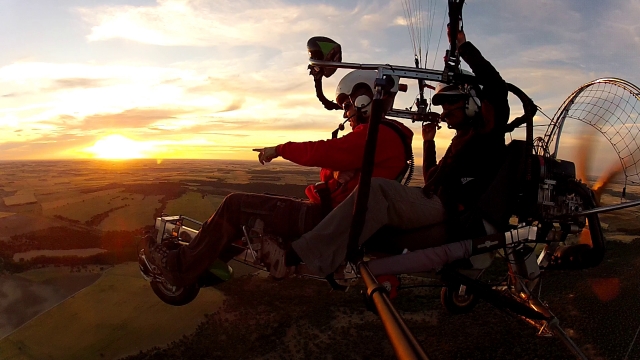
A collaborative initiative with the Rwandan Development Board (RDB), Rwanda Flying Club, and Rwanda Civil Aviation Authority has established safety criteria for paramotoring, which include the utilization of appropriate equipment and a rescue protocol for emergencies. Expert guides are available to assist with the ground-level launch of the Paramotor.
The Rwanda Flying Club provides training for novices at the airport in Huye, located in the Southern Province of Rwanda. Paramotoring can be reserved via a travel operator or RDB.
Where to do Paramotoring in Rwanda
Nyungwe National Park
Rwanda, also referred to as the Land of a Thousand Hills, provides an exceptional overhead perspective of its undulating hills and lush tropical forests, including Nyungwe National Park and the adjacent Gisakura tea plantations.
Spanning 1,019 square kilometers, Nyungwe is one of Africa’s ancient Afromontane tropical forests located in the Albertine Rift Valley. It boasts a rich biodiversity, comprising over 1,100 plant species, 230 tree species, and 12 primate species, including chimpanzees, black and white colobus monkeys, L’hoest monkeys, Hamlyn’s monkeys, velvet monkeys, olive baboons, red-tailed monkeys, and blue monkeys. Additionally, it is home to over 345 bird species, of which 16 are endemic to the Albertine Rift.
The optimal period to visit Nyungwe National Park is during the dry season, specifically from June to September and December to February, for individuals planning to engage in chimpanzee trekking. The weather is favorable for trekking, featuring more than 13 routes that meander through the core of Nyungwe Forest, alongside waterfalls, including Kamiranzovu, the largest waterfall in Nyungwe. The canopy walk offers an opportunity to observe the forest from an elevated perspective while traversing suspension bridges situated 50–70 meters above the ground.
Lake Kivu
Paramotoring in Rwanda is offered at the towns of Karongi and Gisenyi, situated along the shores of Lake Kivu, one of Africa’s seven Great Lakes. Lake Kivu is situated at an elevation of 1,463 meters above sea level, spanning the borders of Rwanda and the Democratic Republic of Congo, with a total surface area of 2,730 square kilometers and more than 200 islands in Rwanda, including Karongi, Napoleon, Akeza, Bugarura, Monkey, and Peace Islands.
Gisenyi, often referred to as Rubavu, is the main town at the northern extremity of Lake Kivu, situated 150 km (a 2-hour drive) from the capital, Kigali, and a 1-hour drive from Volcanoes National Park. Gisenyi features one public beach, multiple private beaches, and a diverse selection of lakeside lodgings for relaxation. Water sports such as canoeing, kayaking, and boating are available for enjoyment.
Individuals seeking bicycling and trekking opportunities may embark on the adventure tourism circuit along the Congo-Nile Trail, which extends 227 kilometers around the periphery of Lake Kivu from Gisenyi to Rusizi. Visitors may undertake en route trips to local communities and coffee and tea estates, including the Kinunu and Ingoboka washing stations near Gisenyi.
Karongi town, previously known as Kibuye, is renowned for its remarkable seven islands, notably Nyamunini Island, which hosts a substantial colony of over 50,000 straw-colored fruit-eating bats. The island is accessible via a boat ride from the primary town, which features restaurants, shops, a market, and a hospital.
Best time for Paramotoring in Rwanda
Rwanda’s tropical environment, characterized by mild temperatures throughout the year, provides generally stable flying conditions. The optimal months for paramotoring in Rwanda are generally the dry seasons from June to September and January to February, characterized by clear weather and tranquil winds.