 info@gorillatrekkinginafrica.com

About Mountain Gorillas
At Gorilla Trekking in Africa, a primary objective is to facilitate comprehension and appreciation of the mountain gorilla, one of our closest relatives in the animal kingdom. MGCF is collaborating with the Rwandan government to offer assistance for a comprehensive array of solutions designed to save both mountain gorillas and their environment. We encourage you to email us with inquiries regarding gorilla behavior, lifestyle, or habitat. We are pleased to provide comprehensive information regarding mountain gorillas in Bwindi.
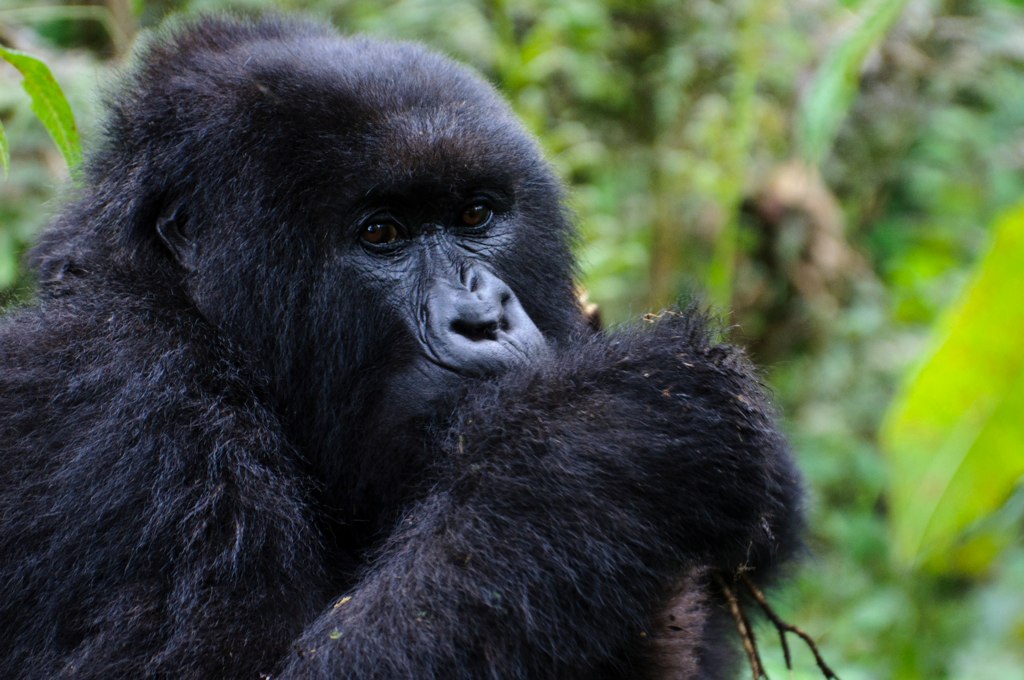
This is a compilation of the most frequently posed inquiries.
About Mountain Gorilla in Bwindi
In where do mountain gorillas live?
Mountain gorillas inhabit the Virunga volcanoes in East-Central Africa. The majority reside on the slopes of the dormant volcanoes Karisimbi, Mikeno, Visoke, Sabinyo, Mgahinga, and Muhavura. The gorillas inhabit hilly regions but seldom ascend beyond 13,000 feet and appear to evade the low, meadow-like areas situated between the volcanoes. Due to the significance of food availability in gorillas’ habitat selection, they predominantly inhabit Hagenia forests, occasionally reside in bamboo forests, and seldom venture into subalpine regions.
What is the greatest current threat to the Mountain Gorilla?
Fewer than 790 mountain gorillas currently are still alive. A multitude of issues has contributed to their endangered status, including habitat destruction, poaching, and snares intended for smaller species. Recently, mountain gorillas have fallen prey to adjacent human conflicts.
A further concern with mountain gorillas is the potential reduction in genetic variation. Mountain gorillas exhibit a delayed reproductive rate: Females attain sexual maturity at approximately ten years of age and reproduce every four to eight years, while males achieve sexual activity at around fifteen years. Moreover, hardly 50 percent of juvenile gorillas endure their initial year. Due to their diminishing gene pool, mountain gorillas encounter prevalent genetic issues stemming from inbreeding. The primary challenge confronting mountain gorillas today is human encroachment upon their environment.
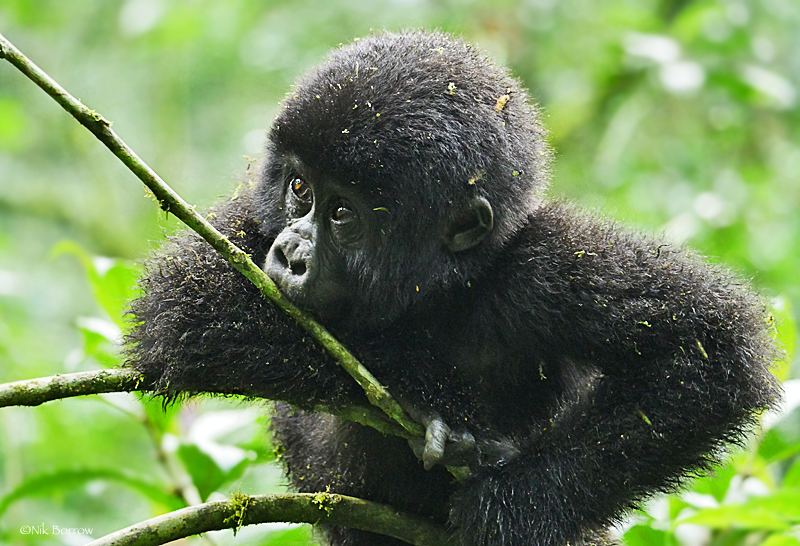
Are there other types of Gorillas?
The response is affirmative. Carl Linnaeus’s zoological categorization system categorizes humans, gorillas, chimpanzees, and orangutans inside the order Primates. The gorilla group is subdivided into three subspecies: (1) western lowland gorillas (Gorillas gorilla gorilla), (2) eastern lowland gorillas (Gorilla gorilla graueri), and (3) mountain gorillas (Gorilla gorilla beringei). The distinctions among the three gorilla subspecies are minimal, chiefly involving slight changes in size and coloration. Approximately 50,000 western lowland gorillas inhabit West Central Africa. In recent years, the population of eastern lowland gorillas in the eastern Congolese rainforest has markedly diminished. In 1960, the number of eastern lowland gorillas was estimated to be between 5,000 and 15,000 individuals. Currently, approximately 2,500 exist in the wild, although less than fifty inhabit zoos. Mountain gorillas, residing in the Virunga Mountains of East-Central Africa, are the most vulnerable of the three subspecies and face a significant threat of extinction. Approximately 790 of them remain globally.
How many gorillas are there in the world?
Compared to other animals, the global population of gorillas is quite limited and is, regrettably, decreasing rather than rising. All three subspecies of gorillas are officially designated as endangered. Approximately 50,000 western lowland gorillas inhabit West Central Africa. In recent years, the population of eastern lowland gorillas in the eastern Congolese rainforest has markedly diminished. In 1960, the number of eastern lowland gorillas was estimated to be between 5,000 and 15,000 individuals. Currently, approximately 2,500 exist in the wild, although less than fifty inhabit zoos. Mountain gorillas, residing in the Virunga Mountains of East-Central Africa, are the most vulnerable of the three subspecies and face a significant threat of extinction. Approximately 790 individuals remain globally, with none existing in captivity.
How can I help protect the Mountain Gorilla from extinction?
One might get further knowledge on this matter and endeavor to enhance public awareness about the present circumstances of mountain gorillas. You can participate in one of our Gorilla Events or make a general donation, which will most effectively support our initiative. Engage actively by volunteering with an organization dedicated to this significant subject.
Are mountain gorillas friendly?
Despite their considerable size and physical presence, mountain gorillas exhibit gentleness, compassion, and intelligence. Mountain gorillas are tranquil herbivores committed to their familial units. Mountain gorillas dedicate a significant part of their day to engaging playfully with their offspring and exhibit great protectiveness when their families are threatened. They exhibit aggressive behavior towards humans solely when they perceive a threat.
Are mountain gorillas biologically similar to human beings?
Affirmative! Mountain gorillas are among our closest cousins, sharing 98.6% of our genomes and 99.6% of our DNA. Humans and gorillas share a common origin, and similar to humans, mountain gorillas exhibit intelligence, playfulness, emotional depth, and strong familial bonds. They possess the ability to acquire sign language. Notwithstanding our affiliations, humans have been the sole effective predators of the mountain gorilla.
Are Mountain Gorillas independent, or do they live in groups?
Mountain gorillas, akin to the majority of primates, exhibit pronounced social behavior. They inhabit familial units of diverse sizes, comprising males, females, juveniles, and newborns. The leader of each group is a dominant silverback, far larger than the other members. All group members yield to the dominant silverback, who serves as a protector and guides the group during foraging activities.
At the age of eleven, men generally depart from their natal group; yet, any effort to integrate into another established group is perceived as a threat to the males of that group. Consequently, young adult males frequently endure prolonged periods of isolation until they can attract females and form their own group. At approximately eight years of age, females depart from their natal group to integrate into a new group prior to breeding.
Due to their gregarious nature, gorillas endeavor to safeguard one another from potential threats. Adult gorillas frequently jeopardize their lives to protect their offspring from poachers and other threats, often resulting in their demise. Similar to humans, gorillas mourn the loss of their family members upon their death. The death of the dominant silverback can significantly disturb the family group, potentially leading to its fragmentation into sub-groups.
Would it be possible to see a Mountain Gorilla in a zoo?
Mountain gorillas cannot thrive in confinement, making it difficult to observe them in a zoo. The western lowland gorilla is the most often exhibited subspecies of gorilla in zoos, with an estimated population of 50,000 residing in West Central Africa. In recent years, the population of eastern lowland gorillas in the eastern Congolese rainforest has markedly diminished. In 1960, the number of eastern lowland gorillas was estimated to be between 5,000 and 15,000 individuals. Currently, approximately 2,500 exist in the wild, although less than fifty inhabit zoos. Mountain gorillas, residing in the Virunga Mountains of East-Central Africa, are the most vulnerable of the three subspecies and face a significant threat of extinction. Fewer than 790 of them remain globally, and they can solely survive in their natural habitat.
What is a Mountain Gorilla’s typical day like?
Gorillas allocate approximately thirty percent of their day to eating, thirty percent to foraging and playing, and forty percent to relaxing and sleeping in their constructed nests. Gorillas inhabit tiny familial units, typically comprising a dominant silverback, multiple females, and their progeny. Although gorillas are predominantly tranquil, disputes may arise during interactions between groups, especially when a solitary male approaches a new group.
What type of food do mountain gorillas eat?
Mountain gorillas are predominantly herbivorous, consuming various forms of vegetation, including stems, roots, leaves, flowers, and the bark of specific trees. Thistles, wild celery, bamboo shoots, and fruits constitute supplementary staples in the mountain gorilla’s diet. Their principal habitat is the Hagenia forest, as the majority of their food sources are available there throughout the year. The growth of bamboo shoots has significant annual variability, and new shoots are exclusively available from August to December; thus, the bamboo forest serves as a secondary home for gorillas.
Gorillas predominantly inhabit mountain forests and typically eschew the adjacent developed fields.
What is the average life span of a mountain gorilla?
The average lifespan of mountain gorillas is challenging to ascertain due to their existence only in the wild. Their lifespan appears to extend from thirty to thirty-five years.
What is the average life span of a mountain gorilla?
Female gorillas exhibit low reproductive rates, typically producing only 2 to 6 children over their lifespan. Male gorillas generally sire 10-20 progeny, frequently with 3-4 distinct females.
Female gorillas typically attain sexual maturity at 10 years, although males generally do not become sexually active until the age of 15. Female gorillas engage with males to initiate copulation and are sexually receptive solely during estrous periods. women possess a 28-day estrous cycle, and subsequent to parturition, women cease ovulation for several years. Following an eight-and-a-half month gestation period, a solitary infant is delivered.
Mountain gorillas lack a specific breeding season, resulting in births occurring year-round. If undisturbed, their population could proliferate at a rate comparable to our own; however, due to disease, poaching, human encroachment on their habitat, and other detrimental factors, gorillas experience a high infant mortality rate, with nearly 50 percent of young gorillas failing to reach maturity.
How long do baby gorillas stay with their mothers?
Infant gorillas typically breastfeed until the age of three, and juvenile gorillas frequently stay with their moms for several additional years. Newborn gorillas typically weigh approximately five pounds, possess black fur, and exhibit a significantly accelerated developmental rate compared to human infants.
At what age do male mountain gorillas develop silver hair on their backs?
Adult male mountain gorillas are referred to as “silverbacks” due to the emergence of grayish or silver-hued hair on their backs upon reaching maturity. In their natural habitat, silverbacks are readily identifiable because to their unique coloration and substantial size.
How much does a full-grown male silverback mountain gorilla weigh?
Adult male mountain gorillas often attain heights of 5 to 6 feet and weights ranging from 450 to 500 pounds. These are large creatures capable of consuming up to 50 pounds of plant matter daily.