 info@gorillatrekkinginafrica.com

Visiting Ngogo Chimpanzees Filmed in Netflix Movie
Have you viewed “Chimp Empire” on Netflix and are now interested in visiting the Ngogo chimpanzees featured in the film? This endeavor was led by Reed, his team, and a contingent of field scientists and trackers who dedicated over a year to documenting the Ngogo chimpanzees in Uganda’s Kibale National Park.
The Ngogo society represents the biggest documented assemblage of chimpanzees globally, and throughout the filming period, it had divided into two rival groups. The stars of Chimp Empire demonstrated elusiveness, volatility, and a tendency towards diva-like behavior regarding their attendance on set. The rivalries may become rather fierce.
Chimpanzees produce much noise, making it often uncomplicated to locate them. James Reed, co-director of My Octopus Teacher and director of the four-part docuseries, stated to Netflix, “The challenge lies in maintaining pace with them.” That occurred prior to the cast beginning to dismember one another.
Reed, his team, and a contingent of field scientists and trackers dedicated more than a year to documenting the Ngogo chimpanzees in Uganda’s Kibale National Park. The Ngogo society represents the biggest known assemblage of chimpanzees globally, and throughout the filming period, it had divided into two rival groups. The filmmakers were present in the forefront of the critical struggle for dominance between the Central and Western factions. Chimp Empire is a nature documentary that resembles a historical conquest epic or a ruthless corporate thriller.
Science was not neglected. Filmed in a secluded rainforest environment, Chimp Empire reveals aspects of chimpanzee existence that have not previously been captured on film. No, not even in that other delightfully enlightening wildlife documentary you enjoy binge-watching. Considering its significant insights into primate existence and its intensely violent narrative, viewers may justifiably inquire: “How was Chimp Empire produced?” Reed elucidated the intricacies of production, encompassing the intimate and alarming chimp relationships as well as the memorable domination rain dance (if you are aware, you are aware).
About the Ngogo chimpanzee research initiative
The Ngogo chimpanzee study project is one of two initiatives developed by the Ugandan government with the assistance of donors, ecologists, and conservationists. The government oversees the Ngogo research initiative through the Makerere University Biological Field Station (MUBFS). Situated in Kibale Forest, the second biggest natural forest in Uganda, Ngogo has been unscathed by commercial logging unlike other regions of the forest.
The Ngogo chimpanzee research project commenced in 1972, initiated by Thomas Struhsaker of the New York Zoological Society, with the primary objective of safeguarding the forest habitat of red colobus monkeys, red-tailed monkeys, and grey-cheeked mangabeys from logging activities.
Since then, the Ngogo Chimpanzee Research Center has been employed by Ugandan students and expats to investigate the behaviors of primates, including chimpanzees. These students receive mentorship from Struhsaker, as well as recently from David Watts and John Mitan of Yale and Michigan institutions, respectively.
About the Ngogo Chimpanzee community
Exploring Ngogo Chimpanzees Featured in the Netflix film Chimp Empire. In 1995, John Mitani (University of Michigan) and David Watts (Yale University) initiated a long-term study of the Ngogo chimpanzee colony in Kibale National Park, Uganda. Kevin Langergraber, affiliated with Boston University and the Max Planck Institute for Evolutionary Anthropology, commenced his involvement with the Ngogo Chimpanzee Project as a doctoral student in 2001 and ascended to the role of co-director in 2011. The Ngogo chimpanzee group is the largest documented to date; as of April 2012, it consisted of 188 individuals, including 32 adult males, 13 adolescent males, 58 adult females, 12 teenage females, 27 youngsters, and 46 babies.
A significant amount of study at Ngogo has concentrated on elucidating the ecological factors underlying this atypical demographic scenario and its impact on chimpanzee behavior. Current and historical research subjects encompass intra- and inter-sexual social dynamics and collaboration, kinship and social affiliations, mating strategies and reproductive efficacy, hunting practices and meat distribution, territorial conduct, and feeding ecology. Alongside observing chimpanzees and documenting their behavior, researchers at Ngogo also non-invasively gather urine, feces, and other biological specimens for endocrinological and genetic analysis, while conducting phenological and botanical investigations of the forest environment.
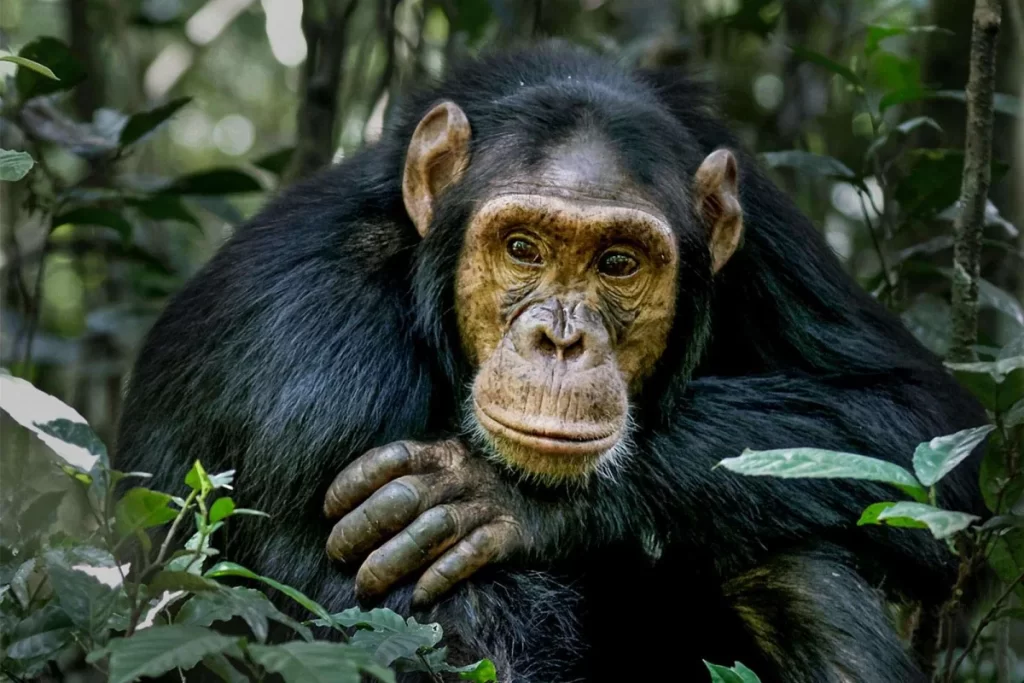
The Ngogo Chimpanzee Project engages a team of local Ugandans who collaborate with local law enforcement personnel from the Uganda Wildlife Authority to retrieve snares and mitigate unlawful hunting within the park. They further gather fecal samples for a genetics-based monitoring study focused on chimpanzees, which seeks to ascertain the size, composition, population, and distribution of unhabituated chimpanzee communities inside the 800 km² Kibale National Park.
What is the best time for seeing the Ngogo chimpanzees featured in the Netflix film “Chimp Empire”?
Chimpanzee trekking in Kibale Forest National Park is optimally conducted from June to October and December to March, coinciding with Uganda’s dry season characterized by minimal rainfall. This period facilitates easier trekking due to less dense vegetation, enhancing visibility and providing excellent photographic opportunities of the chimpanzees. In the months of April, May, and November, typically characterized by increased precipitation, vegetation flourishes, obscuring visibility. However, during this period, treks are generally shorter, as chimpanzees do not traverse long distances in search of sustenance, which is abundantly available. Chimpanzee trekking at Kibale Forest National Park is available year-round, as it is a well planned activity with a 99% likelihood of encountering chimpanzees.
Methods for accessing Ngogo
By Road: Ngogo chimpanzees inhabit Kibale Forest National Park, accessible by the primary safari route from Entebbe/Kampala to Fortportal, approximately a 4-5 hour drive. Access to the park is also available via the Kampala-Mabara-Kasese highway; from Kasese, it is a 1-2 hour journey to Kibale Forest.
By air, one can fly from Entebbe International Airport or Kajjansi airfield in Kampala to Kasese airstrip, from whence a shuttle to Kibale Forest National Park is available. Scheduled and chartered flights are offered and conducted by the domestic airlines Aero Link and Fly Uganda. You must coordinate with your tour operator for a transfer from the airstrip to the park.
Accommodation options for visiting Ngogo Chimpanzees featured in the Netflix film Chimp Empire
Numerous accommodation alternatives are available in Kibale Forest National Park for your chimpanzee trekking experience, encompassing budget, mid-range, and luxury categories. Please inform us, and we will make the appropriate reservations for you.
Accommodation in Kibale Forest National Park includes budget options such as Chimpanzee Forest Guest House, Isunga Lodge, Mountains of the Moon, Rwenzori View Guest House, and Kibale Home Stay, priced at USD 90-100 per person per night. Mid-range accommodations comprise Kibale Forest Camp, Turaco Treetops Lodge, and Prime Lodge Kibale, costing USD 150-200 per person per night. Luxury options feature Ndali Lodge, Crater Safari Lodge, Papaya Lake Lodge, and Kyaninga Lodge, with prices ranging from USD 250-700 per person per night.