 info@gorillatrekkinginafrica.com

Coffee tours in Tanzania
Coffee tours in Tanzania: Numerous locations in Tanzania provide coffee tours, and coffee serves as a principal source of income for many residents.
The fertile soils of Tanzania promote the cultivation of coffee in many regions of the country. Visiting coffee farms is an integral part of the safari experience in Tanzania, typically lasting between three and five hours. Coffee is a significant cash crop in Tanzania, with notable cultivation occurring in Moshi town, situated at the base of Mount Kilimanjaro, Africa’s highest peak.
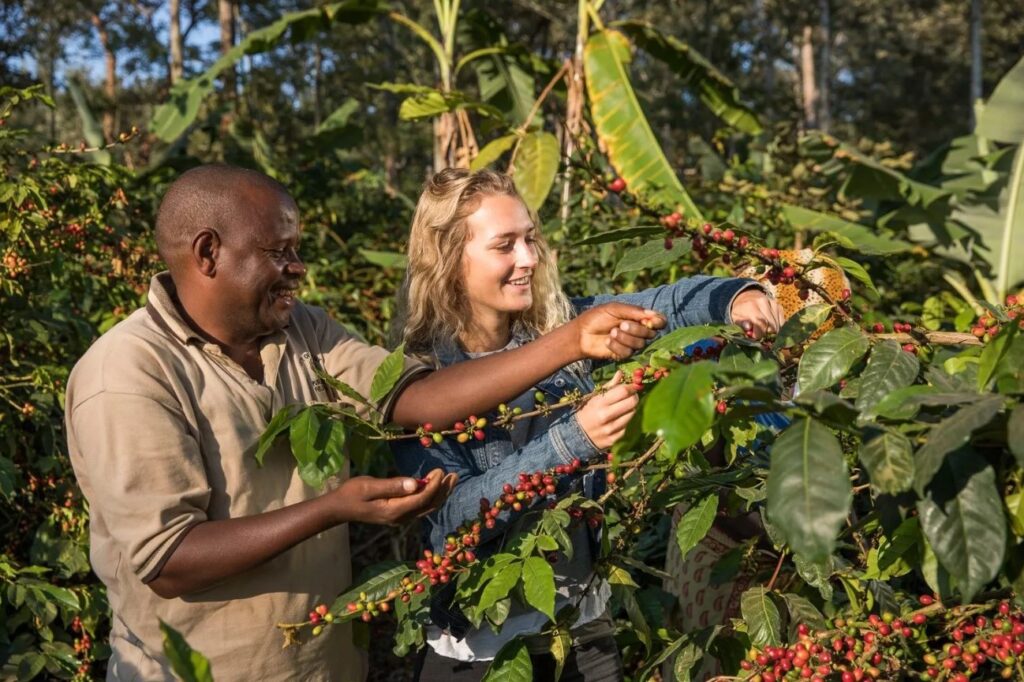
The region surrounding Moshi and Arusha is renowned for its numerous coffee farms, and various resorts are associated with them. These farms offer an intriguing experience, allowing visitors to observe the cultivation, harvesting, and processing of coffee beans into their preferred beverage. During the off-harvest season, one acquires knowledge about the many varieties of beans, the specific factors contributing to the exquisite flavor of coffee, and the processing methods of the beans. Additionally, you will get the opportunity to savor some of the most exquisite, freshly brewed coffee.
Tanzania cultivates Arabica and Robusta coffee varieties. During the coffee excursions, you gain insight into the coffee cultivation process, savor the flavor of the coffee, and learn about the various stages it undergoes from plantation to cup.
The trips can be conducted privately or as part of a group while exploring the plantations in Tanzania. The coffee tour may also be conducted as a guided experience, encompassing a stroll through the coffee farm and a visit to the coffee roasting facility, among other activities.
Village walks are integral to the coffee tour experience in Tanzania, including Materuni village, home of the Chagga, and Tengeru village, among others. These village visits entail engaging with the inhabitants, gaining insights into their culture and lifestyle, and experiencing various aspects of their daily lives.
The Chagga people are recognized for cultivating high-quality coffee in the Kilimanjaro region of Tanzania. In addition to coffee, the Chagga cultivate bananas, and the plantations are accessible for visitation during tours in northern Tanzania.
Tanzania’s coffee sector
In Tanzania, coffee is cultivated alongside other crops in the fertile volcanic soils. The optimal coffee production occurs when the trees are approximately 15 years old, potentially reaching up to 0.5 kilograms.
Following the physical harvesting of coffee, the subsequent step is the selecting procedure. Subsequent to the selection phase, the pulp is extricated, and the procedure undertaken is termed the dry process, whereby the coffee cherries are sun-dried, and once achieving dryness, the cherries are fragmented.

Once the coffee has been processed, it is placed into sacks and made available for sale. In municipalities such as Moshi, these unprocessed coffee beans are marketed during the harvest season. The last stage of coffee production is the roasting process, which can be executed through several methods, including drum roasting—a traditional technique that entails roasting coffee in a revolving drum over an open flame.
The optimal periods for coffee tours are October and March, coinciding with planting; February is designated for harvesting in lower altitudes, while June is reserved for harvesting in higher altitudes. Additionally, the plants bloom in December, and February is focused on the development of green beans.
Best time for excursions in Tanzania
Tours in Tanzania are optimally conducted during the dry season, specifically from June to October, when the weather conditions are excellent. Wildlife observation, a highly sought-after activity during safaris in Tanzania, is optimal during the dry season, which coincides with the peak season for safaris.
Additional locations for day trips in Tanzania encompass waterfalls such as Materuni and Meru, among others. Day trips in Tanzania are available in Arusha National Park, the towns of Moshi and Arusha, Tarangire National Park, Ngorongoro Crater, Lake Manyara National Park, Olpopongi Maasai Village, Kikuletwa Hot Springs, and Kilimanjaro National Park, among others.
Additional attractions in Tanzania that may be explored before or after coffee tours encompass national parks located in the northern, southern, western, and central regions of the country, including Serengeti National Park, Ruaha National Park, Nyerere National Park, Tarangire National Park, Lake Manyara National Park, Katavi National Park, Gombe National Park, Mahale National Park, among others.
Methods of transportation in Tanzania
Various modes of transportation utilized during travels in Tanzania include driving, airplane, ferry or boat, and railway. Driving is the predominant mode of transportation for traveling between places in Tanzania, however for distant locations, alternatives such as flying are advisable.
Domestic and international flights are accessible to several destinations in Tanzania. Scheduled and charter flights are accessible during visits in Tanzania provided by domestic airlines such as Auric Air, Regional Air, Flight Link, and Coastal Aviation, among others.