 info@gorillatrekkinginafrica.com

Lake Eyasi
Lake Eyasi is a substantial lake that surpasses Lake Manyara in size, with its saline perimeter fluctuating based on annual precipitation levels. During periods of significant aridity, water levels diminish markedly, enabling the Datoga and Hadzabe tribes to traverse the Lake on foot. Doum palms are unique, and in a harsh area, the shade provided by the trees is refreshing and highly appreciated. The sunsets at Lake Eyasi are magnificent, rendering it a perfect destination for those intending to embark on a photography-centric safari in Tanzania. The western flank of the Rift Valley stands prominently in the distance.
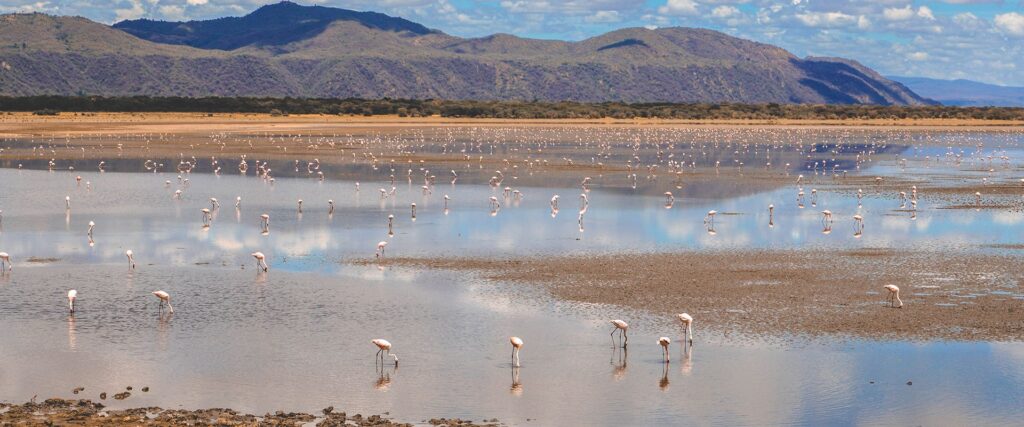
The northernmost point of the lake lies beneath the shadow of Oldeani Mountain, adjacent to the Ngorongoro Conservation Area. Lake Eyasi is situated in one of the most ancient regions of the Eastern Rift Valley, extending northeast-southwest for almost fifty miles beneath the 3000-foot escarpment that delineates the southeastern limit of Serengeti National Park and the Maswa Game Reserve. The Yaida Valley, located southeast of the lake, is inhabited by the Hadzabe hunter-gatherer group.
Although not officially a game reserve, Lake Eyasi is a breathtaking wilderness location that offers an authentic glimpse into some of Tanzania’s intriguing tribes, including the Hadzabe and Datoga. Visiting the Hadzabe Bushmen near Lake Eyasi is essential for those desiring authentic, unconventional cultural immersion. Contact All Tanzania Safaris for other activities that emphasize engaging with local residents while positively contributing throughout your Tanzania safari.
Lake Eyasi is an unconventional attraction in Tanzania. Although situated in the nation’s most frequented area, adjacent to the Ngorongoro Conservation Area and in proximity to Lake Manyara, this intriguing location is hardly, if ever, explored by individuals interested in engaging with the Hadzabe “Bushmen” society.
The scarcity of lodging alternatives, the seasonal nature of the lake, and Lake Eyasi’s position in a cul-de-sac necessitating a return to Karatu, are detrimental to tourism in the region. Lake Eyasi is indeed a destination of merit, and this travel guide will furnish you with comprehensive information necessary for planning a visit to this secluded part of Tanzania, encompassing transportation options, activities, and accommodation surrounding Lake Eyasi.
Location Of Lake Eyasi
Lake Eyasi is an endorheic lake, signifying that it lacks any outlets. The waters are saline and shallow. The dimensions of Lake Eyasi fluctuate significantly with the seasons; it is nearly absent during the dry season, however it often inundates adjacent communities during periods of excessive rainfall, a phenomenon that is increasingly prevalent.
In the dry season, animals are compelled to share the few remaining water, facilitating wildlife observation. In the rainy season, the lake deepens, drawing several hippos. April and May get the most substantial rainfall, rendering travel during these months imprudent due to potential flooding and muddy roads.
This intriguing lake is situated on the floor of the Great Rift Valley, where Africa is gradually being separated by material ascending from the Earth’s mantle. It adjoins the Ngorongoro Conservation Area, with the crater visible from the southeastern shoreline.
The terrain around Lake Eyasi is distinctive, predominantly sandy and arid, featuring peculiar succulents such as cactus trees (Euphorbia ingens), umbrella thorn acacia, and sandpaper bush, alongside areas of tropical flora like palm palms. The climate is consistently sweltering and humid.
Things to do in Lake Eyasi
Cultural Interactions:
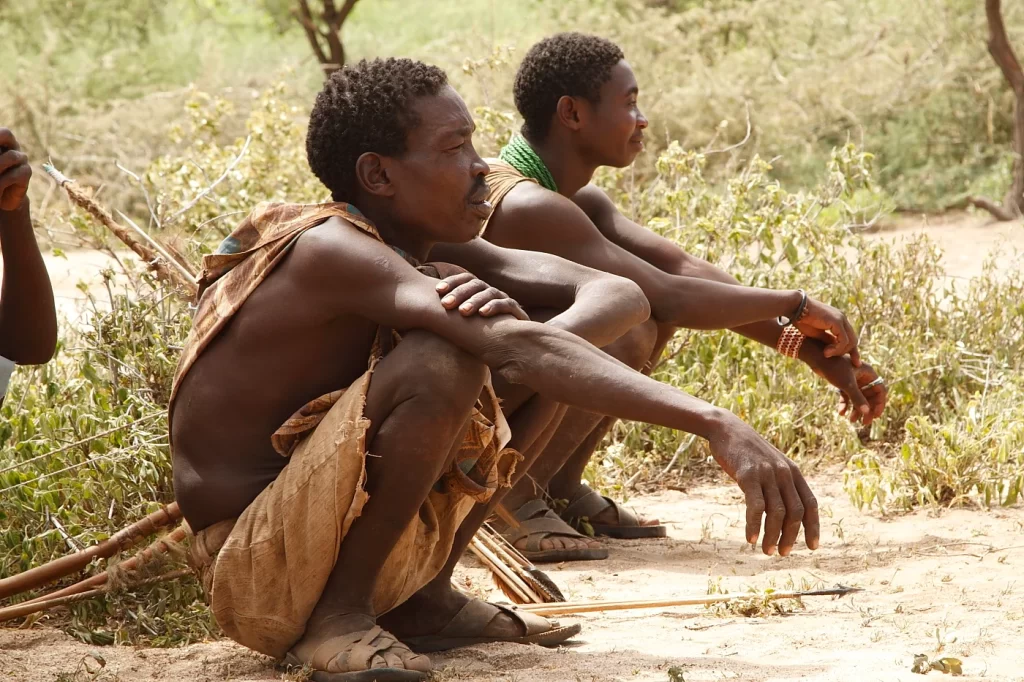
The Hadzabe bushpeople are amicable and take pleasure in showcasing their hunter-gatherer way of life. They will exhibit their cave dwellings and accompany you on a hunt while communicating in a distinctive dialect characterized by a characteristic clicking sound. This offers a distinctive perspective on a lifestyle that has persisted for millennia.
Hiking: The lake and its environs are picturesque and suitable for local excursions. Embark on a guided full- or half-day stroll along its shoreline to observe ancient rock art.
Local Villages
Embark on a leisurely walk through the villages of the Hadzabe and Datoga tribes to engage with these amiable individuals.
Birdwatching: The shoreline and adjacent regions are abundant with lively and diverse avian species.
Ghorofani Market:
On the fifth of each month, a bustling market is located a few kilometers from the northeastern section of the lake. Wander among the local patrons and vendors who travel from various locations around the lake.
Fishing:
Fishing activities may be conducted on the lake during the wet seasons, mostly targeting catfish and lungfish. Regardless of your passion in fishing, a boat excursion is a pleasurable experience.
Bicycling:
The most effective method to traverse the shoreline of Lake Eyasi is unequivocally by bicycle. A two-wheeler enables rapid travel over vast distances, allowing one to appreciate the evolving sceneries along the shore. Evening gatherings at the lakeside
The Bushman Tribe
The Bushman, or Wahadzabe tribe, continue to maintain their ancient hunter-gatherer lifestyle.
A local guide will conduct a visit to the village, elucidating their lifestyle. The Bushman will ignite a fire with sticks and will display their little possessions. They will conduct a simulated hunt in the region using bows and arrows, and guests may engage in target practice. The visit culminates in a customary performance of singing and dancing.
During the rainy season, they inhabit caverns, and in the dry season, they reside in trees and shrubs. Residences are delineated by vertical poles arranged in a semi-circular formation. Beds and floor mats are crafted from the hides of kudu and impala.
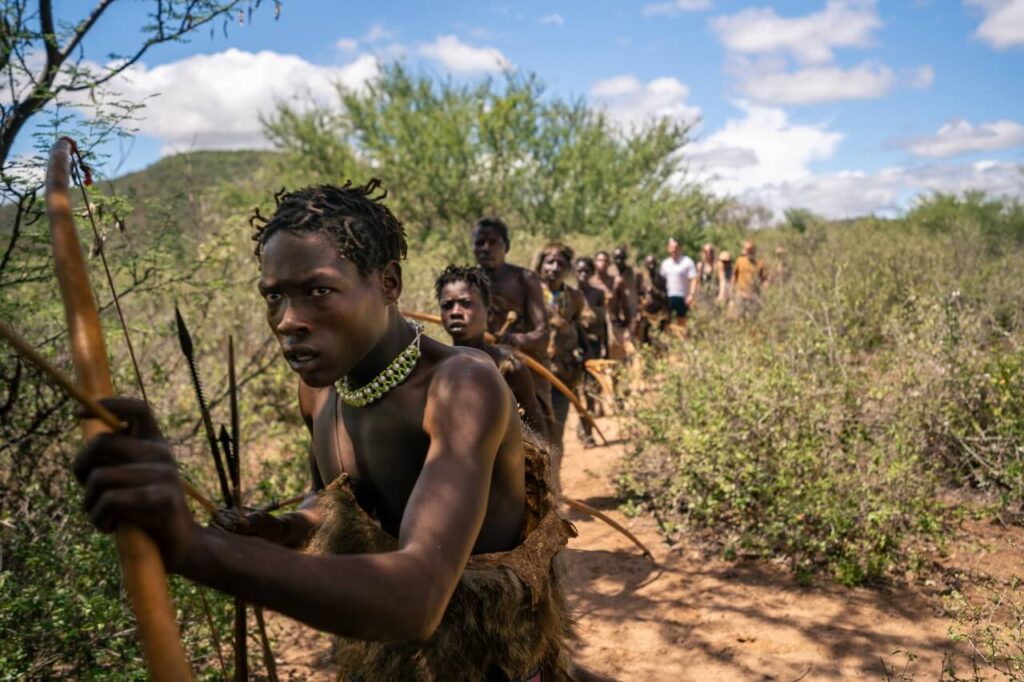
The men pursue wild animals and birds using bows and arrows. Various arrows are designed for distinct species of animals. Poisoned arrows are employed for hunting huge game. They consume honey, subterranean tubers, and fruits from the Baobab tree. During the arid season, they are required to excavate the dry riverbed to locate water.
Men and women engage in distinctly diverse social groupings. Infants and young children remain with women, while boys aged seven and older are grouped with adults.
The Bushmen practice monogamy. The bride price for marrying a woman is two large baboons and numerous liters of honey.
Men don shorts and animal pelts. Women don vibrant garments draped across their bodies. Jewelry is crafted using beads, porcupine quills, fur, and hides. Arrows and jewelry can be acquired from them using TZ shillings or through trade (e.g., baseball hats).
The Hadzabe Tribe
The Hadzabe possess no genetic relationship with any other ethnic group. They do not cultivate crops, do not rear cattle, lack comprehension of calendars, and cannot count beyond four.
They are a contemporary hunter-gatherer group whose lifestyle has remained predominantly unaltered for the last 10,000 years. Their language resembles that of the former Khoisan of the Kalahari due to the incorporation of characteristic clicks; nonetheless, the Hadzabe language (Hadzane) has been established as an isolate, unrelated to any other language.
The Tanzanian government reports that approximately 1,200 to 1,300 Hadzabe individuals survive, with around 400 subsisting exclusively by traditional foraging techniques. All their equipment is locally sourced, including bows constructed with giraffe tendon and arrows that are poisoned.
Is a visit to the Hadzabe Tribe advisable?
If you have read this far, you are likely intrigued by these individuals and their lifestyle, as we are; however, that does not imply you should visit them. In addition to the evident ethical issues associated with “human safaris” (or human zoos), the Hadzabe’s seclusion and distinctive lifestyle render them more susceptible than other African tribes.
Since the publication of several acclaimed documentaries about the Hadzabe in 2001, the Mang’ola Hadzabe has emerged as a tourist destination. While this seems advantageous for the Hadzabe, a significant portion of the revenue generated by tourists is distributed by governmental agencies and tourism enterprises rather than the Hadzabe themselves.
Providing monetary assistance directly to the Hadzabe is futile, as they lack an understanding of currency. It will solely exacerbate alcoholism and alcohol-related fatalities, in addition to the erosion of cultural knowledge.
The Datoga tribe, related to the Maasai, are pastoralists.
The Datoga are pastoralists, similar to the Maasai. These pastoralists, in contrast to the Maasai, are proficient silversmiths who provide the Hadzabe with iron tips, knives, and spears in return for honey and fruits. Their roots are believed to be in the Horn of Africa, from where they moved approximately 3,000 years ago. They don traditional garments embellished with colored beads, and women often exhibit facial scarification as a kind of attractiveness. The Datoga don garments that are reddish-brown, akin to the earth, featuring leather gowns with reddish patches, along with necklaces, beading, and bracelets. The ornamental facial scarification featuring circular patterns surrounding their eyes is a distinctive cultural characteristic that sets the Datoga apart from other tribes.
When is the best time to visit Lake Eyasi
The lake is open year-round. The landscape at Lake Eyasi is adorned with a verdant expanse of grass throughout the two wet seasons and remains arid from June to October. Prolonged rainfall occurs from mid-March to May, while brief rains are observed in November and December, accompanied by sporadic showers. Intense precipitation will hinder the walking trails and roads, perhaps complicating travel; yet, it is preferable to be present.
Entry fee at lake Eyasi
A tourist office is located about 8 kilometers from Mangola, where registration and a cost of $20 per vehicle are required. Participation in any cultural activity, such as visiting the local Hadzabe tribe, incurs a cost of 110 dollars each vehicle. This cost is applicable solely if you want to overnight on the lake’s edge.