 info@gorillatrekkinginafrica.com

4 days Lake Nakuru and Lake Naivasha Safari
Participate on this 4 days Lake Nakuru and Lake Naivasha Safari. Participate in a game drive and boat cruise on this tour, which will familiarize you with various wildlife, including predators, large felines, avian species, and more. During this safari, anticipate encounters with creatures such as lions, hippos, giraffes, wildebeests, dik-dik, gazelles, zebras, and several others.
The boat excursion will take place on Lake Naivasha, featuring the observation of hippo pods, with optional activities such as sport fishing and community walks included in the program.
Comprehensive Itinerary
Day 1: Nairobi to Lake Naivasha
Day 1 of 4 days Lake Nakuru and Lake Naivasha Safari, Depart Nairobi following a pickup and proceed to Lake Naivasha National Park, renowned for its rich fauna sustained by the freshwater lake from which the park derives its name. Upon arrival, proceed to the lodge reserved for your exquisite dining and overnight accommodation.
Day 2: Entire day at Lake Naivasha
Dedicate a whole day to exploring the waterways and plains of Naivasha with game drives and boat excursions. These two excursions provide an excellent opportunity to observe wildlife, including giraffes, wildebeest, impala, zebras, gazelles, dik-diks, buffalo, bat-eared foxes, Kirk’s dik-diks, bushbucks, hippos, and numerous others. Appreciate scenic vistas adorned with acacia trees.
Day 3: Proceed to Lake Nakuru for a game drive.
Depart Lake Naivasha National Park and proceed to Lake Nakuru National Park, which is inhabited by several avian species, including flamingos. Arrive and participate in the game drive, anticipating encounters with creatures such as giraffes, Cape buffaloes, olive baboons, impalas, waterbucks, hippos, colobus monkeys, spotted hyenas, zebras, and gazelles. The gaming drive can last approximately 3 to 4 hours, but it is highly gratifying and memorable. Proceed to the reserved lodge for an exceptional overnight stay.
Day 4: Game drive and return to Nairobi
Embark on a morning game drive to complete the safari, where you may encounter species such as baboons, impalas, waterbucks, hippos, colobus monkeys, spotted hyenas, zebras, and more. Return to Nairobi and be left off at a mutually agreed location, preferably the airport or hotel, signifying the conclusion of the safari.
Inclusions
- Park Fees (for Non-Residents).
- Meals as per itinerary.
- Drinking water while on safari (2 liters per person daily).
- A professional English-speaking driver/ guide.
- Daily game drives while on Safari.
- All Taxes and VAT.
- 4×4 Land Cruiser or Safari Van.
Exclusions
- Additional accommodation before and at the end of the tour (Unless mentioned otherwise).
- Any activities not mentioned in the itinerary.
- Government-imposed Taxes and or Park Fees.
- International flights.
- Airport Transfers (Unless mentioned otherwise).
- Personal Items (Souvenirs, Travel Insurance, Visa Fees, etc.).
- Tips (Tipping guidelines)
When is the best time to visit Lake Nakuru National Park?
Lake Nakuru National Park is a rift valley lake located at an altitude of approximately 1,755 meters above sea level. Lake Nakuru National Park is situated in the southern region of Nakuru County, with Nakuru Town as the nearest urban center, approximately 164 kilometers and a two-hour drive from Nairobi, the capital of Kenya. Lake Nakuru National Park is a UNESCO World Heritage Site designated in 2011, an Important Birding Area acknowledged in 2009, and a Ramsar site recognized in 1990. Lake Nakuru National Park is a wildlife sanctuary and a haven for birdwatchers in Kenya, featuring magnificent vistas formed by Lake Nakuru, millions of pink flamingos, and several gorgeous locations across the park, which spans an area of 45 square kilometers.
best time to visit Lake Nakuru National Park is during the dry season, generally occurring from July to October. During this interval, the climate is comparatively temperate, characterized by clear skies and negligible precipitation. These optimal conditions facilitate the observation of wildlife as they gather along the lake edges and water holes, providing excellent possibilities for game viewing and birdwatching.
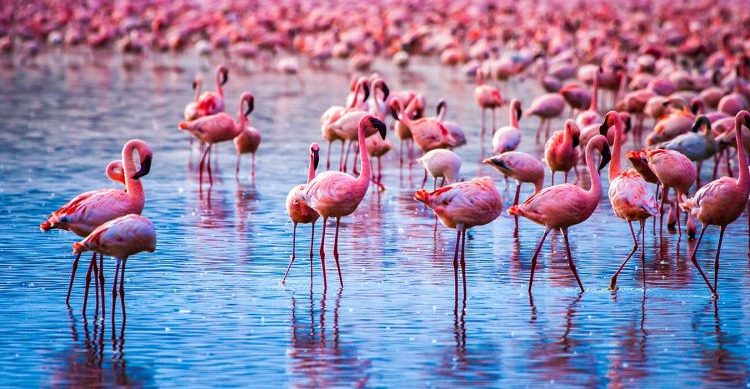
The dry season corresponds with the zenith of the flamingo season at Lake Nakuru. Hundreds of thousands of these vivid birds congregate near the alkaline lake waters, producing a captivating pink display that is quite remarkable. The visual and auditory spectacle of these flamingos collectively is genuinely breathtaking and provides exceptional photographic prospects.
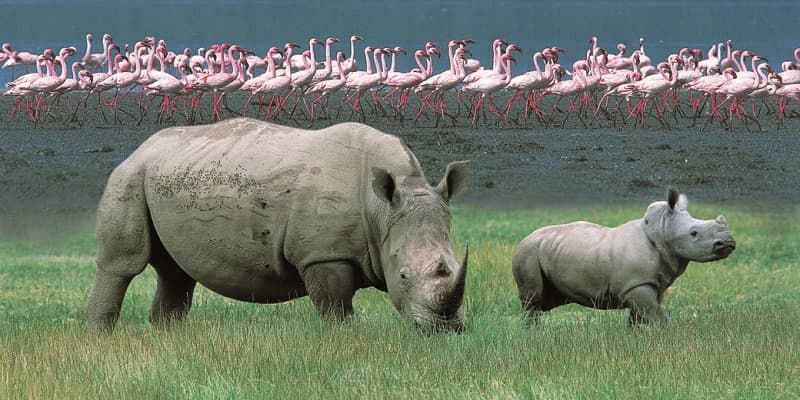
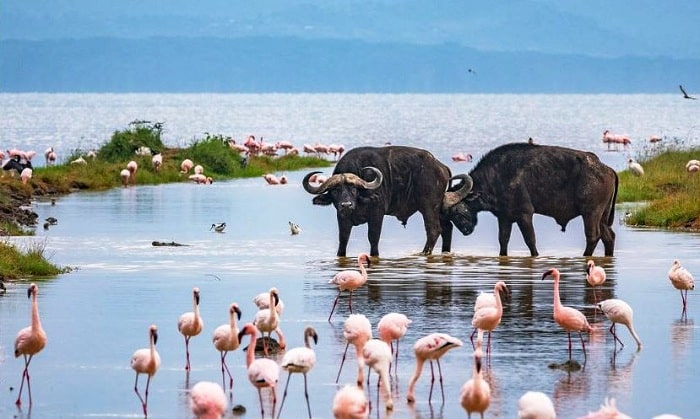
Alongside the flamingos, the arid season presents an opportune moment to observe additional animals in the park, including endangered white and black rhinoceroses, as well as giraffes, zebras, buffalo, and diverse antelope species. The scant vegetation at this period facilitates the detection of predators like lions and leopards, enhancing the thrill of your safari experience. Visiting Lake Nakuru National Park in the dry season provides the opportunity to traverse the park without the hindrance of muddy roads or precipitation, facilitating seamless and pleasurable wildlife drives and safari excursions.
A favorable period to visit Lake Nakuru National Park is from December to March, coinciding with the short rains. Although midday showers may occur, this season is when the park is at its most verdant and vibrant. The terrain is vivid and the wildlife is abundant, creating exceptional photographic opportunity.
The months of April and May are the wettest in Lake Nakuru National Park; therefore, it is advisable to avoid coming during this period, as the roads may become inaccessible. Excessive rainfall disrupts game drive schedules and causes grass to grow excessively tall, hindering wildlife sightings. Nonetheless, for birdwatching aficionados, this period may be optimal for visitation, as the park transforms into a sanctuary for migrating avifauna.
Things to do in Lake Nakuru National Park
Birdwatching
Lake Nakuru National Park is an avian haven, accommodating over 450 bird species, so establishing itself as one of Kenya’s premier birding locales. Birdwatching in this park gives an opportunity to observe a diverse array of bird species. During your guided birdwatching excursions in the park, you will have the opportunity to observe a diverse array of vibrant avian species, including lesser and greater flamingos, ostriches, white-faced whistling ducks, African black ducks, Egyptian geese, helmeted guineafowl, yellow-necked spurfowl, common quails, crested francolins, great crested grebes, speckled pigeons, mourning collared doves, yellow-throated sandgrouse, African palm swifts, Jacobin cuckoos, lesser moorhens, grey crowned cranes, white-bellied bustards, white-bellied go-away-birds, African openbills, yellow-billed storks, great white pelicans, and hammerkops, among others.
Wildlife expeditions
Lake Nakuru National Park provides an exceptional wildlife safari experience, featuring a diverse range of mammals and birds amidst its stunning landscape. The park is renowned for its populations of both black and white rhinoceros, offering a unique opportunity to observe these magnificent animals in their natural environment. The park hosts diverse wildlife, including Rothschild’s giraffes, waterbuck, lions, cheetahs, leopards, pythons, buffalo, and other antelope species. On your wildlife tour, you will get the opportunity to observe these magnificent animals in their natural environment. The park’s diversified habitat accommodates both driving and pedestrian safaris, catering to varying preferences. Expertly led wildlife safaris by seasoned rangers enrich the experience, providing guests with knowledge of animal behaviors and conservation methods.
Scenic drives
The picturesque routes in Lake Nakuru National Park present a stunning amalgamation of enchanting scenery and plentiful wildlife, rendering them a focal point of any visit. These drives traverse varied landscapes, from acacia woodlands to expansive savannahs, offering stunning vistas of the lake set against the striking background of the Great Rift Valley. During your beautiful drives, you will get the opportunity to experience panoramic vistas of the active environment and encounter various wildlife, including grazing herbivores and stalking carnivores. The bamboo cliff offers breathtaking vistas of the park and its extraordinary flora and animals. The experience is heightened at sunrise or sunset when the remarkable interplay of light creates a golden radiance over the area.
Hiking and nature trails
Visitors can engage with the breathtaking beauty of Lake Nakuru National Park by trekking and exploring its nature paths. The park offers multiple clearly designated pathways that accommodate different fitness levels, ranging from casual strolls to more demanding hikes. These routes traverse picturesque landscapes, encompassing woodlands, grassy plains, and rocky outcrops, while providing stunning vistas of the vibrant lake and its environs. During your hiking and nature treks, you will get the opportunity to experience various flora, fascinating geological formations, and observe wildlife that may not be apparent from a car.
Accessing Lake Nakuru National Park
Accessing Lake Nakuru National Park, situated in Kenya’s Rift Valley, is a gratifying expedition that provides entry to one of the nation’s most renowned wildlife reserves. The predominant route by road is a drive from Nairobi, situated around 156 kilometers to the north of the city. The travel generally requires approximately 2-3 hours, contingent upon traffic circumstances. An alternative approach is from Nakuru; upon arriving in Nakuru town, tourists may take the B2 road, which leads immediately to the park entrance. The park is roughly 10 kilometers from the main cores.
Domestic flights from Nairobi to Lake Nakuru might be arranged for anyone seeking to conserve time. Several little airstrips are located near the park, with planes generally arriving at the Naivasha airstrip, from which a brief drive leads to the park.