 info@gorillatrekkinginafrica.com

Climate And Temperatures Of Africa
Climate And Temperatures Of Africa, Climate and temperatures are uncommon throughout Africa, especially at elevated altitudes and around the peripheries. The climate of Africa has greater variability in rainfall amounts than in continuously high temperatures.
The climate encompasses various types, including equatorial, tropical wet and dry, tropical monsoon, semi-desert (semi-arid), desert (hyper-arid and arid), and subtropical highland climates. African deserts are the sunniest and driest regions of the continent, attributed to the dominant subtropical ridge characterized by descending, hot, arid air masses. Africa possesses numerous heat-related records: it features the hottest extensive territory year-round, the locations with the most extreme summer climates, the longest sunshine duration, among others.
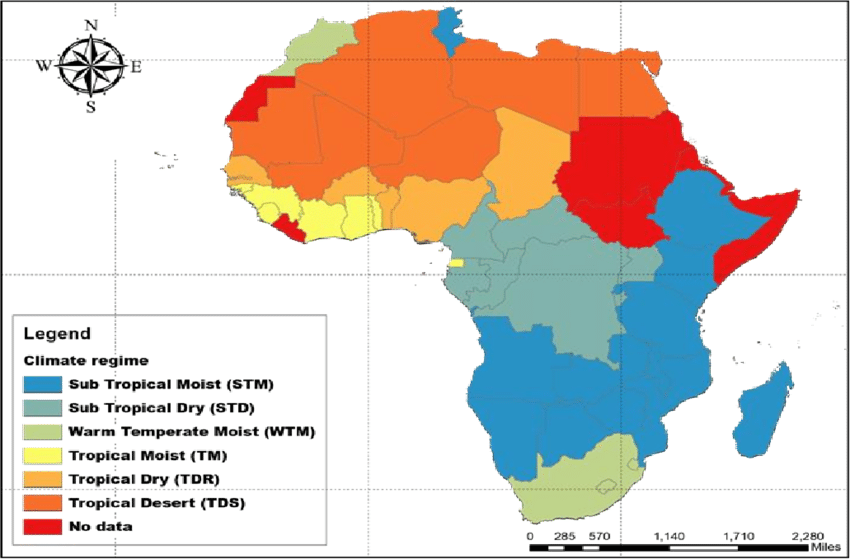
Due to Africa’s location throughout equatorial and subtropical latitudes in both the northern and southern hemispheres, it encompasses several climate types. The continent predominantly resides inside the intertropical zone between the Tropic of Cancer and the Tropic of Capricorn, resulting in its notable humidity density. The continent experiences consistently high precipitation intensity and elevated temperatures. Warm and hot climates dominate Africa, particularly in the northern region, characterized by aridity and elevated temperatures. Only the extreme northern and southern edges of the continent have a Mediterranean climate.
The equator, together with the Tropic of Cancer and the Tropic of Capricorn, traverses the center of Africa, rendering it the most tropical continent.
The global heating of the Earth at the equator induces significant upward motion and convection along the monsoon trough or Intertropical Convergence Zone. The divergence at the near-equatorial trough causes air to ascend and disperse away from the equator at higher altitudes. As it progresses toward the Mid-Latitudes, the air cools and descends, resulting in subsidence at the 30th parallel in both hemispheres.
The circulation referred to as the Hadley cell results in the establishment of the subtropical ridge. Numerous deserts globally, especially the Sahara Desert, are attributed to these climatological high-pressure zones.
Temperatures are highest in the Sahara regions of Algeria and Mali, and lowest in the southern areas and at higher elevations in the eastern and northwestern parts of the continent. The highest average temperature on Earth is recorded at Dallol, Ethiopia, with an annual mean of 33.9 °C (93.0 °F).
The highest temperature documented in Africa, and globally, was 57.8 °C (136.0 °F) in ‘Aziziya, Libya on September 13, 1922. This was subsequently demonstrated to be untrue, stemming from an erroneous interpretation of a thermometer reading. Death Valley in California is the hottest spot on Earth. The apparent temperatures, which account for both temperature and humidity, between the Red Sea coast of Eritrea and the Gulf of Aden coast of Somalia, fluctuate between 57 °C (135 °F) and 63 °C (145 °F) in the afternoon. The lowest recorded temperature in Africa was −24 °C (−11 °F) in Ifrane, Morocco, on February 11, 1935.
Nonetheless, a significant portion of Africa endures high heat for much of the year, particularly in the deserts, steppes, and savannas. The African deserts, particularly the Sahara and Danakil Deserts in the Horn of Africa, are possibly the hottest locations on Earth.
Factors influencing the African climate
Several variables affect the climate of the African continent. The majority of the continent, spanning from 35° S to around 37° N latitude, is situated inside the tropics. The Equator’s near bisection of the continent creates a predominantly symmetrical distribution of climate zones on both sides. This symmetry is, nonetheless, flawed due to a third factor—the extensive east–west span of the continent north of the Equator, in contrast to its limited width to the south.
Consequently, the sea’s effect penetrates further inland in Southern Africa. Additionally, a quasi-permanent subtropical high-pressure system, known as the Saharan anticyclone, forms in central northern Africa, whereas in Southern Africa, the land-based high-pressure zone diminishes during the period of maximum solar elevation (the season when the Sun is directly overhead—between December and January in the southern hemisphere). A fourth factor comprises the cool ocean currents, which temper the winds that traverse them and consequently affect the climate of the adjacent coasts.
Fifth, due to the continent’s expansive plateau surfaces and the lack of extensive mountain ranges akin to the Andes in South America or the Himalayas in Asia, climatic zones in Africa tend to transition gradually rather than shift abruptly from one location to another. Ultimately, the elevated mountains possess distinct climatic zones that fluctuate with altitude.
Although these elements elucidate the overarching climate trends of the African continent, significant local differences exist within the same climatic zone. Urban areas can exhibit climatic variations that contrast significantly with those of the adjacent rural regions. Urban environments generally exhibit elevated average temperatures, sometimes accompanied by diminished wind and reduced relative humidity; nevertheless, little pertinent data from Africa precludes a comprehensive analysis of urban climates.
The primary distinguishing climatic factor is precipitation; this, along with various other climatic aspects, is contingent upon the attributes of the prevailing air mass. The air masses pertinent to the African climate can be generically categorized as maritime tropical, maritime equatorial, continental tropical, maritime polar, and continental polar.
The least significant are the continental polar air masses, which may sporadically introduce severe cold to northern Egypt in December and January, and the maritime polar air masses, linked to precipitation-producing depressions at the northern and southern edges of the continent during winter. Aside from these, the continent is influenced by a continental tropical air mass from the north and by maritime tropical and maritime equatorial air masses from the south.
The northern and southern air masses converge at the intertropical convergence zone (ITCZ). The hot, arid continental tropical air mass, located in the upper atmosphere, descends to the surface solely at the convergence zone. The maritime tropical and maritime equatorial air masses, originating from the Indian and South Atlantic oceans respectively, are less hot than the continental tropical air mass. The key distinction is that the maritime equatorial air mass is unstable and produces precipitation, whereas the fully developed maritime tropical air mass is stable and typically does not generate rain unless compelled to ascend by a significant mountain range.
In July, the Intertropical Convergence Zone (ITCZ) migrates northward in alignment with the sun, approaching the low-pressure region over the Sahara; here, maritime and continental tropical air masses converge, with maritime air masses advancing inland from the sea. The northern side of the convergence zone has little precipitation, as it is entirely dominated by the arid continental tropical air mass originating from the Sahara. At the ITCZ, precipitation is sustained and strong as air converges between maritime and continental air masses and is elevated.
Directly south of the convergence zone, precipitation is substantial due to the volatile characteristics of maritime tropical air over a warmed terrestrial surface. South of the Equator, at a greater distance from the convergence zone, the marine air masses are cooler, dense, and stable, resulting in minimal precipitation, save in certain East African highlands. At this period, only the southern tip of South Africa experiences precipitation due to winter cyclones.
In the Northern Hemisphere, during the low-sun period from December to January, when the sun reaches its southernmost position, the aforementioned condition is inverted. The convergence zone shifts southward, extending into Southern Africa. During this season, the entirety of northern Africa (except the Atlas Mountains) is dominated by a dry continental tropical air mass, whilst Southern Africa experiences precipitation, except in the Cape region and along the southwest coast, where the maritime air mass remains stable offshore over the cool Benguela Current.
Climatic Regions
A detailed examination of air mass movements and their impacts establishes a framework for categorizing the continent into eight climatic areas. The regions include hot desert, semiarid, tropical wet-and-dry, equatorial (tropical wet), Mediterranean, humid subtropical marine, warm temperate highland, and mountainous areas.
The arid desert region comprises the Sahara and Kalahari deserts, perpetually affected by dry continental tropical air masses, alongside the northern Kenya–Somali desert, whose dryness is primarily attributed to the stable characteristics of the maritime air masses that traverse it year-round. The stability of these maritime air masses is caused by their passage over the chilly offshore waters.
The desert climate is marked by aridity and elevated mean monthly temperatures; yet, the diurnal temperature variation exceeds the yearly mean temperature range.
Semiarid climatic regions border desert areas and encompass the majority of the territory south of the Zambezi River. They contrast with genuine desert regions by being situated near the ITCZ during its seasonal migration, resulting in increased precipitation. Temperatures approximate those seen in desert environments.
The tropical wet-and-dry zone is frequently referred to as the savanna climatic region; this suggests, inaccurately, that all regions with savanna vegetation possess this climate type. This region encompasses slightly less than half of the continent’s total surface area, extending toward the Equator from the semiarid zones. The primary distinguishing characteristic of this climatic zone is the seasonal nature of its precipitation. In the high-sun period, marine air masses generate up to six months of precipitation, with the duration of the rainy season contingent upon proximity to the Equator.
The remainder of the year is arid. In certain regions, such as the coasts of Mauritania and Senegal, there is minimal precipitation during the period of diminished sunlight. In desert and semiarid climates, mean monthly temperatures exhibit less fluctuation than daily temperatures. In West Africa, the period of diminished sunlight coincides with the harmattan season. The harmattan is a warm, arid wind originating from the southern Sahara, blowing from the northeast or east, often carrying substantial amounts of sand and dust.
Areas characterized by an equatorial or tropical wet climate, together with its modifications, represent the most humid regions in Africa. Two peak rainfall intervals correspond to the dual transit of the ITCZ. Due to the persistent presence of warm maritime air masses in equatorial climates, fluctuations in monthly and daily temperatures are less significant compared to tropical wet-and-dry zones.
Significant fluctuations in the rhythm of the equatorial climate occasionally transpire. For instance, the precipitation may be monsoonal, whereas the subsequent rainy season may be virtually absent. The most significant anomaly is evident along the western African coast, extending from Cape Three Points in Ghana to Benin, where, despite the prevalence of a bimodal rainfall regime, the total annual precipitation is below 40 inches (1,000 millimeters).
Proposed explanations include the chilling effect of a cold offshore water body on the lower layers of the maritime air mass, which enhances stability; the diversion of incoming airstreams to the west and east of the unusually dry area by the cold air mass formed offshore; the tendency for winds to flow parallel to the shore during rainy seasons; the lack of highlands, which precludes orographic rainfall; fluctuations in offshore moisture-laden winds during the rainy season that diminish precipitation; and local meteorological characteristics of thunderstorms that further contribute to reduced rainfall.
At the northern and southern extremes of the continent, a dry summer subtropical, or Mediterranean, climate prevails. Precipitation occurs exclusively in winter (December–January in North Africa, June–July in Southern Africa), however it may sometimes occur in autumn in certain regions (September in North Africa, April in Southern Africa). Mean monthly temperatures are lower than those in tropical climes, falling to approximately 50 °F (10 °C) in winter, although summer temperatures (June–July in North Africa and December–January in Southern Africa) may occasionally surpass those of tropical regions. Characteristic features include clear blue skies.