 info@gorillatrekkinginafrica.com

10 Amazing Facts About Giraffes
10 Amazing Facts About Giraffes, the giraffe is among the most emblematic creatures of Africa. As the tallest mammals on Earth, these beings are peculiar and remarkable, characterized by their elongated legs and necks, prominent eyes, lengthy eyelashes, distinctive coat patterns, leisurely pace, and serene disposition.
On World Giraffe Day, we have the opportunity to celebrate these creatures; however, we must also recognize that these gentle giants face a significant risk of extinction in Africa, a situation that necessitates acknowledgment and intervention through rigorous research, conservation, and educational initiatives.
What significance does a name hold?
The scientific designation of the giraffe is Giraffa camelopardalis, with the species name camelopardalis derived from Latin. Camelopard is an obsolete English term for giraffe, originating from the Ancient Greek words for camel and leopard, creatures to which the giraffe was believed to bear resemblance.
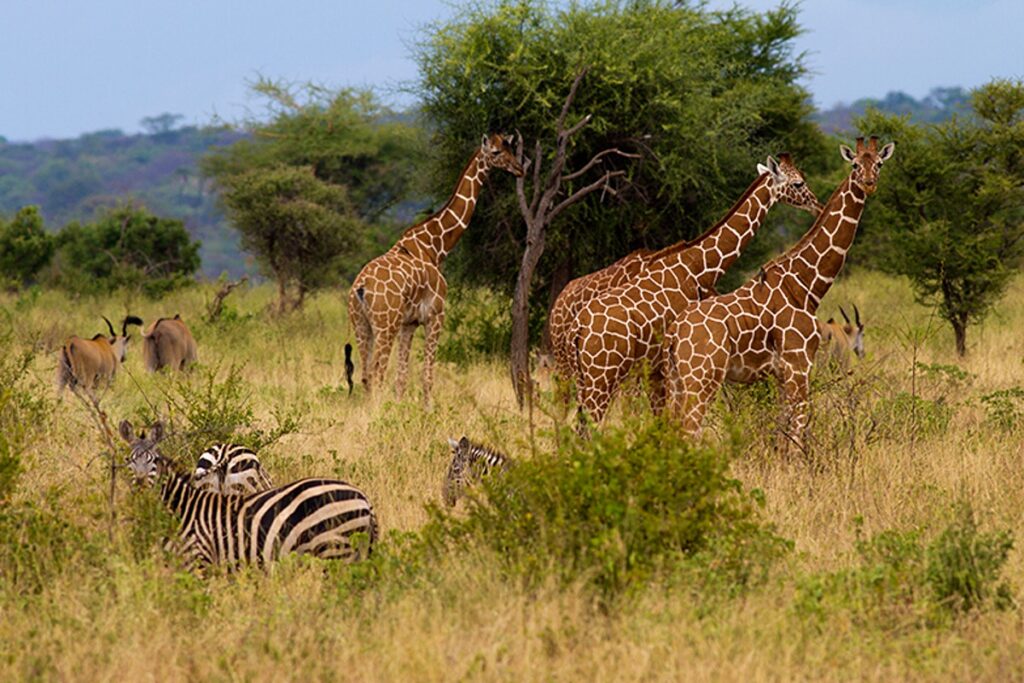
There are nine distinct subspecies of giraffe in Africa.
An lesser-known fact about this intriguing animal is that there are nine recognized subspecies of giraffe in Africa. These subspecies occupy many countries in Africa, although mounting genetic data indicates that some may not differ significantly from one another, while others may represent unique species independently. Current research endeavors aim to elucidate the complexities of giraffe genetics. Each subspecies varies in coat pattern as well as in size.
Regarding a horse-like creature from the Congo
The giraffe is closely related to the okapi (Okapia johnstoni), which inhabits the woods of the Democratic Republic of Congo. The okapi possesses a body form akin to that of the giraffe, however with a significantly shorter neck. Okapis, similar to giraffes, has distinctive fur-covered ossicones, specialized dentition and tongue, as well as a ruminating four-chambered stomach. Notably, only the male okapi possesses ‘horns’. It is sometimes referred to as the ‘rainforest zebra’ (or ‘forest giraffe’) because to the black and white stripes on its hindquarters and upper limbs.
How many giraffe are left in Africa?
Presently, less than 90,000 giraffes remain in Africa. The population of giraffes has declined by 40% in recent years, placing the species under significant stress. Giraffes are already extinct in at least seven African countries. The IUCN Red List categorizes giraffes as a species of ‘Least Concern’. Two subspecies, the West African giraffe (G.c.peralta; fewer than 400) and Rothschild’s giraffe (G.c.rothschildi; fewer than 1500), are presently classified as ‘Endangered.’ The species faces threats from habitat loss, fragmentation, degradation, poaching, and human encroachment.
A tower of giraffes.
The giraffe is a social, gregarious species that forms a stable group known as a tower. A group of moving giraffes is referred to as a trip. The giraffe exhibits a fission-fusion social structure. The group’s composition varies throughout hours, days, and weeks. Typically, groups include of females (cows) and their offspring. Male bulls inhabit bachelor herds and periodically integrate with female groupings to locate females in estrus for mating purposes.
An elongated neck.
A notable attribute of a giraffe is its elongated neck. Nonetheless, despite its elongated neck, the giraffe possesses the same quantity of cervical vertebrae as humans and other mammals. Giraffes possess seven cervical vertebrae, each measuring up to 25 cm in length. Besides its function in aiding feeding and enhancing attentiveness, the neck is employed in a complex ritualized combat known as ‘necking,’ typically observed exclusively in males. They consistently pivot their necks to execute forceful head-butts against their opponent’s torso.
Giraffe horns
Giraffe ‘horns’ are correctly termed ‘ossicones,’ and both male and female giraffes possess them. They are composed of ossified cartilage and are enveloped with skin. Giraffes are born with their ‘ossicones’; however, they remain flattened and are not affixed to the skull to prevent harm during birth. They merge with the skull only later in life. To differentiate between the sexes, examine the ‘horns.’ The females are slender and tufted, whereas male giraffes typically possess bigger ‘horns’ that go hairless on top due to repeated necking. They augment the mass of the male giraffe’s head, which frequently escalates with age, allowing for the delivery of increasingly forceful strikes during necking competitions.
A very quick heartbeat
The giraffe, despite its considerable size, possesses a very modest heart, weighing approximately 11 kg and measuring about 60 centimeters in length. The heart can beat as rapidly as 170 times per minute. They possess exceptionally elevated blood pressure, double that observed in humans. The heart of a giraffe must produce about double the standard blood pressure of other mammals to ensure enough blood flow to the brain against gravitational forces. In the cervical region, a sophisticated pressure-regulation mechanism known as the rete mirabile inhibits excessive blood flow to the brain when the giraffe lowers its head to drink.
Giraffe dermal patterns
Similar to human fingerprints, each giraffe possesses a unique coat pattern, which can be utilized to differentiate between individuals and subspecies. Male giraffes also darken with age. The coat pattern of a giraffe (spots) largely aids in camouflage, as well as in thermoregulation. Below each patch resides a complex network of blood arteries that aids in thermoregulation. Surrounding each patch is a major blood artery that diverges into smaller vessels beneath the patch. A giraffe may circulate blood through these microscopic vessels into the center of the patch to dissipate heat; hence, each patch functions as a thermal window for releasing body heat.
Giraffes are mute, right?
Despite being predominantly silent and non-vocal, giraffes have been observed to communicate through a range of sounds. During courting, guys produce pronounced coughs. Females vocalize to summon their offspring. Calves will produce snorts, bleats, mooing, and mewing sounds. Giraffes also produce snoring, hissing, moaning, grunting, and flute-like noises, and may communicate across vast distances via infrasound, although this is contested. At night, giraffes seem to communicate with one another through hums that fall inside the infrasound range, however the reasons for this behavior remain ambiguous.