 info@gorillatrekkinginafrica.com

The Khoisan people of South Africa provide insight into an alternative existence.
The Khoisan People Of South Africa , the culture of the Khoisan tribe is captivating, characterized by its distinctive artistic expressions and profound spiritual beliefs. This ancient clan of hunter-gatherers, with a history extending over millennia, offers insight into the past.
Who are the Khoisan people of South Africa?
The Khoisan are an ancient ethnic group with a rich and fascinating history. The Khoisan are regarded as the earliest human dwellers of southern Africa.
Historically categorized as the Khoisan, scholars assert that this tribe comprises two separate groups: the Khoe (also known as the Khoikhoi or Khoekhoe) and the San (or San bushmen). In contemporary society, fragmented groups have led to the amalgamation of the Koe and the San into a singular tribe known as the Khoisan.
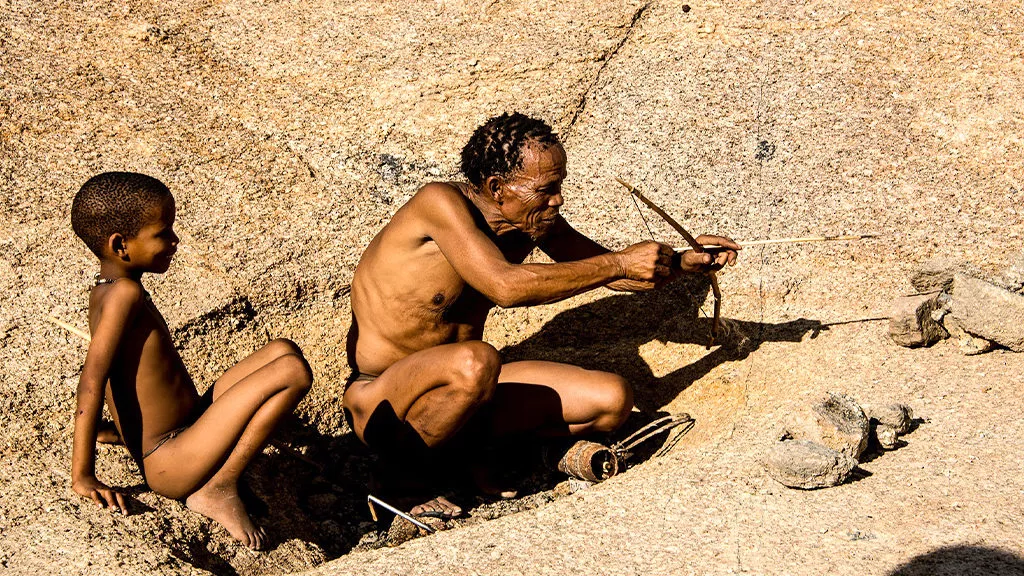
The San people were foragers. They sustained a tight interaction with their environment as they required interpreting the indications of nature for survival. The San traditionally depended on foraging for wild fruits and plants, in addition to hunting wildlife, resulting in a nomadic lifestyle. The San hunter-gatherers are recognized as the original inhabitants of South Africa. Paleoanthropologists assert that the San inhabited South Africa approximately 20,000 years before to any other groups.
Evidence of the San people is present at 20,000 to 30,000 rock art sites in South Africa alone. Examples of San rock art are dispersed throughout the county, including the Northern, Western, and Eastern Cape, as well as the Drakensberg Mountains in KwaZulu-Natal. The San people were ubiquitous.
In 1928, German explorer and anthropologist Leonhard Schulze introduced the name ‘Khoisan’ to denote both the Khoe herders and the San hunter-gatherers. Currently, the San people favor the designation of San. In South Africa, those reclaiming their ancestry identify as Khoesan.
Preliminary African Migrations and Colonization
The San were the original inhabitants of South Africa, but a series of migrations and colonization have nearly led to the extinction of this African society. The Khoe people’s entrance, succeeded by Nguni (Bantu) migrations, and subsequently the European settlers’ arrival post-1652, all significantly influenced the San people.
The Khoekhoe, or Khoi, were pastoralists who predominantly herded cattle, goats, and sheep. The San tribe in Botswana is believed to have acquired cattle approximately 10,000 years ago, which transformed their lifestyle. They evolved into the semi-nomadic Khoekhoe, or Khoi, and traveled south in search of grazing land. Their semi-nomadic existence led to interactions and possible confrontations with the San people to the south, who were either assimilated or displaced off fertile grazing lands.
Khoikhoi (or Khoe) translates to ‘men of men’ or ‘the true people’.
Beginning in the 4th century, Nguni migrants commenced their arrival in southern Africa. The Bantu ethnic groups were pastoralists who arrived with Iron Age technologies and well-structured societies. The Nguni migrants from central Africa evolved into the contemporary Zulu and Xhosa, as evidenced by language similarities.
Despite the conflict over valuable resources, hunting territories, and grazing lands for cattle that progressively displaced the San into the interior, the distinctive click sounds in the Xhosa language, along with specific physical characteristics (prominent cheekbones, yellowish skin tones, and slanted eyes), suggest a significant degree of integration. The San identity, already diminished, suffered a last blow with the entrance of European settlers in the mid-1600s.
In 1652, Jan van Riebeeck came at the Cape to create a colony for the benefit of transiting mariners. The European colonists engaged in direct combat with the semi-nomadic Khoisan people for cattle and grazing lands. The Khoisan people were designated as ‘Bushmen,’ subjected to hunting akin to animals, deprived of their land, incarcerated, ravaged by European diseases, and ultimately driven to the verge of extinction.
Subsequently, the Khoisan became recognized as the San bushmen and the Kalahari bushmen. The designation “bushmen” is presently regarded as pejorative and is no longer commonly employed.
Currently, over 100,000 Khoisan individuals, speaking 35 distinct dialects, reside throughout southern Africa. The remnant Khoisan population predominantly resides in the Kalahari regions of Namibia, Botswana, and South Africa.
Khoisan Rock Art
The Khoisan are renowned for their rock art. More than 20,000 rock art sites, distributed throughout South Africa, provide insight into their civilization. The San paintings, primarily located in caves, were created using natural colors, resulting in their frequent deterioration. The Linton Panel, completely dismantled and currently located at the Iziko Museum in Cape Town, is among the most well-preserved instances of San art globally.
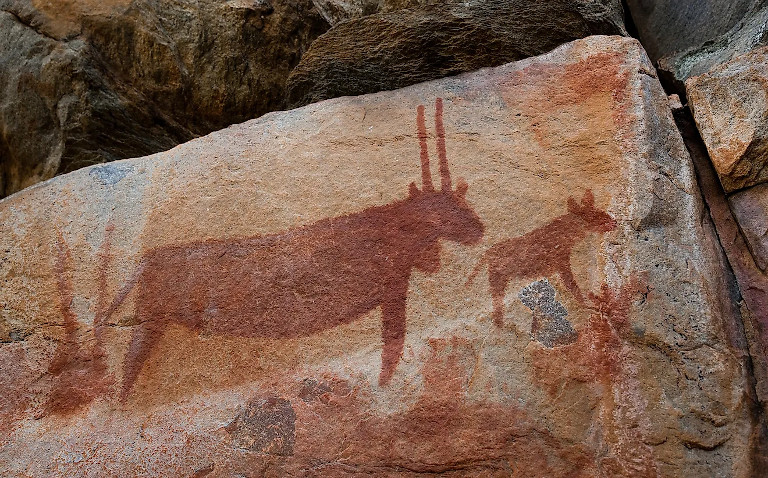
The Khoisan people employed diverse methods to create rock art, including ochre painting, gouging into soft stones, and carving on rocks. Yellow and red ochres were derived from the ground, black from charcoal, and white from avian excrement or other animal feces. Their meaning and representation have been contentious for decades.
Initially, the San artworks were believed to depict scenes from quotidian existence. Wildlife, hunting expeditions, and the subsequent advent of settlers in contemporary depictions. Contemporary ideas have shown connections between the San’s rock art and their belief in other realms. The painters are said to have also been shamans. The San rock art locations are considered portals to spiritual realms, and the human-animal forms depict the transformations occurring during these rites.
The oldest San rock paintings, located in Namibia, have been dated to approximately 26,000 years ago. Despite several instances of inadequate preservation, this ephemeral collection of over one million distinct photos collectively constitutes a remarkable repository of ideas and cultural practices. They may provide insights into the Khoisan culture and lifestyle, yet ultimately remain enigmatic.
Optimal Locations for Viewing San Rock Art
- The Iziko South African Museum in Cape Town features an outstanding exhibition of San rock art, including remarkable segments of cave walls adorned with authentic San artworks.
- The Bushman Cave Museum, located in the Drakensberg Mountains, houses 500 paintings, with some believed to be millennia old.
- The Shelter Cave in Kamberg, located near Estcourt in KwaZulu-Natal, is accessible only with a guide.
- The Cederberg region features an impressive San rock art gallery at Bushman’s Kloof.
- The Wildebeest Kuil Rock Art Centre in Kimberley is a collaborative endeavor between the indigenous San and Khoi peoples and scholars.
- The McGregor Museum in Kimberley and the Vryburg Museum on the periphery of the Kalahari Desert feature outstanding exhibits of San rock art.
The San People in Contemporary Culture
Despite the tragic circumstances surrounding the “Bushman,” the San have significantly influenced the national consciousness in South Africa. The San people are regarded as the original conservationists of southern Africa. The San lifestyle emphasizes minimal environmental impact and coexistence with nature, a principle praised by the conservation movement. The Khoisan people have been depicted in children’s literature, short narratives, and cinematic works within popular culture.
In the 1950s, Laurens van der Post was tasked by the BBC to produce a documentary concerning the San in the Kalahari Desert. Drawing from this experience, van der Post authored “The Lost World of the Kalahari.” Criticized by some, the work was his most renowned publication and introduced the concept of the San tribe to a worldwide audience.
In Margaurite Polland’s 1983 acclaimed children’s book “The Woodash Stars,” the narrative follows a San hunter, Gau, who, lost in the desert, navigates his way home by tracing the wood ash stars cast into the sky by his heartbroken beloved, Xama. The book is exquisitely drawn and skillfully narrated. It encapsulates a fragment of the allure and intrigue of these mysterious individuals.
In 1981, within the apartheid government, Jamie Uys directed “The Gods Must Be Crazy.” This little South African product shattered global box office records. The narrative centers on a San town and a glass Coca-Cola bottle that descends from the heavens. N!xau, the principal San character, engages with his encounters with Europeans via a lens of rationality. His rational deductions illuminate several behaviors and presuppositions of Western society, yielding amusing outcomes. “The Gods Must Be Crazy” has achieved cult status globally.
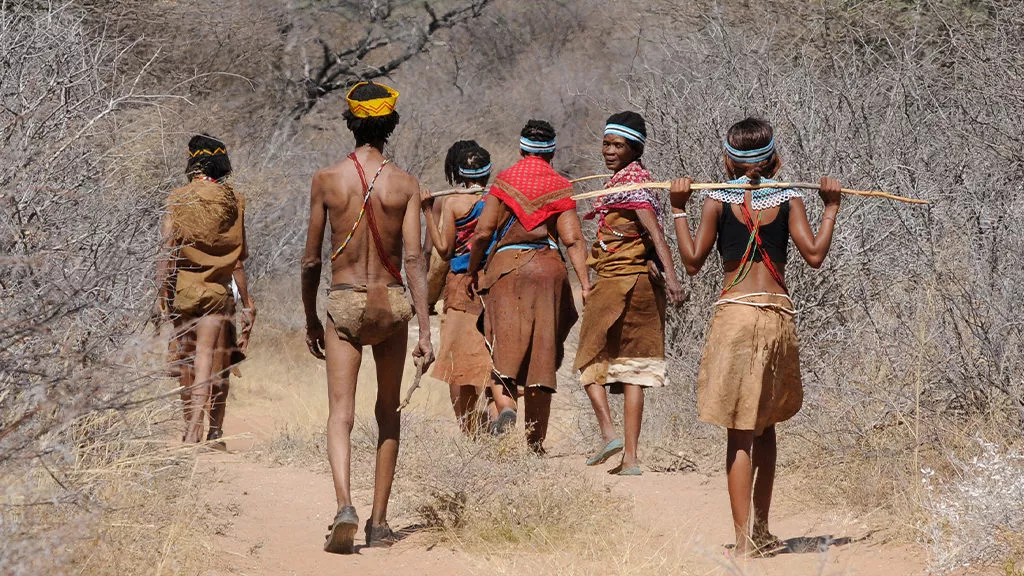
The Contemporary Khomani San People in South Africa
In 1995, the San tribe submitted a land claim within the Kgalagadi Transfrontier Park, following the deliberate confiscation of territory during the colonial era. In 1999, the Khomani San were awarded more than 68,000 hectares of land and substantial land-use rights within Kgalagadi Park. This is the sole successful aboriginal land claim in South Africa.
The Heritage Park is collaboratively administered by SANParks, the Khomani San, and the neighboring Mier communities. A Living Museum in the park aims to teach tourists about the lifestyle of the last San people. Activities encompass archery, engaging in cultural performances, participating in nature hikes, touring medicinal plants, or hunting alongside a seasoned San hunter. Visitors may purchase local arts and crafts.
Alongside eco-tourism options, a Veld School exists to facilitate the transmission of indigenous San knowledge and skills to the next generation. Students receive instruction in a conventional manner within the dunes of the Kgalagadi Transfrontier Park.