 info@gorillatrekkinginafrica.com

Hell’s Gate National Park
Hell’s Gate National Park is situated northwest of Nairobi and southwest of Lake Naivasha. This national park is situated between Lake Naivasha and the Longonot and Suswa volcanoes, on the Great Rift Valley plain. This national park exemplifies a region of geological activity that has resulted in diverse land formations, including hot springs and geysers, due to continuous geological processes that have produced remarkable and picturesque landscapes. Hells Gate National Park is renowned for its proximity to Nairobi, and its name derives from the steep-sided valley that traverses the park.
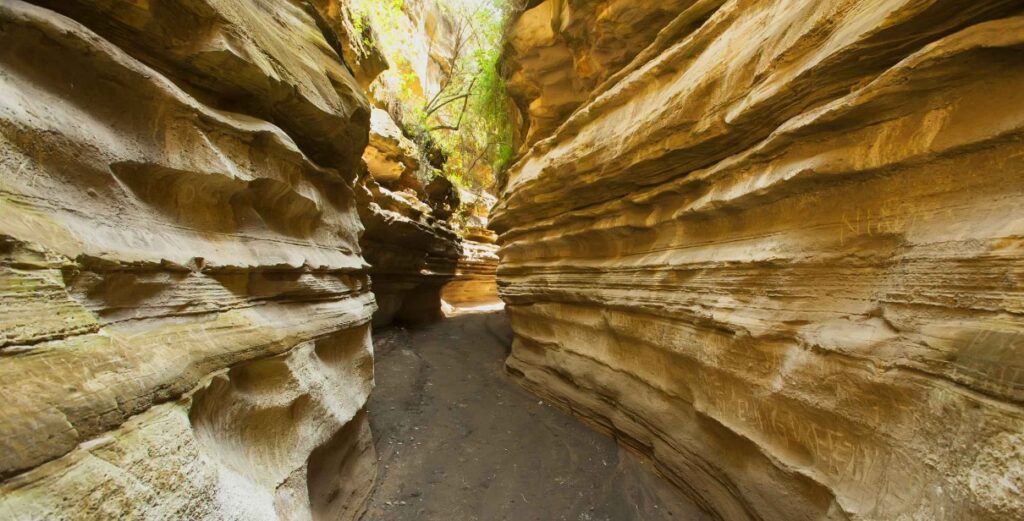
The National Park derives its name from a tiny fissure in its cliffs and was formerly a prehistoric lake, influenced by geothermal activity within the ecology. The flora in this national park consists of meadows interspersed with shrubs, bushes, and acacia. The topography of Hell’s Gate National Park is defined by remarkable volcanic features, including steep cliffs, gorges, rock formations, emanating geothermal steam, and dormant volcanoes like Ol Karia and Hobley’s, rendering it one of the most picturesque national parks in Kenya. Ancient lava plugs protrude from the valley bottom within the national park. The national park is recognized for its steam plumes resulting from subterranean geothermal energy, which is utilized for electricity generation. Three geothermal stations, including the Ol Karia power plant, are located within the park. A rise in tourist numbers has been seen in recent years, attributed to geothermal projects like Ol Karia One and Two, which have significantly helped the park.
Attractions in Hells Gate National Park
Tourist attractions at Hell’s Gate National Park include the following:
This national park is home to several wildlife and bird species, including giraffes, elands, hartebeests, buffalo, gazelles, klipspringers, rock hyraxes, and Chanler’s mountain reedbucks, some of which are uncommon. Bird species observable among the cliffs and soaring in the park include vultures, Verreaux’s eagle, lammergeyer, and augur buzzard, among others.
Fischer’s Tower and Central Tower are volcanic plugs composed of resilient igneous rock that have withstood erosion, resulting in granite columns that serve as climbing destinations for tourists at Hell’s Gate National Park.
Fischer’s tower is situated adjacent to the primary entrance of the national park. The tower was created by semi-molten rock intruding into a fissure, which subsequently cooled and consolidated to form an extrusion. The creation of Fischer’s tower is linked to local folklore of the Maasai, who think that the rock represents a Maasai girl who transformed into stone after defying her father en route to her future spouse, contrary to tradition. Fischer’s Tower is located at the northeastern extremity of Hell’s Gate National Park and is within walking distance from Elsa Gate.
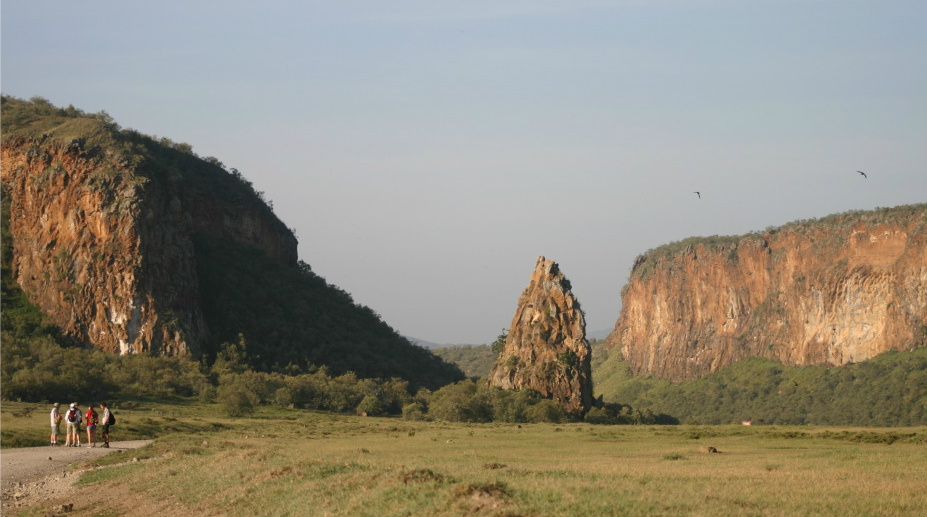
Hell’s Gate Gorge is a profound valley within the national park, distinguished by its steep rock walls and a prominent volcanic column that can be ascended with a guide. This valley is home to various wildlife species, including zebras, giraffes, warthogs, and avian species such as vultures. Geothermal projects occur in this region, and industrial pipes are visible when traversing the valley.
The Obsidian caverns are a notable feature situated within the Obsidian rock formation in the Buffalo circuit. The obsidian rock was produced from the rapid cooling of molten lava upon contact with water, resulting in its glassy structure.
The Lower Gorge, also known as Ol Njorwa Gorge, is a geological formation located in Hell’s Gate National Park, distinguished by water-eroded walls that obscure the sky. This canyon is renowned for hosting various film projects, including Tomb Raider, which were filmed in this location and influenced the cinematic creation.
The Ol Karia geothermal power station is a notable feature within the national park, enabling visitors to observe the utilization of subterranean thermal energy for electricity generation in Kenya.
Things to do in Hell’s Gate National Park
Tourist activities available during a safari in Hell’s Gate National Park include the following:
Walking safaris
Walking safaris involve travelers trekking through the wilderness, where they can observe many wildlife species, including zebras, elands, and giraffes. These excursions allow participants to stroll alongside these animals while appreciating the sounds of nature and the stunning landscapes. One of the paths traversed by tourists on a walking safari includes the lower valley of Ol Njorwa, featuring sights such as thermal and frigid waterfalls, hot springs, and vividly colored rock striations and formations, all observed in the presence of a guide. Climbing Ol Njorwa during the wet seasons poses significant risks due to the slipperiness of the rocks.
Biking/cycling
Biking allows tourists to cycle freely past various wildlife species, including zebras, hartebeests, gazelles, and jackals. Visitors can either rent a bicycle at the entrance or bring their own for this distinctive form of game viewing.
Game viewing
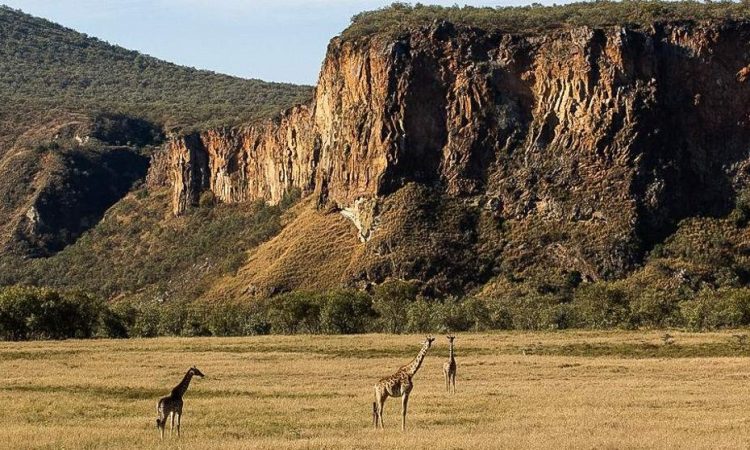
Game viewing in this national park entails the observation of diverse wildlife species, including the buffalo, one of the Big Five, as well as giraffes, zebras, elands, hartebeests, Thomson’s gazelles, olive baboons, and klipspringers in the sparse vegetation where they graze. A trip through the national park provides a glimpse of the valley flanked by red rock cliffs, where klipspringers and rock hyraxes may be observed.
Rock climbing
Tourists can engage in rock climbing in Hell’s Gate National Park, where climbing equipment is available for rental to ascend the cliffs. The activity is conducted alongside a park ranger or guide, and the rock climbing locations feature Fetcher’s Tower, which served as the inspiration for “Pride Rock” in the animated film The Lion King.
Cultural interactions
Hiking in Hell’s Gate National Park traverses river gorges, providing an opportunity to experience the park’s landscape, including deep gorges, red cliffs, rock towers, hot springs, and geysers, all of which present excellent picture opportunities.
Cultural exchanges entail gaining insights into the Maasai culture and traditions at a cultural center adjacent to the national park, where the Maasai reside in their traditional farmhouse, or “boma,” and provide entertainment to tourists through cultural dances. Souvenirs are available for purchase at the Maasai cultural center.
Exploring a Budget Safari in Kenya (Hell’s Gate and Maasai Mara)
A budget safari in Kenya provides a remarkable chance to encounter the breathtaking natural landscapes and varied species of the country at an affordable cost. This safari is intended to make renowned destinations accessible to all travelers, merging cost-effectiveness with memorable encounters. Opting for economical alternatives like as camping, affordable lodgings, and communal transportation allows for an immersive experience in Kenya’s dynamic landscapes and wildlife.
A key benefit of a Kenya budget safari is the diverse range of hotels offered. Budget lodges and campsites offer comfortable and affordable accommodations, frequently situated in or adjacent to national parks. This enables guests to conveniently reach premier wildlife observation locations such as Masai Mara and Hell’s Gate National Park. Moreover, group trips and communal safari vehicles can substantially decrease transportation prices, thereby improving the whole experience while maintaining affordability.
Engaging in a budget-friendly Kenya wildlife safari does not entail compromising on excitement. Numerous budget safaris encompass exhilarating activities like as game drives, walking safaris, and cultural excursions to local communities. These encounters facilitate a profound connection with Kenya’s abundant wildlife and cultural heritage while providing the exhilaration of adventure. A Kenya budget safari may be both fulfilling and economical with meticulous planning and an emphasis on cost-effective alternatives.
Best Time to Visit Hell’s Gate National Park
You may be wondering what the optimal time to visit Hell’s Gate National Park is. This adventure park, located near Nairobi, is accessible throughout the year. Hell’s Gate National Park is a haven for adventurers, with exceptional hiking and cycling paths, along with opportunities for exhilarating activities such as abseiling and rock climbing. Hells Gate National Park is the perfect destination for a day trip, a camping respite, or a picnic location outside Nairobi.
Hell’s Gate is accessible for hiking and cycling year-round; however, animal safari viewing is optimal during the dry season from June to October when the grass is sparse. The landscape is most magnificent during the Wet season, which spans from November to May.
Peak Season: The park experiences minimal visitation year-round; nevertheless, Naivasha becomes crowded with expatriates during school holidays, particularly during Christmas, making accommodation reservations more challenging. Numerous schools and families frequently visit because to the excellent cycling, camping, and Adventure Park opportunities.
Optimal Period: June to March is ideal for general wildlife observation and outdoor pursuits (Minimal precipitation)
Low Season: The Park experiences minimal visitation year-round (It remains uncrowded).
Optimal Weather: June to February (Minimal precipitation)
Adverse Weather: March to May (Intense precipitation) may impact your camping and cycling activities; however, visitation remains feasible.
Contact Enclose Africa Safari for professional recommendations on the optimal time to visit Hell’s Gate National Park while planning your Kenya Safari, which should include this place on your itinerary.
The park is remarkable and located near Nairobi, which accounts for its frequent visitation and reputation for cycling and picturesque camping areas.
How to get to Hell’s Gate National Park
Hell’s Gate National Park encompasses 68.25 square kilometers and is located near Lake Naivasha, approximately 90 kilometers from Nairobi, to the south of Lake Naivasha in Kenya. Hell’s Gate National Park is located 14 kilometers beyond the turnoff from the former Nairobi-Naivasha route. Hell’s Gate National Park derives its name from a narrow fissure in the cliffs, which was formerly a tributary of an ancient lake that nourished early inhabitants in the Rift Valley. It was founded in 1984. A little national park is recognized for its diverse species and picturesque landscapes. There are several methods to reach Hell’s Gate National Park.
The park is readily accessible by road because to its proximity to Nairobi, and it may also be reached by air.
Hell’s Gate National Park is situated around nine kilometers from the junction of the Nairobi-Naivasha highway. The two-hour journey from Nairobi is noteworthy, particularly due to the Escarpment Road’s breathtaking vistas of the Great Rift Valley. If you are willing to negotiate, there are possibilities to purchase Kenyan trinkets from merchants along the highway. This also provides an excellent opportunity to gather ample fresh food and fruits if you are embarking on a camping excursion in the park. The road was constructed by Italian prisoners of war during World War II, and the small church they erected merits a visit. Hell’s Gate is accessible via two primary entrances: the main Elsa Gate and the Olkaria Gate.
If you wish to fly, you will utilize the Naivasha airstrip as your landing site, then proceed to connect. Chartering planes between parks can facilitate efficient travel. These flights are reserved by tour operators as components of their travel packages. The majority of domestic flights, including those to Naivasha, depart from Wilson Airport (WIL), located 6 km/4 mi south of Nairobi en route to Hell’s Gate.
To access Hell’s Gate National Park from Lake Naivasha National Park, the proximity facilitates easy travel. Some tourists opt to stay overnight at Lake Naivasha National Park for superior lodging and embark on a day trip to Hell’s Gate National Park, returning in the evening after a delightful day, located 18 km (11 miles) west of Naivasha. Due to the absence of lodging within the park, the majority of visitors do day trips from Lake Naivasha. Naivasha is readily accessible by automobile via a paved route from Nairobi. Alternatively, daily flights are available to Loldia airfield located on the western side of Naivasha.
A combination safari to both places is feasible due to their proximity.
Naivasha serves as a convenient intermediary between Nairobi and the Masai Mara. The trip from Naivasha to the Masai Mara is 170 kilometers (105 miles), with an approximate driving duration of 3.5 hours.